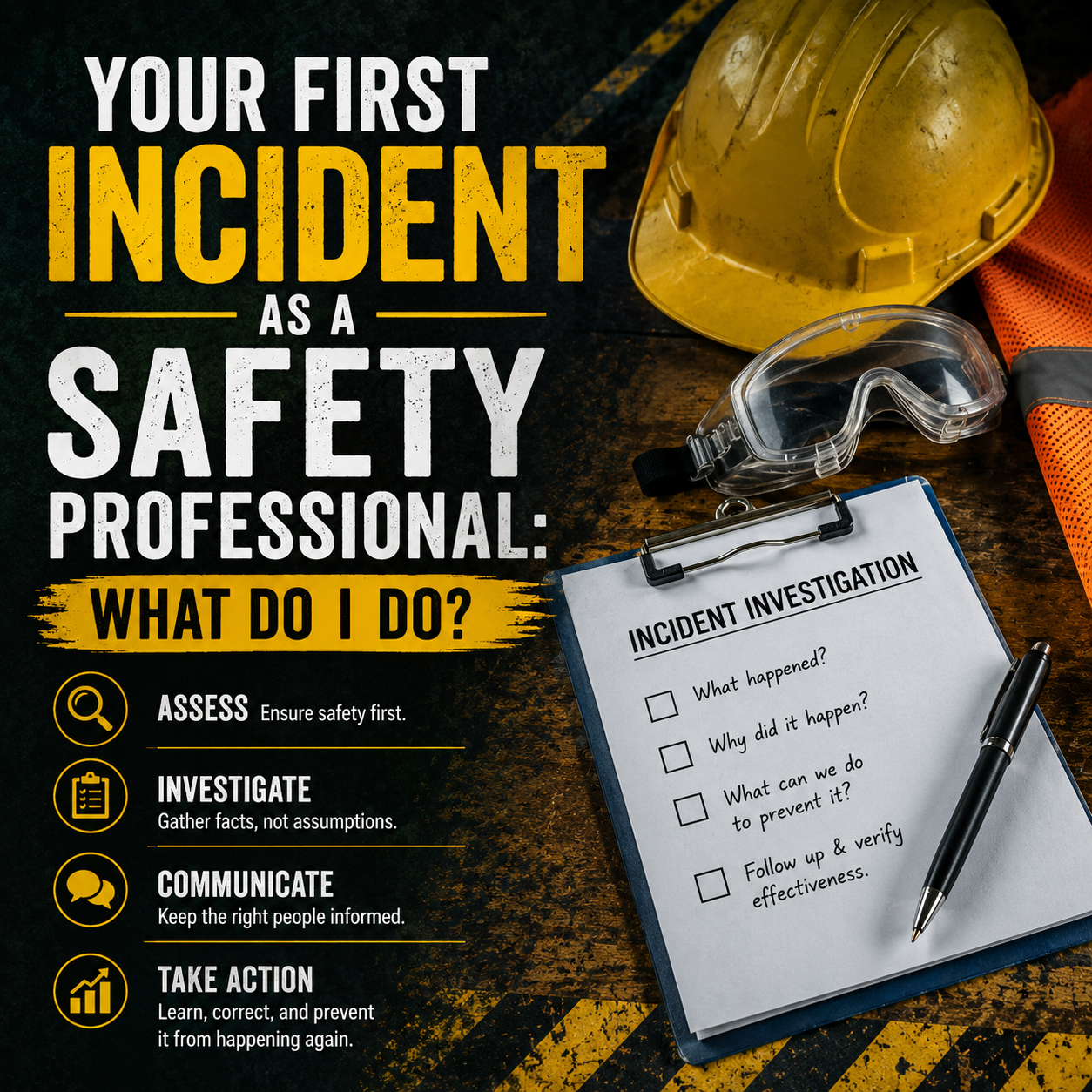
Your First Incident as a Safety Professional: What Do I Do?
Being the person from Safety who gets sent to an incident scene for the first time can be intimidating.
You may know the legislation. You may understand your company's procedures. You may have completed incident investigation training. But standing at an active incident scene with supervisors asking questions, workers looking to you for direction, and management waiting for answers is a very different experience.
The good news is that you don't have to know everything the moment you arrive.
Your first responsibility isn't to solve the incident. It's to make sure the situation is controlled, people are safe, and the facts are preserved so the incident can be properly investigated.
This guide walks through what to do when you're sent to your first incident.
Before You Start Investigating, Make Sure the Scene Is Safe
Your first priority is not evidence. It's safety.
Before you start taking photographs, interviewing witnesses, or examining equipment, determine whether the hazards that caused or contributed to the incident are still present.
Ask yourself:
- Is anyone still in danger?
- Is the equipment still energized or operating?
- Could something move, fall, collapse, roll, or release energy?
- Are there electrical, chemical, fire, atmospheric, traffic, or environmental hazards?
- Is additional personal protective equipment required?
- Does the area need to be barricaded or isolated?
- Does anyone need medical attention?
If the scene isn't safe for you to enter, don't enter it simply because you're there to investigate.
A safety professional becoming the second person injured at an incident scene doesn't help anyone.
Determine Whether the Incident Is Still an Emergency
Don't assume that because the injured worker has been transported away, the emergency is over.
Depending on the circumstances, you may need to make sure that:
- Emergency services have been contacted.
- First aid or medical treatment has been provided.
- The area has been evacuated if necessary.
- Equipment has been shut down or isolated.
- Energy sources have been controlled.
- The scene has been secured.
- Required internal notifications have been made.
- Regulatory reporting requirements are being considered.
Your company's emergency response plan should guide these decisions.
Follow your established procedures and applicable legislation. Incident investigation should never interfere with emergency response or lifesaving activities.
Preserve the Scene
Once the immediate hazards are controlled, think about preserving evidence.
One of the biggest mistakes a new investigator can make is allowing the scene to be cleaned up, equipment moved, or conditions changed before the relevant information has been documented.
That doesn't mean you should prevent necessary actions to make the workplace safe.
It means that, whenever reasonably possible, you want to document the scene before it changes.
Take photographs.
And don't just take one picture of the obvious point of contact.
Photograph the incident area from multiple angles. Capture the surrounding environment, equipment, controls, access points, housekeeping, lighting, signage, guards, ground conditions, and anything else that may help someone understand what happened later.
A photograph that seems irrelevant at the scene may become extremely important when you're trying to reconstruct the sequence of events days later.
Don't Start With "Who's at Fault?"
This is one of the most important things to remember.
Your job is to determine what happened and why it happened, not to find someone to blame.
There is a significant difference.
Instead of asking:
"Who caused this?"
ask:
"What happened?"
Then ask:
"Why did that happen?"
And then keep going.
For example:
An operator's hand was injured while working near moving equipment.
That may initially appear to be an operator error.
But keep asking questions.
Why was the worker's hand there?
Why did the worker need to access that location?
Was the equipment stopped?
Was energy isolated?
Was there a guard?
Was the guard adequate?
Was the task performed according to the procedure?
Was the procedure practical?
Had the worker been trained?
Was there production pressure?
Was the equipment designed or maintained appropriately?
Was this task normally performed differently?
The first explanation you hear is often what happened, not necessarily why it happened.
Talk to Witnesses—But Don't Interrogate Them
People involved in incidents may be nervous, embarrassed, angry, frightened, or worried about getting someone in trouble.
Your job is to obtain information, not conduct an interrogation.
Start with open-ended questions.
For example:
"Can you walk me through what happened?"
Then let the person talk.
Avoid immediately filling every silence. People often remember additional details when they have a moment to think.
Follow up with questions such as:
- What happened immediately before that?
- What happened next?
- Where were you standing?
- What was the equipment doing?
- What did you see?
- What did you hear?
- Had you seen this happen before?
- Was anything unusual about the task that day?
- How was this task normally performed?
Be careful about leading questions.
There's a big difference between:
"The machine suddenly moved, didn't it?"
and:
"What did the machine do?"
The second question allows the witness to provide their own account.
Talk to the Injured Worker When Appropriate
If the worker is medically able and circumstances permit, their account can be extremely valuable.
Remember that the injured person may have the best understanding of what happened—but they may also be dealing with pain, shock, embarrassment, or anxiety.
Approach the conversation accordingly.
You aren't looking for a confession.
You're trying to understand the task from the worker's perspective.
Ask them to describe what they were doing, what they expected to happen, what actually happened, and anything they believe contributed to the incident.
Sometimes a worker will tell you something that completely changes your understanding of the event.
Document the Facts—Not Your Assumptions
When you're writing your notes, separate observations from conclusions.
For example:
Observation:
"The machine was parked approximately two metres from the excavation."
Assumption:
"The operator parked too close to the excavation."
The first is something you can document.
The second is a conclusion that requires further investigation.
Your notes should capture what you know, what you observed, what witnesses reported, and what evidence you collected.
You can develop conclusions later.
Collect the Documents
The physical scene is only part of an investigation.
Depending on the incident, relevant documentation may include:
- Safe work procedures
- Job hazard assessments
- FLHAs/JHAs
- Training records
- Equipment inspection records
- Maintenance records
- Operator certifications
- Work permits
- Toolbox talks
- Pre-use inspections
- Manufacturer instructions
- Previous incident reports
- Photos or video
- Site plans
- Weather information
- Production or work schedules
Don't automatically assume that paperwork proves what actually happened.
A procedure may say one thing while workers routinely perform the task another way.
That difference may be one of the most important findings in your investigation.
Reconstruct the Timeline
One of the most useful things you can do is build a timeline.
Start before the incident.
What time did the worker arrive?
What task were they performing?
What happened immediately before the incident?
What happened during the incident?
What happened immediately afterward?
Who responded?
When was the area secured?
When was medical assistance provided?
A timeline can reveal details that aren't obvious when you're looking at the incident as a single event.
It can also help identify contributing factors such as changing conditions, fatigue, interruptions, equipment problems, communication issues, or unexpected changes to the work.
Look Beyond the Person Closest to the Incident
A good investigation doesn't stop at "operator error."
Workers interact with systems.
Consider the larger picture:
People → Equipment → Procedures → Training → Supervision → Environment → Organization
Was the worker trained?
Was the equipment functioning correctly?
Was the procedure available?
Was the procedure realistic?
Was supervision adequate?
Were hazards identified?
Was the work environment changing?
Was there time pressure?
Was maintenance overdue?
Were there communication problems?
Was the worker performing the task differently because the normal method wasn't practical?
These questions can help you identify root and contributing causes instead of simply assigning blame.
Don't Rush to Recommend Corrective Actions
It's tempting to finish the investigation and immediately recommend something like:
"Retrain the employee."
Sometimes retraining is appropriate.
But if retraining is your answer to every incident, you're probably not looking deeply enough.
If a worker makes the same mistake because a procedure is confusing, training may not solve the problem.
If a guard is constantly removed because it interferes with maintenance, simply telling workers not to remove it may not solve the underlying issue.
If workers are bypassing a safety control because production cannot be completed efficiently with it in place, the organization may need to address the system rather than simply discipline the worker.
Corrective actions should address the causes you actually identified.
Know When You Need Help
Being the person from Safety doesn't mean you have to be the person who knows everything.
Some incidents require additional expertise.
Depending on the circumstances, you may need assistance from:
- Engineers
- Equipment specialists
- Maintenance personnel
- Occupational health professionals
- Emergency responders
- Management
- Legal counsel
- Regulatory authorities
- Specialized investigators
If you're unsure whether an incident triggers a regulatory reporting requirement, don't guess.
Consult your company's established reporting procedures and the applicable occupational health and safety requirements for your jurisdiction.
Remember That Your First Incident Doesn't Have to Be Perfect
Your first incident investigation can feel overwhelming.
You may worry that you're missing something.
You may wonder whether you're asking the right questions.
You may feel like everyone expects you to immediately know exactly what happened.
They don't.
A good investigator isn't someone who walks into a scene already knowing the answer.
A good investigator walks in with an open mind and systematically gathers enough reliable information to determine what happened.
Slow down. Be observant. Ask questions. Document everything. Challenge your assumptions.
And most importantly, don't turn the investigation into a search for someone to blame.
The purpose of an incident investigation should ultimately be to learn enough to prevent the same event—or something worse—from happening again.
Your First Incident: Keep It Simple
When you arrive at your first incident, remember these basic priorities:
1. Make sure the scene is safe.
2. Make sure emergency response is handled.
3. Preserve the scene and evidence.
4. Document what you see.
5. Talk to witnesses.
6. Build the timeline.
7. Review the relevant documents.
8. Determine what happened—and why.
9. Identify meaningful corrective actions.
10. Ask for help when you need it.
You don't have to walk onto your first incident scene as an expert investigator.
You just need to approach it methodically, objectively, and safely.
Because the goal isn't simply to explain what happened yesterday.
The goal is to make sure it doesn't happen again tomorrow.