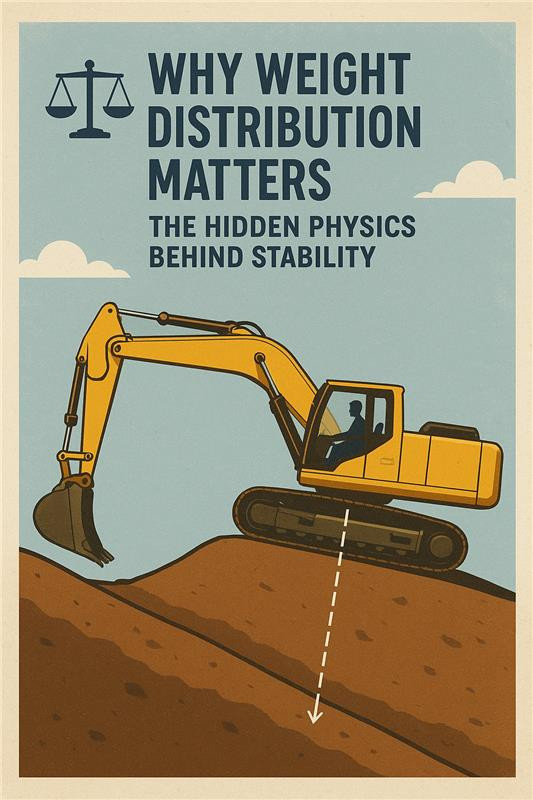
Why Weight Distribution Matters: The Hidden Physics Behind Stability
When a 40-ton excavator tips, it doesn’t just happen suddenly — it’s physics at work. Every operator has felt that uneasy shift when the boom stretches too far or the ground gives way under one track. The truth is, weight distribution is one of the most important — and least understood — factors in machine performance and safety.
In this Iron Insights breakdown, we’ll dig into the science behind stability, how manufacturers design around it, and what operators can do to keep their iron steady on any terrain.
____________________________________________________________________________________
The Basics: Center of Gravity and Balance
At the heart of stability is the center of gravity (CG) — the point where the machine’s entire weight is balanced.
When the CG is low and centered, the machine is stable. But shift that point too far in any direction — forward when lifting, sideways on a slope, or backward during transport — and the risk of tipping increases dramatically.
Manufacturers work hard to engineer machines with an ideal CG by carefully distributing heavy components like the engine, counterweights, and hydraulic systems. Still, operator behavior and terrain can easily change that balance.
____________________________________________________________________________________
How Design Influences Stability
Every piece of heavy equipment — from dozers to excavators to wheel loaders — is designed with weight distribution in mind.
• Excavators: The counterweight at the rear balances the boom and stick. Extend the boom fully over the side, and that balance shifts fast.
• Dozers: Wide tracks spread the load and keep the center of gravity low, which is why they’re more stable on slopes than wheeled machines.
• Wheel Loaders: Their articulated steering changes the weight distribution dynamically, especially when carrying a raised load.
Designers test machines on tilt tables and stress models to find safe operating angles, then translate that data into the operating limits you see in your manual. Those aren’t just legal disclaimers — they’re physics-based warnings.
____________________________________________________________________________________
The Hidden Forces Operators Face
In the field, stability is never static. Weight shifts constantly based on your load, ground conditions, and operating technique. Here are the biggest real-world factors at play:
1. Boom and Load Position – The farther your load extends from the machine’s base, the more leverage it exerts on the undercarriage or tires.
2. Slope Angle – Even a few degrees of side slope can shift the CG enough to cause a tip-over, especially with a raised load.
3. Ground Support – Soft or uneven soil can compress under one track or tire, instantly changing balance.
4. Dynamic Movement – Sudden stops, quick turns, or swinging heavy loads all generate momentum that pushes the CG outside the machine’s footprint.
____________________________________________________________________________________
How to Maintain Stability in the Real World
Even perfectly designed machines rely on smart operators to stay upright. Here’s how to make stability work in your favor:
• Keep Loads Low and Centered: Travel with your load as low as possible to maintain a low CG.
• Avoid Over-Side Lifting: Always lift over the front or rear when possible, where the machine’s design supports the most weight.
• Use the Right Attachments: A mismatched or oversized attachment can alter balance and stress the undercarriage.
• Read the Ground: Soft or sloped surfaces are warning signs. Always test the ground before positioning your machine.
• Understand Rated Load Charts: Those numbers are based on balance equations — not guesses. Know your limits before you lift.
____________________________________________________________________________________
Weight Transfer Isn’t Always a Bad Thing
Smart operators know how to use weight transfer to their advantage. When pushing, pulling, or digging, shifting the machine’s weight forward can increase traction and control. The trick is staying within limits — using weight, not fighting it.
____________________________________________________________________________________
Weight distribution is the invisible force behind every smooth lift, every stable pass, and every near-miss that didn’t happen. Understanding how your machine’s balance shifts — and working with it instead of against it — keeps you productive, safe, and in control.
When you know the physics, you’re not just operating the machine — you’re mastering it.
____________________________________________________________________________________
Stability isn’t just about the size of your machine — it’s about where the weight goes when it moves.