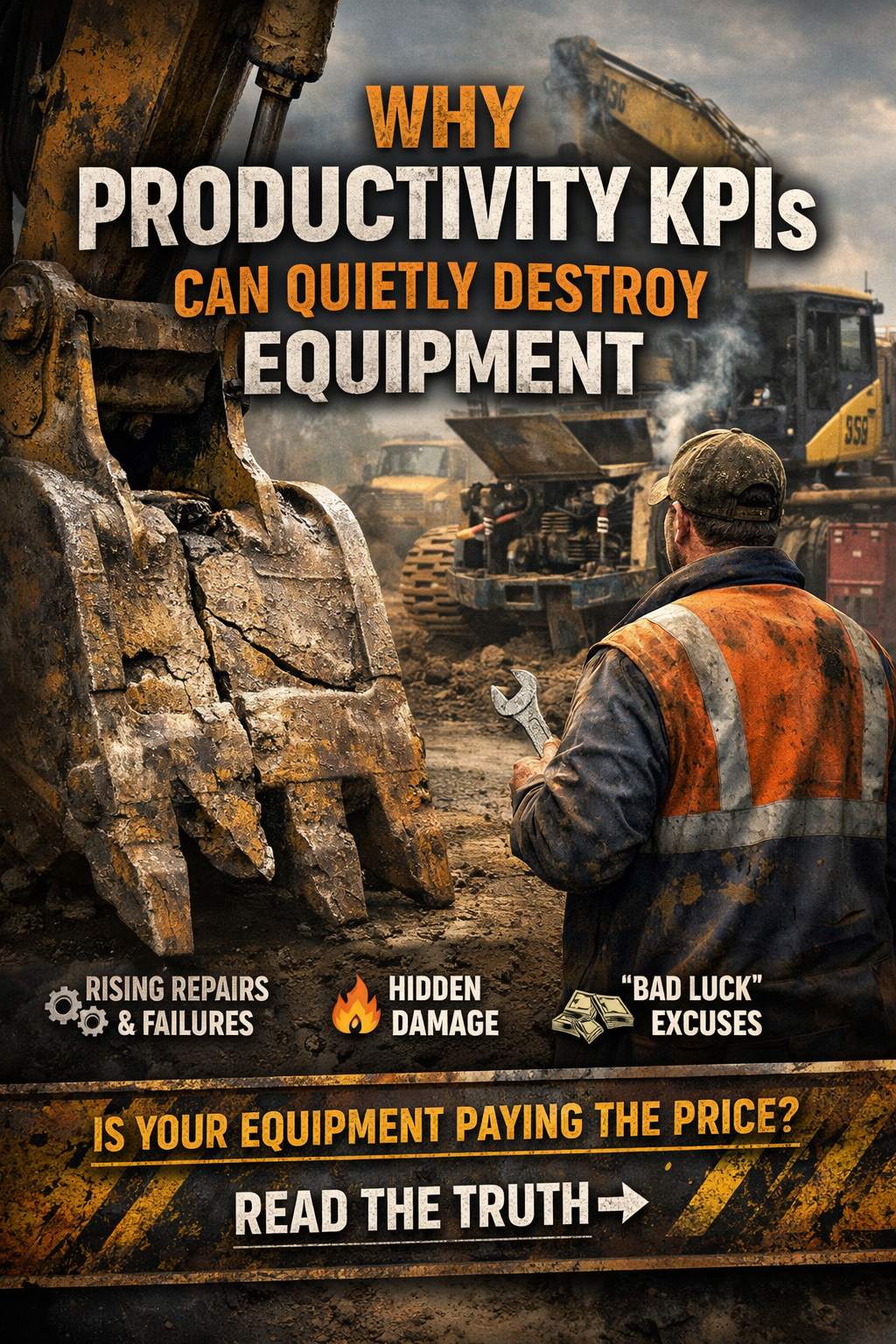
Why Productivity KPIs Can Quietly Destroy Equipment
Productivity KPIs are everywhere in modern operations: tons per hour, cycles per shift, utilization rates, cost per unit. On paper, they look like the holy grail of efficiency. In reality, when they’re poorly designed or blindly enforced, productivity KPIs can quietly shorten equipment life, inflate maintenance costs, and create failure patterns that only show up years later—when the damage is already done.
The problem isn’t measurement itself. The problem is what gets rewarded, what gets ignored, and what operators feel pressured to do to “hit the number.”
When KPIs Reward Speed Over Sympathy
Most productivity KPIs focus on output. How fast. How much. How often. What they rarely measure is how that output was achieved.
Operators who are judged primarily on production numbers quickly learn what the system values. Smooth operation, mechanical sympathy, and long-term equipment health don’t show up on the dashboard—so they get deprioritized. Aggressive throttle use, hard stops, high-impact bucket work, and rushed warm-ups become normalized because they move the needle today, even if they cost tens of thousands tomorrow.
The machine doesn’t complain in real time. It absorbs the abuse quietly—through microfractures, heat stress, accelerated wear, and fatigue that won’t surface until a major failure occurs.
Deferred Damage Is Still Damage
One of the most dangerous aspects of productivity-driven KPIs is that they delay consequences.
An excavator arm doesn’t crack the first time it’s shock-loaded. Bearings don’t fail the first time oil temperatures spike. Welds don’t give up because of one bad cycle. Instead, damage accumulates invisibly. By the time a failure occurs, the operator who caused it may be long gone, the KPI target long forgotten, and the repair bill written off as “bad luck” or “normal wear.”
This disconnect allows destructive behaviors to persist. If the KPI cycle resets daily or weekly but the damage timeline is measured in years, the system never self-corrects.
Utilization KPIs and the Death of Downtime
High utilization sounds good—until it eliminates necessary downtime.
Machines need idle time for cooling, inspections, greasing, and operator feedback. When utilization KPIs punish downtime without context, equipment gets run hot, run tired, and run past early warning signs. Operators skip walk-arounds. Minor issues go unreported. Preventive maintenance gets treated as lost production instead of asset protection.
Ironically, the harder the KPI pushes for “maximum uptime,” the more catastrophic the eventual downtime becomes.
Operators Become KPI Managers, Not Equipment Stewards
Good operators think in terms of feel, sound, resistance, and rhythm. They know when something isn’t right long before a sensor trips. But when KPIs dominate performance evaluations, operators stop trusting their instincts and start managing optics.
If stopping to investigate a noise risks missing a target, the noise gets ignored. If reporting an issue risks blame or lost bonuses, silence wins. The KPI becomes the job—not the machine.
Over time, this erodes craftsmanship and pride. The operator is no longer a steward of expensive equipment; they’re a throughput lever.
Engineered Machines vs. KPI Abuse
Modern equipment is engineered with specific load paths, thermal limits, and duty cycles in mind. Productivity KPIs often ignore those design assumptions entirely.
Repeated shock loading, sustained high RPM under marginal cooling conditions, and constant operation at the edge of capacity all fall outside what engineers intended—even if the machine “can” do it. Just because a system tolerates abuse doesn’t mean it’s designed for it.
This is where engineered components meet KPI-driven behavior—and the engineer always loses.
Smarter Metrics, Stronger Iron
The solution isn’t fewer KPIs—it’s better ones.
Productivity metrics need to be paired with indicators of equipment health: temperature trends, maintenance compliance, operator-reported issues, and component life tracking. Operators should be rewarded for longevity, not just output. Maintenance should be seen as production protection, not production loss.
When KPIs reflect reality instead of spreadsheets, behavior changes. Operators slow down when it matters, speak up when something’s wrong, and treat machines like the long-term assets they are.
The Quiet Cost of Chasing the Number
Productivity KPIs don’t destroy equipment overnight. They do it slowly, subtly, and expensively. By the time the failure shows up, the dashboard looks clean—but the balance sheet tells a different story.
In heavy equipment, what you measure is what you teach. And what you teach, your machines will eventually pay for.