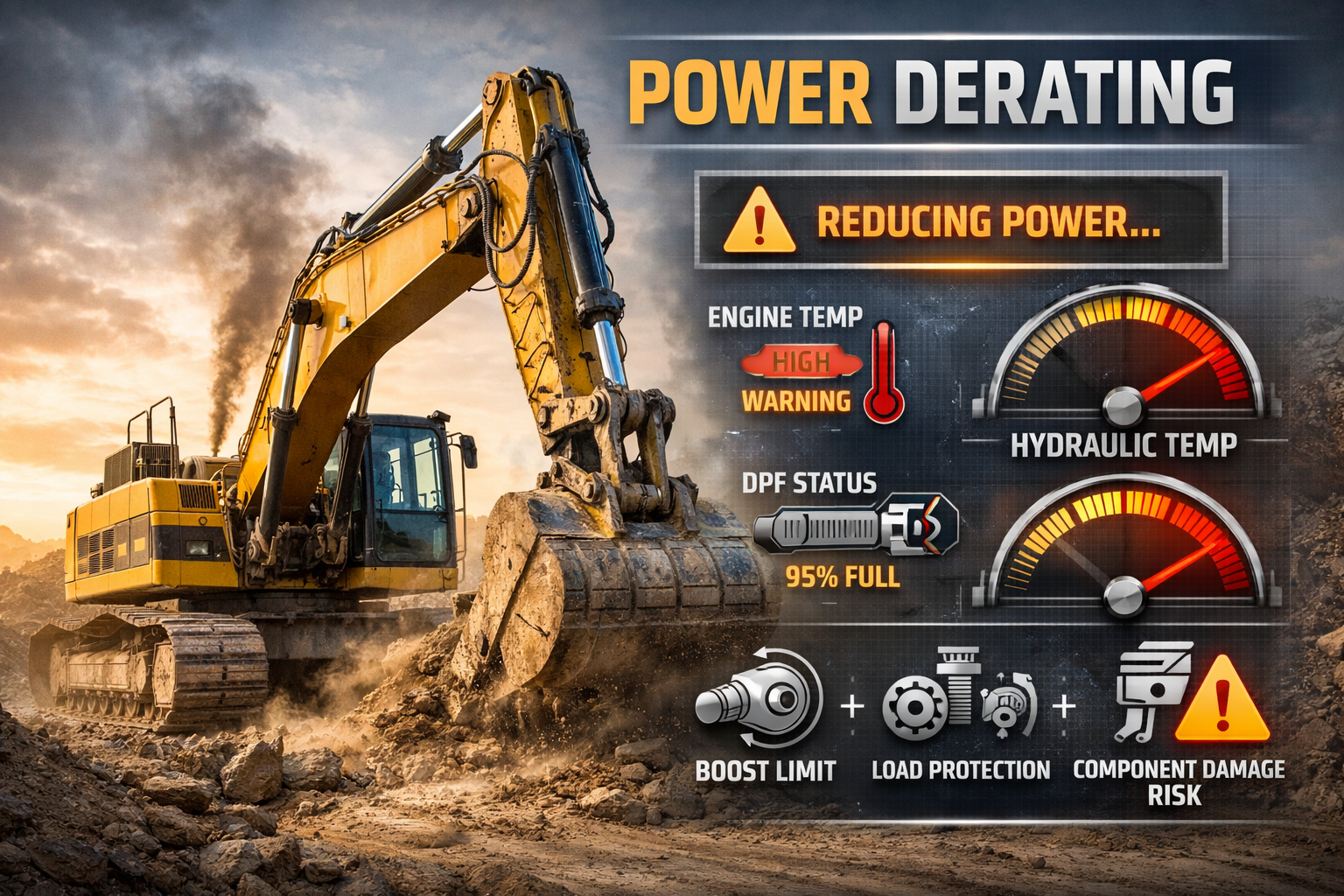
Why Modern Machines Derate Power—and When It’s a Good Thing
If you’ve run older iron and newer machines back-to-back, you’ve probably felt it:
“This thing should have more power than that.”
On paper, the engine ratings look impressive. Horsepower numbers are higher than ever, torque curves are flatter, and electronic controls are far more sophisticated. Yet in certain conditions—hot days, high loads, sustained pulls—modern machines will quietly pull power back.
That’s not a defect. It’s derating—and in many cases, it’s doing exactly what it’s supposed to do.
Understanding why machines derate power, and when it actually helps you, requires looking past peak horsepower and into how modern equipment is designed to survive real-world abuse.
What Power Derating Actually Means
Power derating is the intentional reduction of available engine output under specific operating conditions. Unlike a mechanical failure or fuel restriction, derating is commanded by the machine’s control systems.
Modern machines monitor dozens of variables in real time, including:
- Engine coolant temperature
- Intake air temperature
- Exhaust gas temperature
- Emissions system status
- Hydraulic oil temperature
- Transmission load and slip
- Altitude and air density
When one or more of these parameters approaches a safe limit, the machine reduces fuel delivery, limits boost pressure, or modifies torque curves to lower stress.
The operator usually notices this as a machine that “won’t quite pull like it should,” even though nothing appears broken.
Why Older Machines Felt Stronger
Older mechanical engines often delivered whatever power they could make—right up until something failed.
There were no sensors watching exhaust temperature. No electronic controls limiting torque spikes. If the engine could burn the fuel and spin the turbo faster, it did.
That made machines feel aggressive and responsive, but it also meant:
- Higher peak component stress
- Greater thermal cycling
- More frequent engine and driveline failures
- Shorter service life under heavy loads
Modern machines are designed with a different philosophy: controlled performance instead of uncontrolled power.
The Three Main Reasons Machines Derate Power
1. Thermal Protection
Heat is the enemy of engines, hydraulics, and electronics.
When coolant, intake air, or exhaust temperatures climb too high, combustion efficiency drops and component life shortens rapidly. Rather than allowing temperatures to exceed safe limits, the machine reduces power to stabilize heat.
This is especially common in:
- High-ambient temperatures
- Sustained high-load work (dozing, ripping, uphill hauling)
- Plugged coolers or restricted airflow
In these cases, derating prevents long-term damage that wouldn’t be obvious until thousands of hours later.
2. Emissions System Survival
Modern emissions systems operate within narrow temperature and pressure windows.
Excessive exhaust temperatures can:
- Damage diesel particulate filters (DPFs)
- Overheat SCR catalysts
- Accelerate sensor failure
When the control system detects conditions that could harm aftertreatment components, it will reduce engine output to protect extremely expensive hardware.
From the operator’s seat, this can feel frustrating. From a design standpoint, it’s far cheaper than replacing emissions systems prematurely.
3. Driveline and Hydraulic Protection
Peak engine torque doesn’t act in isolation. It travels through:
- Torque converters
- Transmissions
- Final drives
- Axles and differentials
- Hydraulic pumps and motors
Modern machines actively manage torque delivery to prevent shock loads that shorten component life. Sudden traction changes, high hydraulic demand, or sustained stall conditions can all trigger power limiting.
This is why newer machines often feel smoother but less violent than older ones—they’re protecting everything downstream of the crankshaft.
When Derating Is Actually a Good Thing
Extending Component Life
By limiting peak stress and thermal overloads, derating dramatically improves the longevity of:
- Engines
- Turbos
- Transmissions
- Final drives
- Hydraulic systems
Machines designed this way often go thousands of hours longer before major repairs are needed—especially in severe duty cycles.
Preventing Operator-Induced Damage
Not every operator backs out of the throttle when things get hot or overloaded. Derating acts as a built-in safeguard against habits that would otherwise destroy expensive components.
In fleet operations, this consistency matters. The machine protects itself regardless of who’s in the seat.
Improving Reliability in Harsh Conditions
High altitude, extreme heat, and continuous heavy loads are realities in mining, pipeline, forestry, and earthmoving work.
Derating allows machines to keep working in these environments—just not at a level that would cause rapid failure.
When Derating Signals a Real Problem
Not all derating is “normal.”
If a machine derates:
- Early in a shift
- Under light loads
- In moderate temperatures
- Repeatedly without recovery
…it may indicate:
- Plugged radiators or oil coolers
- Faulty sensors
- Emissions system restrictions
- Software or calibration issues
Understanding the difference between protective derating and abnormal derating is critical for maintenance teams and operators alike.
Power Isn’t Just a Number Anymore
Modern machines aren’t built to deliver maximum horsepower at all costs. They’re built to deliver sustainable power—day after day, year after year.
Derating is part of that design philosophy. It trades a bit of peak performance for reliability, longevity, and predictability.
It may not feel as exciting as older iron, but when the machine is still running strong long after its mechanical predecessor would be in pieces, the benefits become clear.
Sometimes, less power in the moment means a lot more machine in the long run.