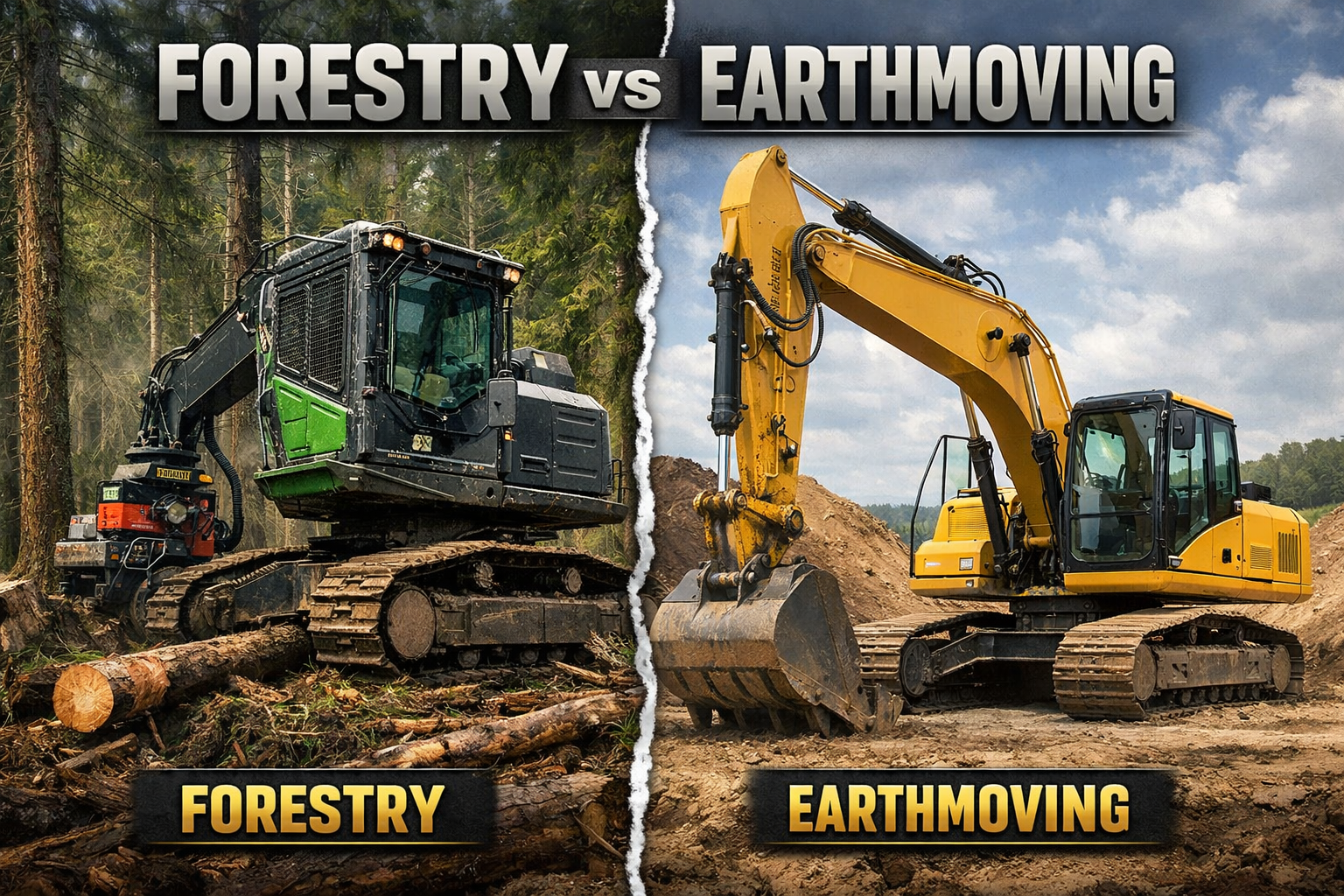
Why Forestry Machines Are Built Differently From Earthmoving Machines
At first glance, a forestry excavator and a standard earthmoving excavator may look similar. They share tracks, booms, cabs, and hydraulic systems. But put them into a logging site side by side, and the differences become obvious very quickly. Forestry machines are engineered for a completely different kind of abuse—one that involves constant shock loads, uneven terrain, and unpredictable forces that earthmoving equipment rarely encounters.
The Nature of the Work Changes Everything
Earthmoving machines are designed to move material with relatively predictable resistance. Soil, gravel, and rock behave in ways engineers can model fairly well. Forestry machines, on the other hand, deal with living—or recently living—material. Trees don’t break, twist, or fall consistently. A cut tree can hang up, snap suddenly, or transfer enormous shock loads back into the machine.
Because of this, forestry equipment must survive violent, irregular forces rather than steady digging resistance. That single difference drives almost every design decision.
Structural Reinforcement Where It Matters Most
Forestry machines are heavily reinforced in areas that would be overkill on a standard excavator. Booms, sticks, and main frames often use thicker plate, additional gussets, and strategically placed cast components. These reinforcements help absorb sudden impacts when a tree shifts or a grapple slams shut on a heavy stem.
Where earthmoving machines prioritize weight efficiency for fuel economy and transport, forestry machines prioritize survivability. Extra steel means extra weight—but in the forest, durability wins.
Completely Different Upper Structure Protection
One of the most obvious differences is guarding. Forestry machines are wrapped in protection because the environment is actively trying to destroy them.
• FOPS-rated cabs protect operators from falling limbs
• Polycarbonate windows replace glass to resist shattering
• Heavy belly pans and side guarding protect hoses, pumps, and final drives
• Sweeps and deflectors push branches away from critical components
Earthmoving machines operate in open sites with controlled material flow. Forestry machines work in tight, hostile environments where branches, stumps, and debris constantly threaten vulnerable systems.
Hydraulics Tuned for Shock, Not Speed
Forestry hydraulics are designed to absorb impact and control massive loads smoothly. Attachments like harvesters and grapples require precise modulation while handling extreme weight and sudden movement.
To manage this, forestry machines often feature:
• Higher-capacity hydraulic cooling
• Additional accumulators to absorb pressure spikes
• Valve tuning that prioritizes smooth, controlled motion over fast cycle times
Earthmoving machines benefit from quick, repetitive cycles. Forestry machines benefit from control and shock resistance.
Undercarriage and Stability Differences
Logging terrain is rarely flat. Steep slopes, soft ground, and debris-covered surfaces are the norm. Forestry machines often have:
• Wider track frames
• Heavier undercarriage components
• Increased ground clearance
• Optional tilting or leveling cabs
Stability matters more than speed. A machine that can safely hold a tree on a slope is far more valuable than one that cycles quickly on level ground.
Cooling Systems Built for Debris
Forestry machines operate in environments packed with bark, needles, dust, and wood chips. Cooling systems must continue functioning even when airflow is compromised.
This is why forestry equipment commonly uses:
• Reversible fans
• Larger cooling packages
• Debris-resistant radiator designs
• Easily accessible cleaning points
Earthmoving machines rarely face this level of contamination for extended periods.
Attachments Drive the Entire Design
Unlike earthmoving machines, where the bucket is relatively simple, forestry attachments are complex, heavy, and constantly active. A harvester head or processing grapple can weigh several tons and applies continuous torsional and side loads.
This forces:
• Stronger swing bearings
• Reinforced carbody and house structures
• Higher swing torque and braking capacity
In forestry, the attachment isn’t just a tool—it defines the machine.
Built for Abuse, Not Just Efficiency
Earthmoving machines are optimized for productivity, fuel efficiency, and predictable duty cycles. Forestry machines are optimized to survive chaos. They trade weight savings and elegance for brute strength, protection, and control.
That’s why a forestry machine costs more, weighs more, and looks overbuilt—because in the woods, failure isn’t just expensive, it’s dangerous.