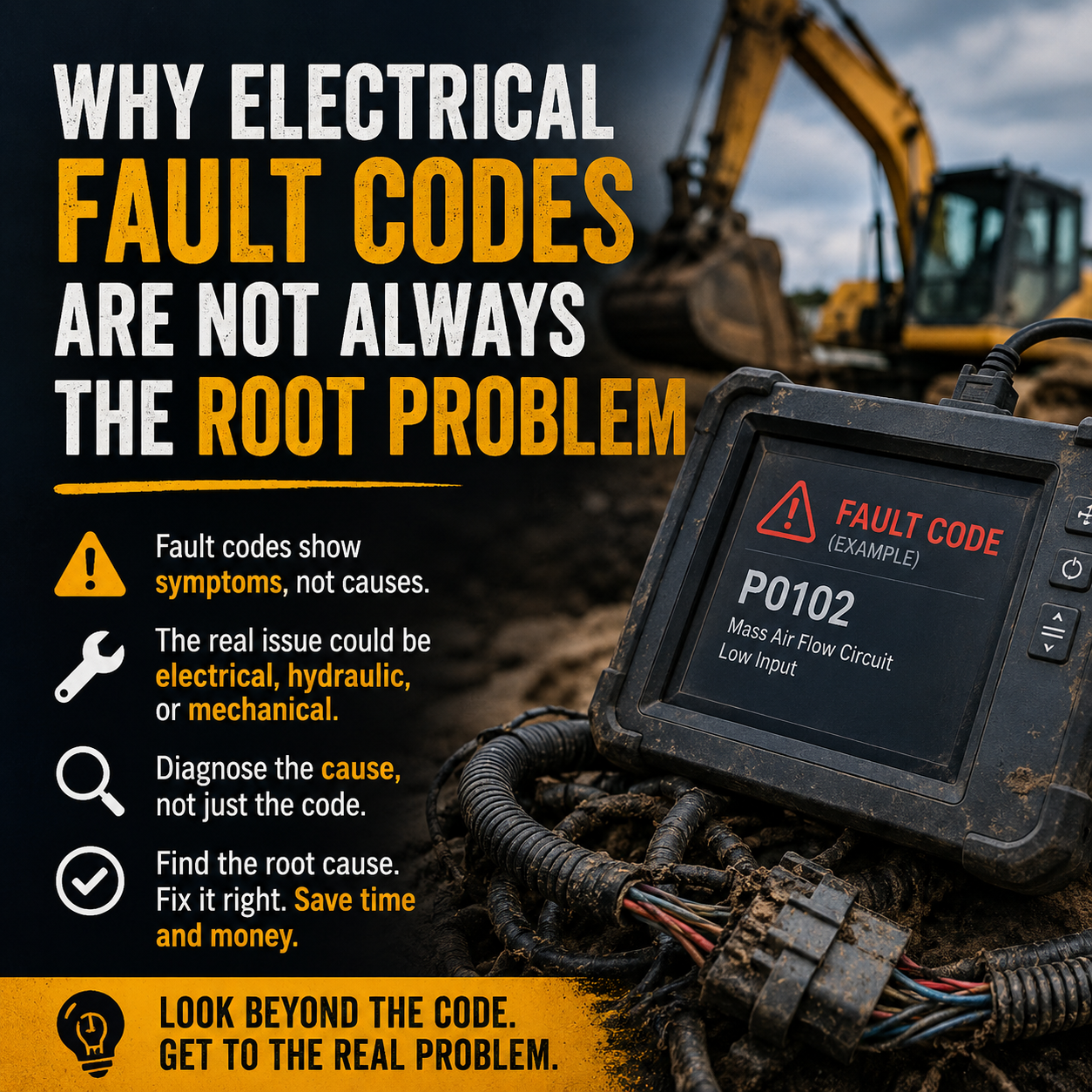
Why Electrical Fault Codes Are Not Always the Root Problem
Iron Insights
Why Electrical Fault Codes Are Not Always the Root Problem
Modern heavy equipment is packed with sensors, controllers, and electronic systems designed to monitor machine performance. When something goes wrong, the machine often responds by displaying a fault code. While these codes are invaluable diagnostic tools, they can also be misleading if treated as the root cause of the problem rather than a symptom.
Understanding the difference can save technicians and equipment owners significant time, money, and frustration.
Fault Codes Point to Symptoms
A fault code simply tells you what the machine's electronic control system has detected. It does not necessarily tell you why the condition occurred.
For example, a machine may display a sensor voltage fault. The immediate temptation might be to replace the sensor. However, the actual problem could be:
- Damaged wiring
- Corroded connectors
- Low system voltage
- A failed controller
- Hydraulic or mechanical issues affecting sensor readings
In these situations, replacing the sensor may do nothing to solve the problem.
The "Parts Cannon" Approach
One of the most common mistakes in troubleshooting is what technicians often call the "parts cannon" approach—replacing components one after another until the fault disappears.
This method is expensive, time-consuming, and frequently ineffective.
A fault code indicating a failed pressure sensor does not automatically mean the sensor itself is defective. If the underlying issue is a damaged harness or poor ground connection, the new sensor will produce the same fault code as the old one.
Successful troubleshooting requires determining why the fault was generated in the first place.
Electrical Problems Can Be Mechanical
Many fault codes that appear electrical in nature are actually triggered by mechanical problems.
Consider a hydraulic pressure fault. The controller may report an electrical issue because the pressure sensor is reporting values outside of expected limits. However, the true cause may be:
- A failing hydraulic pump
- Internal cylinder leakage
- A sticking relief valve
- Restricted hydraulic flow
The electronics are simply reporting abnormal operating conditions.
The machine's computer can only interpret the information it receives. It cannot always distinguish between a failed sensor and a genuine mechanical failure creating unusual readings.
Voltage Is Often the Hidden Culprit
Low system voltage is responsible for countless electrical fault codes.
Weak batteries, poor charging systems, corroded terminals, and bad grounds can cause multiple sensors and controllers to behave erratically. This often results in a long list of seemingly unrelated fault codes appearing simultaneously.
Before diving into complex diagnostics, technicians should verify:
- Battery condition
- Alternator output
- Ground integrity
- Power supply voltage at critical modules
Many "mysterious" electronic issues disappear once proper voltage is restored.
Intermittent Faults Are Especially Tricky
Intermittent electrical problems can generate fault codes that appear and disappear without warning.
A loose connector may only lose contact when the machine hits a bump. A damaged wire may only open when the boom is raised or when the machine reaches operating temperature.
In these cases, the fault code accurately identifies what the controller experienced, but it may not reveal the exact source of the interruption.
Finding intermittent faults often requires patience, inspection, and testing under real operating conditions.
Use Fault Codes as Clues
The best technicians treat fault codes as clues rather than final answers.
A fault code should be the starting point of the diagnostic process, not the end of it. Service manuals, wiring diagrams, voltage checks, continuity testing, and system inspections are all critical steps in identifying the true root cause.
When approached correctly, fault codes help narrow the search area and speed up repairs. When treated as definitive diagnoses, they can lead technicians down the wrong path.
The Bottom Line
Electrical fault codes are valuable diagnostic tools, but they do not always identify the actual problem. They simply report what the machine's electronic systems have detected.
Whether the issue is a bad sensor, damaged wiring, low voltage, hydraulic failure, or a mechanical defect, effective troubleshooting requires looking beyond the fault code itself. The most successful technicians understand that a fault code is often the first clue in the investigation—not the final answer.
By focusing on root-cause analysis instead of simply replacing the component named in the code, equipment owners can reduce downtime, avoid unnecessary parts costs, and return machines to work faster.