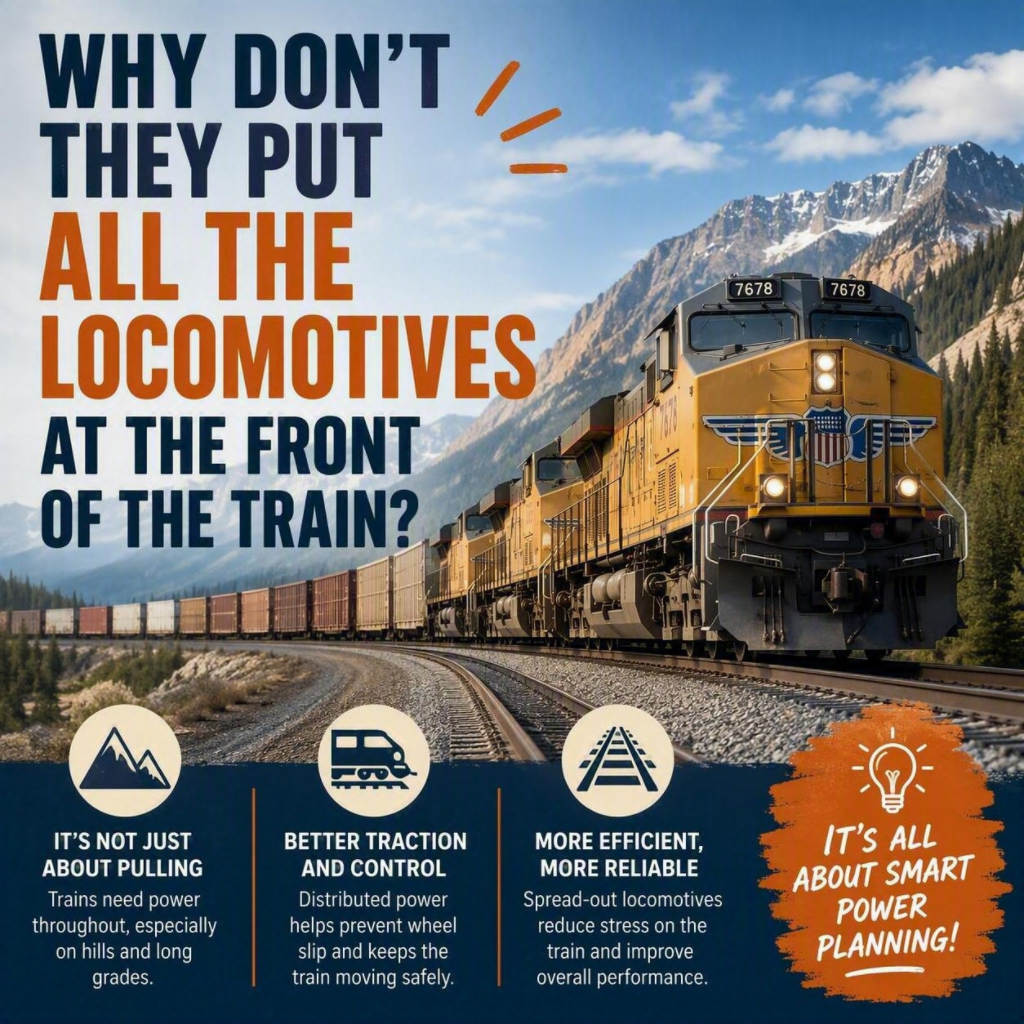
Why Don’t They Put All the Locomotives at the Front of the Train?
If you have ever watched a massive freight train roll by, you may have noticed something that seems a little strange: there might be locomotives in the middle of the train—or even at the rear.
At first glance, it seems like an unnecessary complication. If a train needs five or six locomotives to pull thousands of tonnes of freight, why not simply connect all of them to the front?
The answer comes down to physics.
Putting locomotives throughout a long freight train can actually make the train safer, easier to control and less stressful on the equipment.
It Isn't Just About Pulling the Train
A locomotive at the front provides the pulling force needed to get the train moving. So why would another locomotive be placed halfway down the train?
Because a freight train can be extremely long and extremely heavy.
A locomotive pulling from the front has to transmit its pulling force through every coupler between itself and the cars behind it. Imagine trying to pull a several-kilometre-long string of extremely heavy objects using a single connection point.
The cars closest to the locomotive experience the greatest forces.
Those forces can become enormous when the train starts moving, stops, climbs a grade or travels through curves.
By distributing locomotives throughout the train, the railroad can distribute those forces instead of concentrating everything at the front.
The Problem With a Giant "Pulling Chain"
Think about a long freight train as a giant chain.
If the locomotive at the front suddenly accelerates, the first few cars begin moving before the cars at the back have had time to respond. The slack between the couplers begins to disappear as each car catches up with the one ahead of it.
On a very long train, this can create substantial in-train forces.
The same thing happens in reverse when the train slows down. The cars at the front begin slowing while the cars farther back still have momentum.
Eventually, that force travels through the entire train.
Locomotives placed in the middle or at the rear can reduce how much force has to travel through any single section of the train.
Distributed Power
This arrangement is commonly referred to as distributed power.
Instead of having every locomotive coupled together at the front, locomotives can be positioned at different points throughout the train.
The engineer can control these remote locomotives electronically from the lead locomotive.
They aren't simply sitting there and pulling whenever they feel like it. Their operation is coordinated with the lead locomotive to help manage the entire train.
This can be particularly useful with extremely long or heavy freight trains.
It Helps Prevent Coupler Damage
Railroad couplers are incredibly strong, but they still have limits.
A long train can experience both tension and compression forces.
When the train is stretched out under power, the couplers are primarily dealing with pulling forces. When the train compresses during braking or changes in grade, the couplers can experience enormous pushing forces.
Putting locomotives throughout the train helps reduce the maximum forces transmitted through individual sections.
That can reduce the risk of equipment damage and make the train behave more predictably.
It Helps With Hills
Terrain is another major factor.
Imagine a train several kilometres long approaching a steep hill.
The locomotive at the front begins climbing while much of the train is still on level ground. As more and more cars begin climbing, the locomotive has to overcome their combined resistance.
Now imagine placing a locomotive farther back in the train.
That locomotive can provide additional tractive effort closer to the portion of the train that needs it.
Distributed power can therefore be particularly useful on routes with significant grades.
What About Braking?
Braking is just as important as pulling.
A modern freight train has brakes throughout the train, but getting the entire train to respond uniformly is complicated because of the train's enormous length.
Distributed locomotives can help with train handling by allowing the railroad to manage forces within the train more effectively.
The goal isn't necessarily to make every part of the train do exactly the same thing at exactly the same instant.
The goal is to keep the forces within acceptable limits while maintaining control of the entire train.
Why Not Just Use One Giant Locomotive?
You might wonder why railroads don't simply build one gigantic locomotive powerful enough to do the work of several smaller locomotives.
There are a few problems.
Traction is one of them.
A locomotive can only put so much power onto the rails before its wheels begin to slip. Adding locomotives provides additional powered axles, allowing more tractive effort to be transferred to the rail.
There are also practical considerations involving locomotive availability, maintenance, reliability and operating flexibility.
Using multiple locomotives means a railroad can assemble power appropriate for the particular train and route.
There's Also a Limit to How Much Force a Train Can Handle
This is perhaps the most important part of the answer.
A freight train isn't simply a collection of cars being dragged behind a locomotive.
It is a massive mechanical system.
Every acceleration, deceleration, hill, curve and change in speed affects the forces throughout that system.
If you put all the locomotives at the front, you concentrate a tremendous amount of pulling force at one end.
Put locomotives throughout the train and you can divide the train into sections, with each locomotive helping manage the forces affecting the cars around it.
That makes the train more manageable.
So Why Do Some Trains Have Locomotives Only at the Front?
Because distributed power isn't necessary for every train.
A shorter or lighter train may not generate the same extreme in-train forces as a massive unit train hauling thousands of tonnes over long distances.
Railroads consider factors such as:
- Train length
- Train weight
- Terrain and grades
- Curves
- Number of locomotives
- Available tractive effort
- Braking requirements
- Coupler and draft-gear limitations
- Operating rules and procedures
The locomotive arrangement is therefore part of the overall train plan.
The Locomotive in the Middle Isn't "Pushing"
One common misconception is that the locomotive in the middle is simply pushing the back half of the train while the locomotive at the front pulls the rest.
It's more complicated than that.
The remote locomotives are controlled as part of a coordinated system. Their power can be adjusted to manage the forces throughout the train.
In some situations, the rear locomotive may provide significant pulling power. In others, the amount of power may be reduced.
The objective is controlled train handling, not simply maximum horsepower.
Think of It Like Moving Something Very Heavy
Imagine trying to move an extremely long, heavy object by pulling on one end.
Everything behind the pulling point has to respond to that force.
Now imagine having several people positioned along the object, each helping move their section.
The job becomes much more manageable.
That's essentially the principle behind distributed power—except the "people" are locomotives, the object weighs thousands of tonnes, and the consequences of losing control are considerably more serious.
More Locomotives Don't Always Mean More Speed
Another misconception is that adding locomotives throughout a train is primarily about making the train faster.
It isn't.
The additional locomotives are often about moving more weight while keeping the train's mechanical forces under control.
A railroad may need several locomotives not because it wants the train to travel faster, but because it needs enough tractive effort to move the train safely and efficiently over the route.
The Bottom Line
So why don't they just put all the train engines at the front?
Because on a very long, heavy freight train, where the locomotives are located matters almost as much as how much horsepower they have.
Putting locomotives throughout the train can distribute pulling and pushing forces, reduce stress on couplers and equipment, improve handling on grades and help control an enormous train as a single system.
The next time you see a locomotive sitting in the middle of a freight train, don't assume it's there because the first locomotive isn't powerful enough.
It's there because sometimes the smartest way to move a massive amount of weight isn't to pull harder from the front—it's to spread the power throughout the train.