Why Do Some Machines Have Planetary Gears Inside Their Wheels?
Imagine a massive wheel loader pushing into a pile of crushed rock. Its engine is working hard, its tires are gripping the ground, and thousands of pounds of material are resisting every inch of forward movement.
Now consider what is happening inside the machine's wheels.
On many heavy equipment machines, a surprisingly compact arrangement of gears is multiplying the torque delivered to the wheels. These gears are part of a system known as a planetary final drive, and they help explain how enormous machines can generate tremendous pushing and pulling force without requiring equally enormous drivetrain components.
The secret lies in a clever mechanical arrangement that has been used for generations but remains essential to modern heavy equipment.
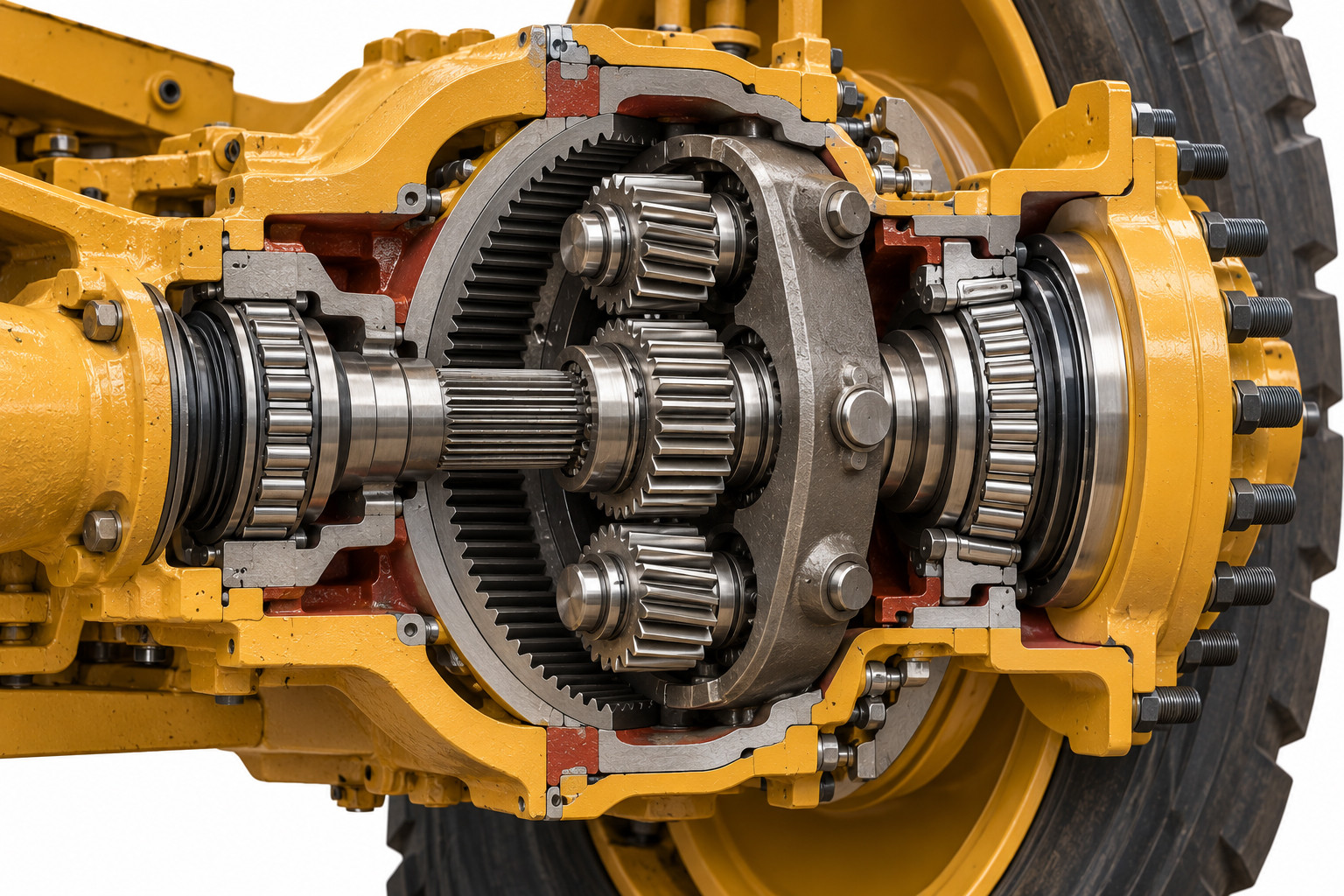
What Is a Planetary Gear System?
A planetary gear system, also called an epicyclic gear train, gets its name from the way its gears are arranged.
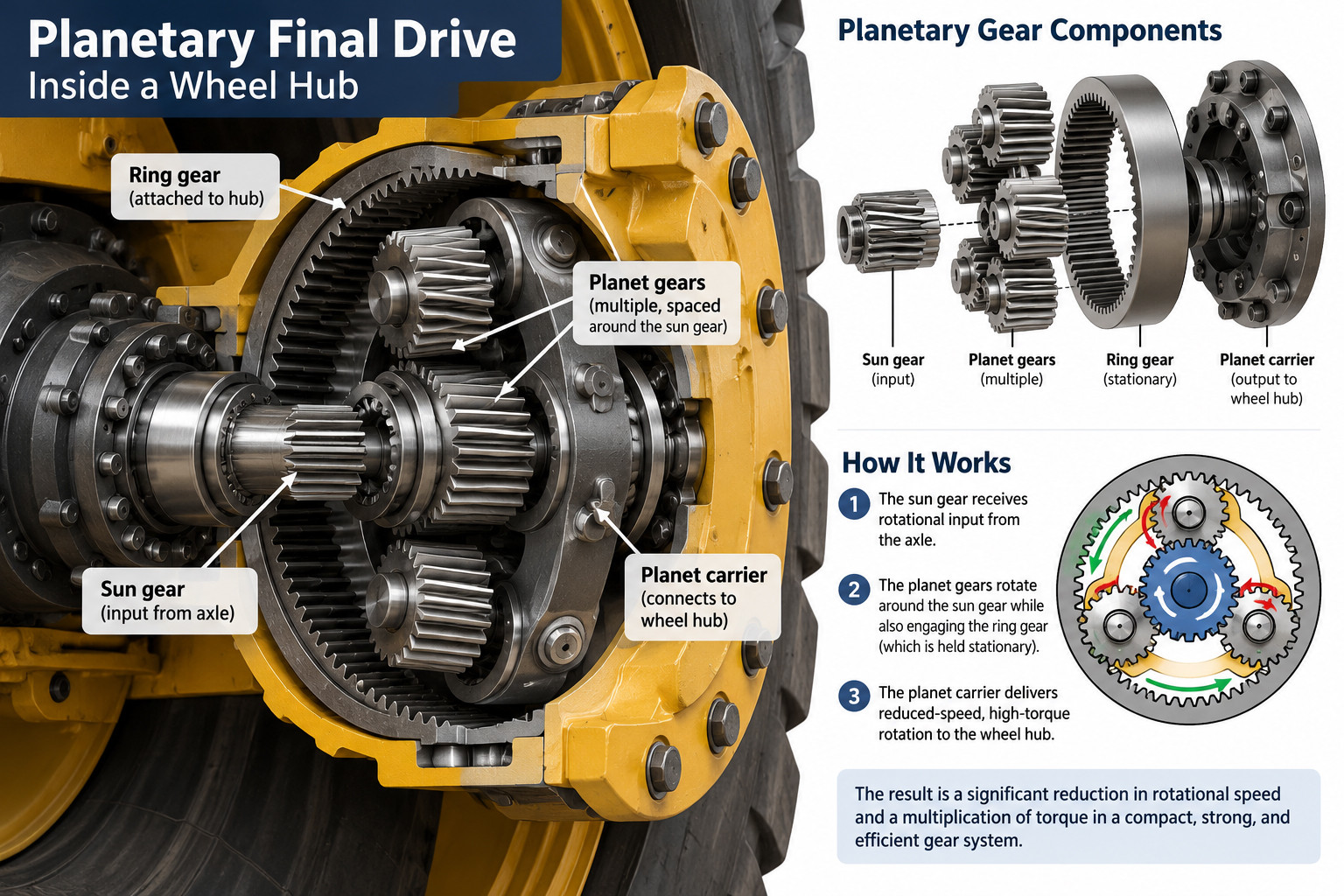
At the centre is a gear called the sun gear. Surrounding it are several smaller gears known as planet gears. These planet gears mesh with the sun gear while also engaging with a larger internally toothed gear called the ring gear.
The planet gears are mounted on a component called the planet carrier, which holds them in position and allows them to revolve around the sun gear.
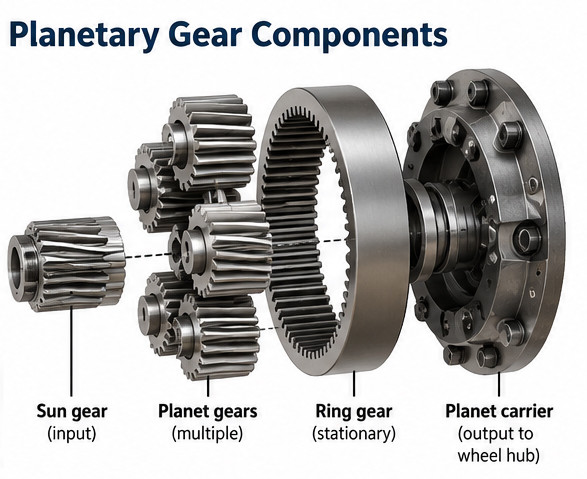
The basic arrangement consists of four important components:
• Sun gear: The central gear that often receives power from the drivetrain.
• Planet gears: Smaller gears that rotate around the sun gear and share the transmitted load.
• Ring gear: The large outer gear with teeth facing inward.
• Planet carrier: The structure that supports the planet gears and can transmit power to the wheel hub.
The fascinating part is that different components can serve as the input, output, or stationary member.
By changing which component is held stationary and which components rotate, engineers can create different gear ratios within the same basic arrangement.
For heavy equipment final drives, a common configuration uses the sun gear as the input, holds the ring gear stationary, and uses the planet carrier as the output.
This arrangement reduces rotational speed while increasing torque.
How Can Small Gears Produce So Much Torque?
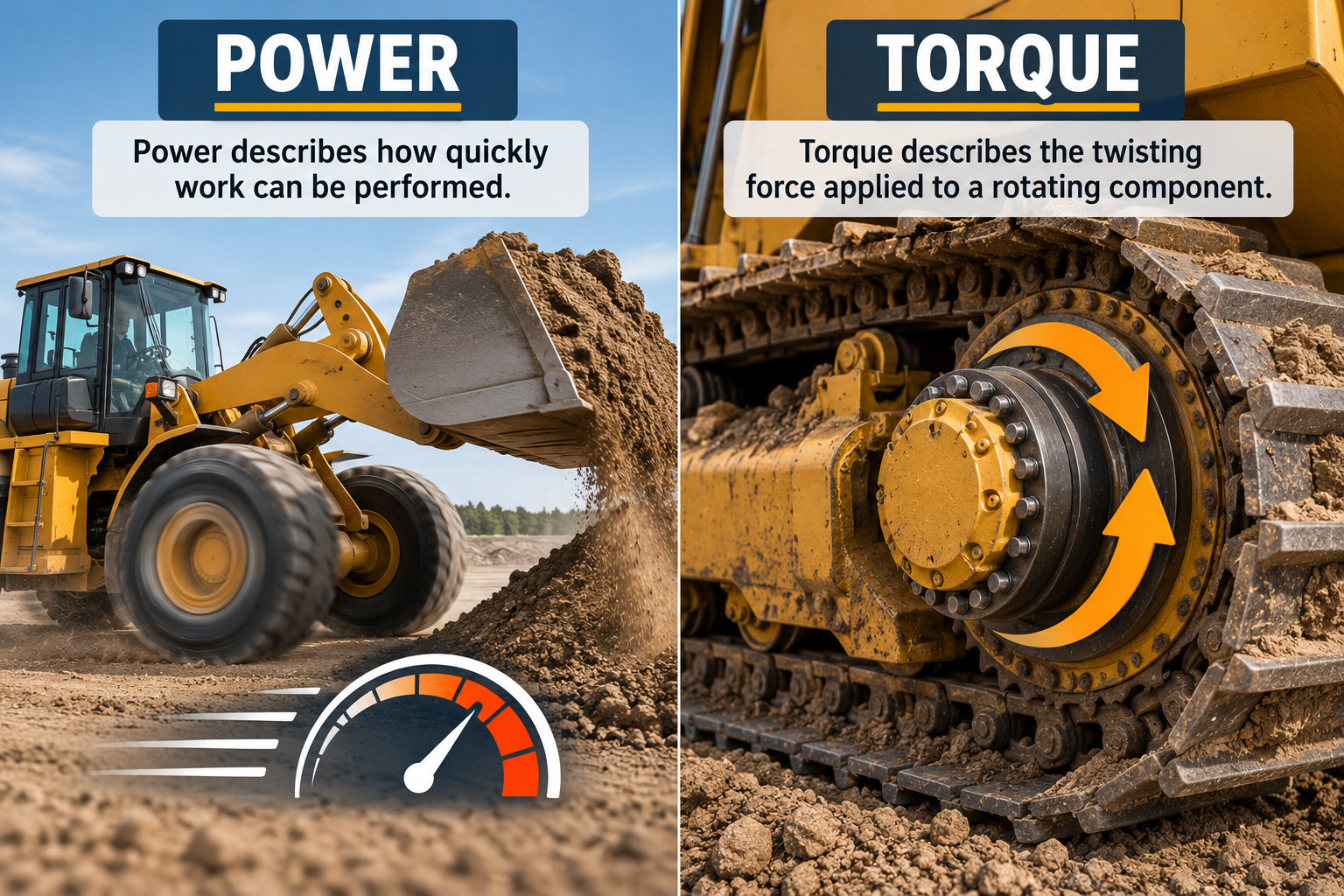
To understand why planetary gears are useful, it helps to understand the difference between power and torque.
Power describes how quickly work can be performed. Torque describes the twisting force applied to a rotating component.
Heavy equipment needs substantial torque because moving a large load often requires enormous force at relatively low speeds.
A wheel loader pushing into a gravel pile doesn't necessarily need its wheels to spin quickly. It needs enough torque to overcome resistance and keep the machine moving.
That's where gear reduction becomes important.
Imagine a drivetrain delivering 1,000 newton-metres (Nm) of torque to a planetary final drive.
If the planetary gear system has a reduction ratio of 5:1, the output rotates five times slower than the input.
Ignoring mechanical losses, the torque increases by the same factor.
Illustrative planetary gear reduction
Input torque
1,000 Nm
At 500 RPM
Output torque (ideal)
5,000 Nm
At 100 RPM
5:1 reduction — one-fifth the speed, five times the torque
Actual output torque is slightly lower because friction and other mechanical losses reduce efficiency.
The planetary gears haven't created additional power. Instead, they've exchanged rotational speed for increased twisting force.
This mechanical advantage allows relatively compact drivetrain components to deliver the tremendous torque needed to move heavy machinery.
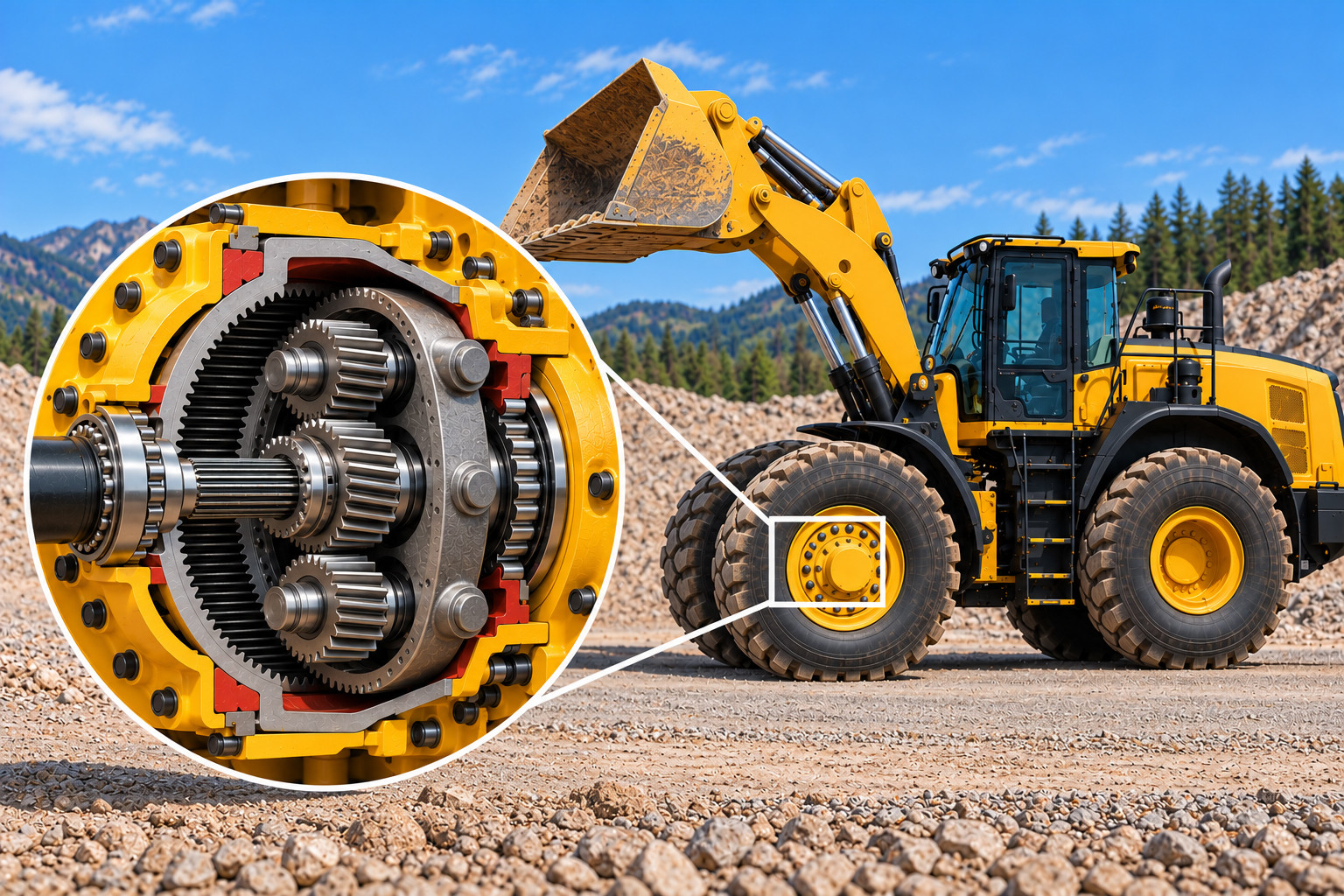
Why Put Planetary Gears Inside the Wheels?
One of the cleverest aspects of planetary final drives is their location.
Rather than producing all the necessary gear reduction inside the transmission or differential, engineers can place an additional reduction stage near the wheels.
This is often called a wheel-end planetary reduction or planetary hub reduction.
In a conventional axle arrangement, the differential and axle shafts transmit torque directly toward the wheel hubs.
In an axle equipped with planetary wheel ends, the axle shafts can transmit power at a higher rotational speed and lower torque. The planetary gears then provide the final reduction immediately before the torque reaches the wheels.
This arrangement offers several important advantages.
1. Less Torque Through the Axle Shafts
When the final reduction happens at the wheel, the axle shafts don't have to transmit the full torque ultimately delivered to the tire.
That means the shafts, differential components, and certain other upstream drivetrain parts can be designed for lower torque loads than they would experience without wheel-end reduction.
This can help engineers manage component size, weight, and durability.
2. More Torque Where It Is Needed
A machine's pushing or pulling ability depends partly on how much torque reaches the wheels.
Planetary wheel-end reduction increases the torque available at the wheel hub without requiring the transmission to provide the entire reduction.
This is particularly valuable for machines that frequently operate under heavy loads at low speeds.
3. Compact Packaging
Planetary gear systems are especially useful because their gears are arranged concentrically.
The input and output can share the same rotational axis, allowing a substantial gear reduction to fit into a relatively compact space.
Instead of relying on a large pair of external gears, the planetary arrangement distributes the gearing around a central axis.
That makes it well suited to wheel hubs, where space is limited but torque requirements can be enormous.
Why Are There Several Planet Gears Instead of Just One?
One of the biggest advantages of a planetary gear system is its ability to distribute loads across multiple gear meshes.
A conventional pair of gears transfers force through the teeth engaged between those two gears.
A planetary arrangement typically has three, four, or sometimes more planet gears surrounding the sun gear.
Under appropriate design and loading conditions, these planets share the transmitted load.
Instead of relying on one gear mesh to carry the entire load, several gear meshes contribute.
This offers significant advantages for heavy equipment.
The load-sharing arrangement can increase torque capacity within a compact package. It also helps distribute forces around the central axis.
However, the load isn't always divided perfectly evenly. Manufacturing tolerances, component deflection, alignment, and bearing conditions can affect how much force each planet gear carries.
Engineers account for these factors when designing final drives for demanding applications.
The result is a gear system capable of transmitting substantial torque without requiring a single enormous gear.
Which Heavy Equipment Machines Use Planetary Final Drives?
Planetary gearing appears throughout the heavy equipment industry, although its location and arrangement vary by machine.
Wheel Loaders
Many large wheel loaders use planetary reduction in their drive axles. These systems help deliver the high wheel torque needed to push into dense material piles and carry heavy loads.
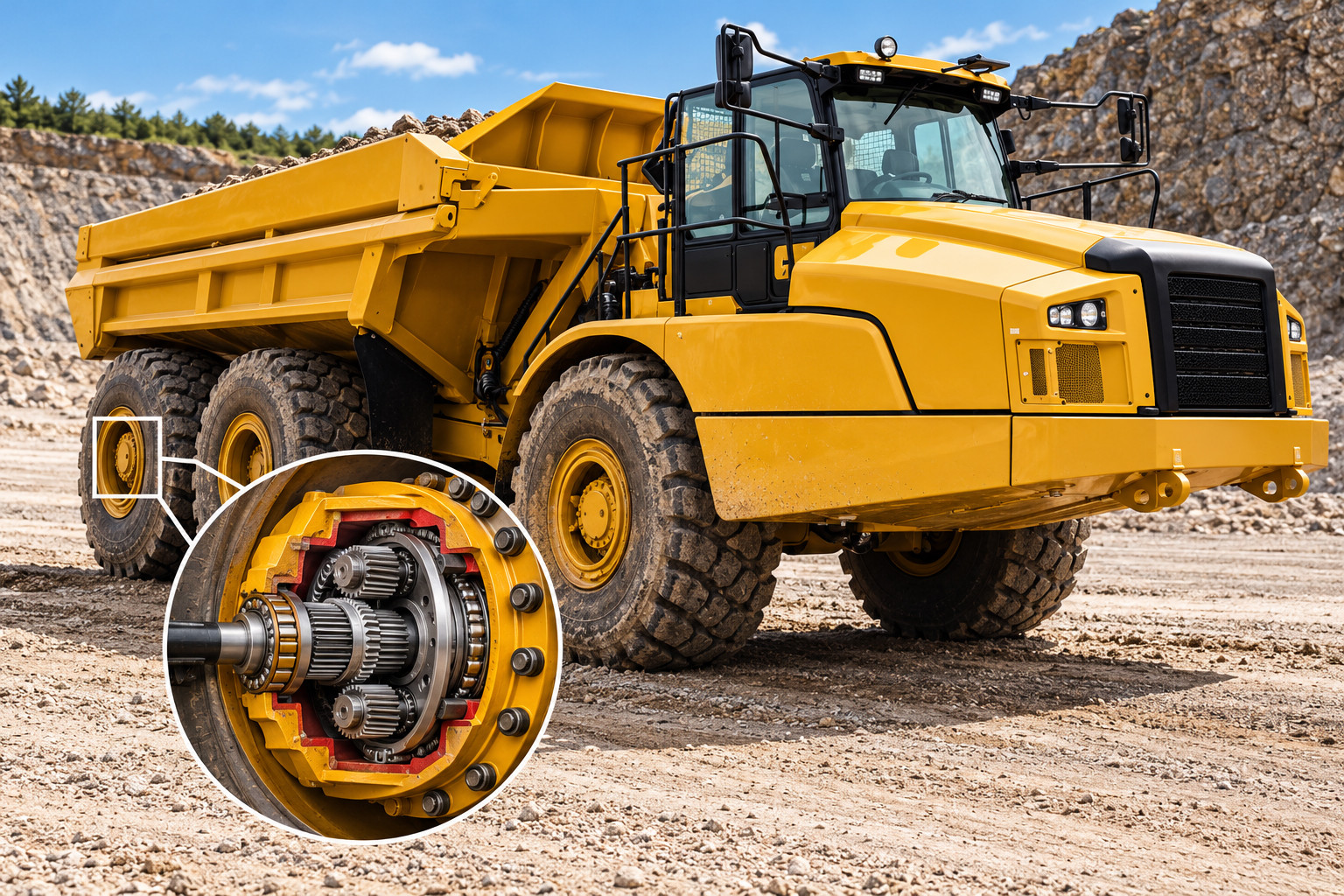
Articulated Haul Trucks
Planetary wheel-end reductions are used in many articulated haulers, helping their drivetrains deliver high torque while moving heavy payloads over difficult terrain.
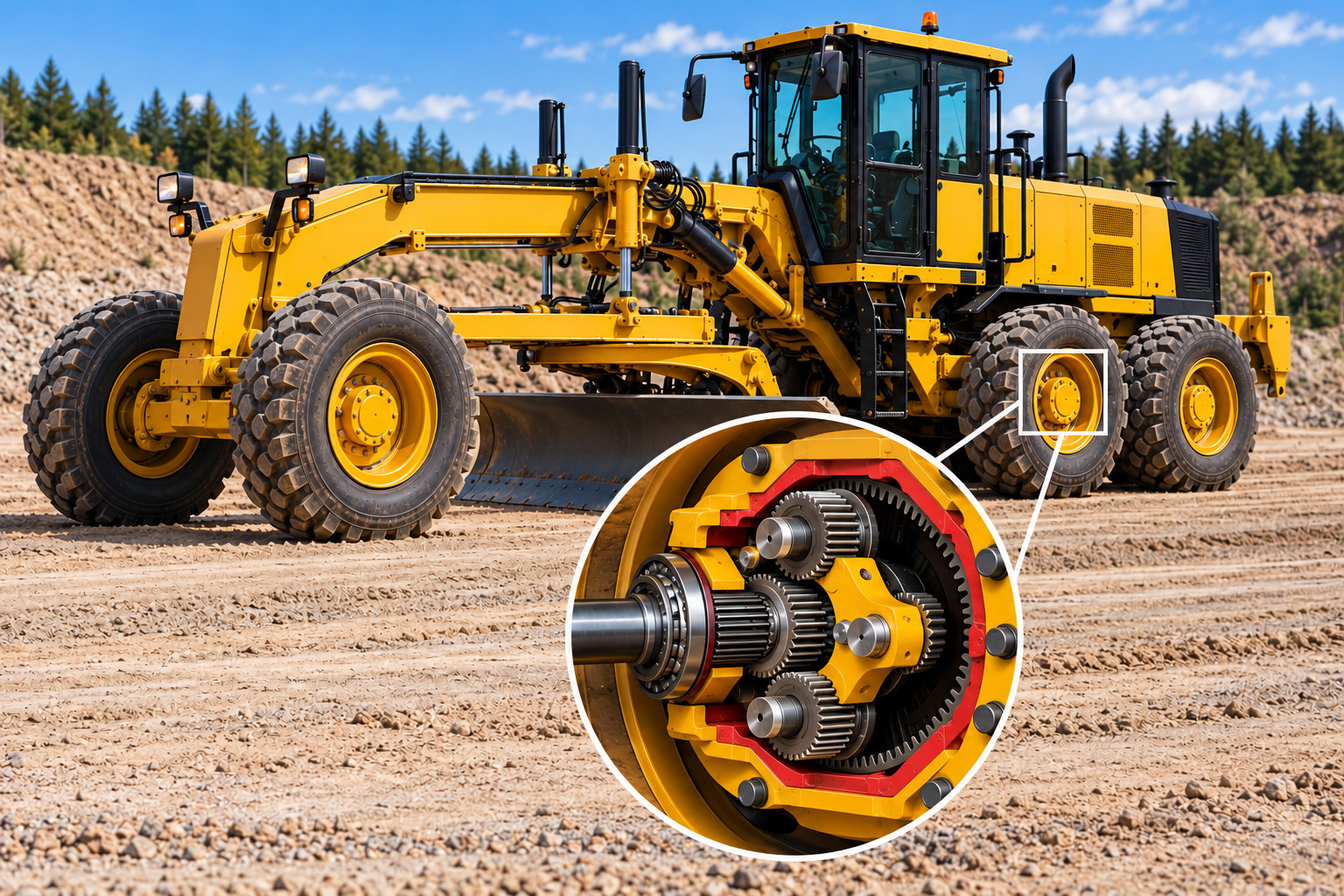
Motor Graders
Some motor grader drivetrains incorporate planetary reductions within their axle or tandem-drive arrangements to provide the torque required for demanding grading operations.
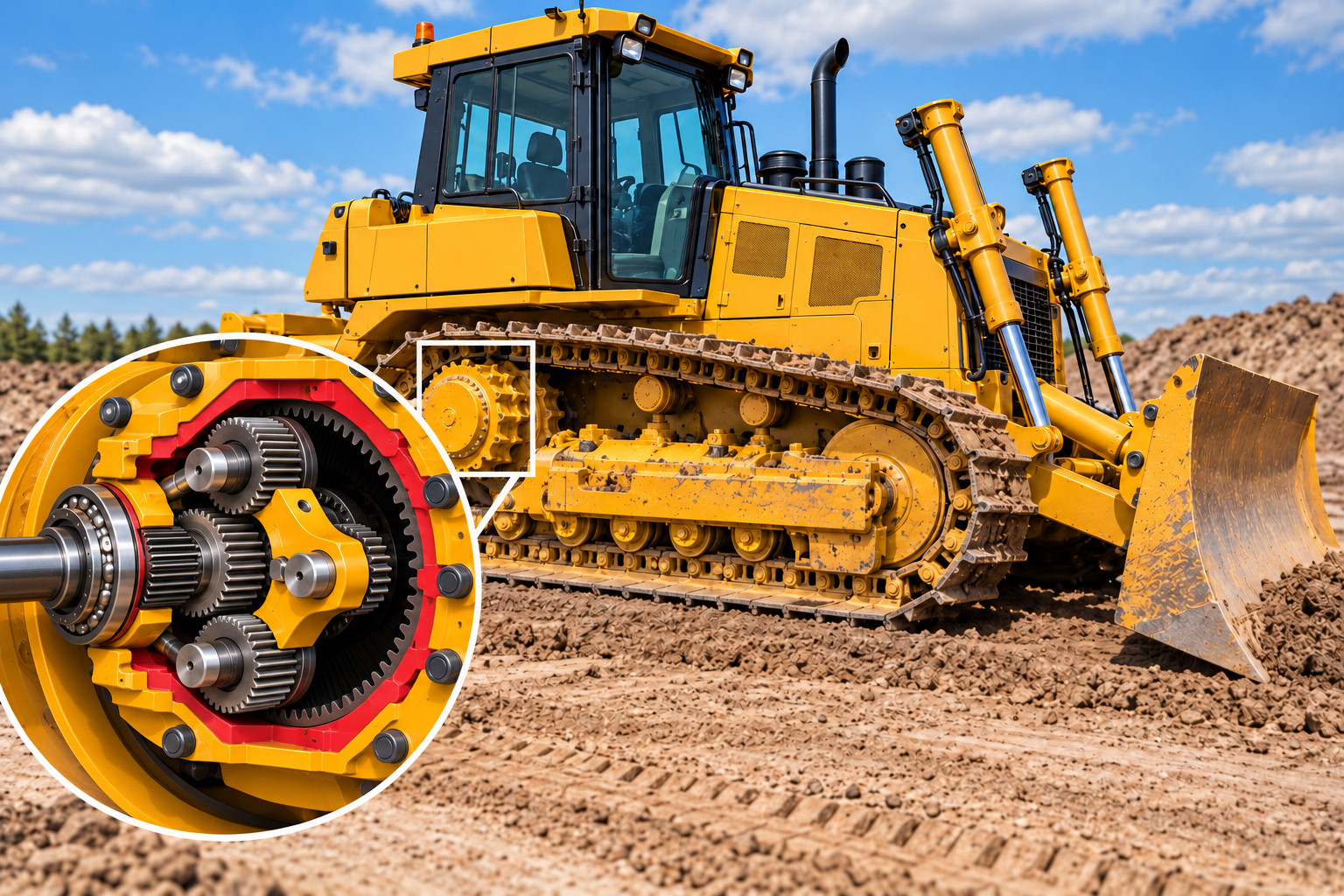
Bulldozers
Many crawler dozers use planetary gearing in their final drives. Although these systems drive sprockets rather than rubber-tired wheels, the principle of reducing speed and multiplying torque is similar.
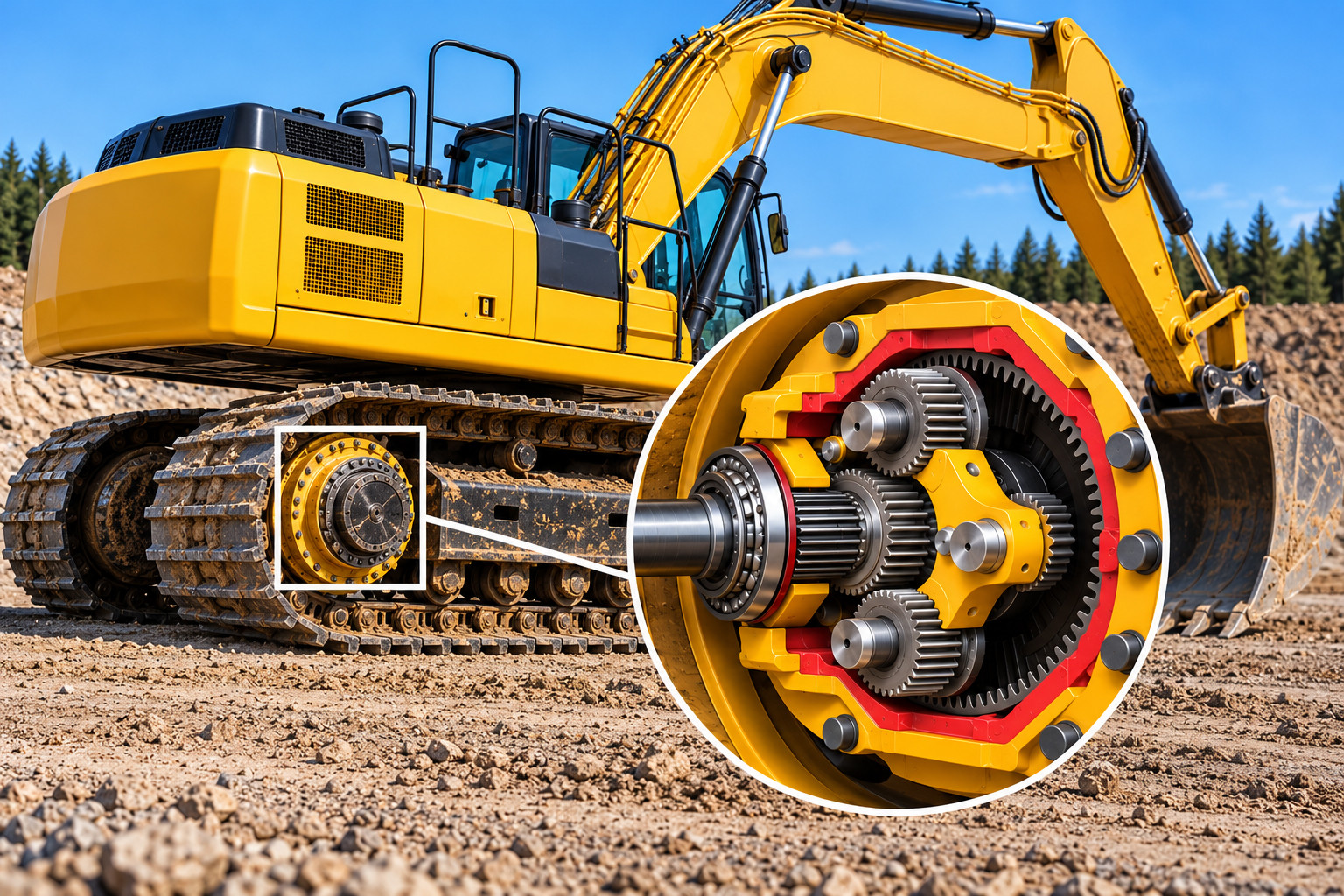
Excavators
Excavators commonly use planetary gear reduction inside their track travel drives. Hydraulic motors turn relatively quickly, while the reduction gears produce the slower, high-torque rotation needed at the drive sprockets.
Not every machine uses the same arrangement. Some have planetary reduction at the wheel hubs, others use planetary gearing inside axle assemblies, and tracked machines typically incorporate it into their travel-drive systems.
Why Not Just Build a Bigger Transmission?
If more torque is required, why not simply build a transmission capable of delivering it directly?
Technically, engineers could design a drivetrain with a much greater reduction ratio before power reaches the axle shafts.
But that approach introduces challenges.
Delivering enormous torque through the differential and axle shafts places greater demands on those components.
Larger shafts, gears, bearings, and housings may be required.
By moving part of the reduction closer to the wheels, engineers can reduce the torque that certain upstream components must transmit.
This allows torque multiplication to be distributed throughout the drivetrain rather than concentrated entirely in the transmission.
Planetary gearing also provides a compact way to achieve high reduction ratios, especially when multiple planetary stages are used.
However, wheel-end planetary systems introduce additional components, lubrication requirements, and maintenance considerations. They aren't automatically the best choice for every machine.
Their value depends on the vehicle's weight, intended operating conditions, speed requirements, and overall drivetrain design.
What Happens When a Planetary Final Drive Starts to Fail?
Planetary final drives are designed for severe operating conditions, but they are not indestructible.
They operate under substantial loads and depend on proper lubrication, healthy bearings, and correctly aligned gear components.
When problems develop, the consequences can be expensive.
Some warning signs include:
• Unusual whining or grinding noises: These may indicate gear tooth damage, bearing problems, or other internal wear.
• Excessive hub temperatures: Increased friction from poor lubrication, excessive loading, or component damage can generate abnormal heat.
• Metal particles in the oil: Fine wear debris may be expected within manufacturer limits, but larger particles or increasing concentrations can indicate developing damage.
• Oil leaking around the wheel hub: Damaged seals can allow lubricant to escape, increasing the risk of gear and bearing failure.
• Abnormal vibration or looseness: Worn bearings or damaged internal components can affect how smoothly the assembly operates.
One particularly important maintenance consideration is lubricant condition.
The gear teeth and bearings inside a planetary final drive operate under high contact pressures. They depend on the correct lubricant to maintain protective films between moving surfaces.
If lubricant levels become too low or contamination enters the housing, wear can accelerate rapidly.
In severe cases, a damaged planetary final drive can seize or lose its ability to transmit torque.
Because the system is located near the wheel or drive sprocket, failure can immobilize the machine.
Do Planetary Gears Make a Machine Stronger?
In a sense, yes, but not because they create additional engine power.
Planetary reduction increases the torque available at the wheels by sacrificing rotational speed.
That increased torque can translate into greater tractive force at the tire or track, provided the machine has sufficient traction.
This distinction matters.
A wheel loader might have enough torque to spin its tires, but that doesn't mean it can push an unlimited amount of material.
Once the tires lose traction, additional wheel torque won't necessarily produce additional useful pushing force.
The machine's weight, tire design, ground conditions, and available traction all influence how effectively torque can be converted into movement.
Planetary gearing gives the drivetrain a mechanical advantage. The rest of the machine determines how effectively that advantage can be used.
The Engineering Hidden Inside a Wheel
Perhaps the most remarkable thing about planetary final drives is how much mechanical work happens inside a relatively small housing.
From the outside, a wheel hub may appear to be little more than a large metal assembly supporting a tire.
Inside, however, several precisely manufactured gears may be working together to transform rotational speed into tremendous torque.
The sun gear drives the planets, the planets interact with the ring gear, and the carrier delivers the reduced-speed output.
Multiple gear teeth share the load, while bearings support the rotating components and lubricating oil protects the contact surfaces.
All of this happens repeatedly as a machine pushes, pulls, climbs, turns, or carries heavy loads.
It's an impressive example of how thoughtful mechanical design can accomplish something that brute force alone cannot.
Small Gears, Enormous Work
The next time you watch a massive wheel loader drive into a pile of aggregate or a bulldozer push a heavy load, remember that engine horsepower is only part of the story.
Between the engine and the ground is a carefully engineered drivetrain designed to convert that power into useful movement.
And on many machines, some of the most important work is happening inside a planetary final drive.
What makes these systems remarkable isn't simply that they multiply torque. It's that they can do so using a compact arrangement of gears, sharing substantial loads while helping protect other drivetrain components from extreme torque demands.
Sometimes, the secret to moving thousands of pounds isn't a bigger engine. It's a smarter arrangement of gears.
Explore more fascinating engineering, machinery technology, and heavy equipment insights at HeavyEquipment.com, where we take a closer look at the machines that keep the world moving.
