Why Do Graders Angle Their Wheels Differently?
The Dirt Desk - Q&A
Why Do Graders Have Their Wheels Angled Differently?
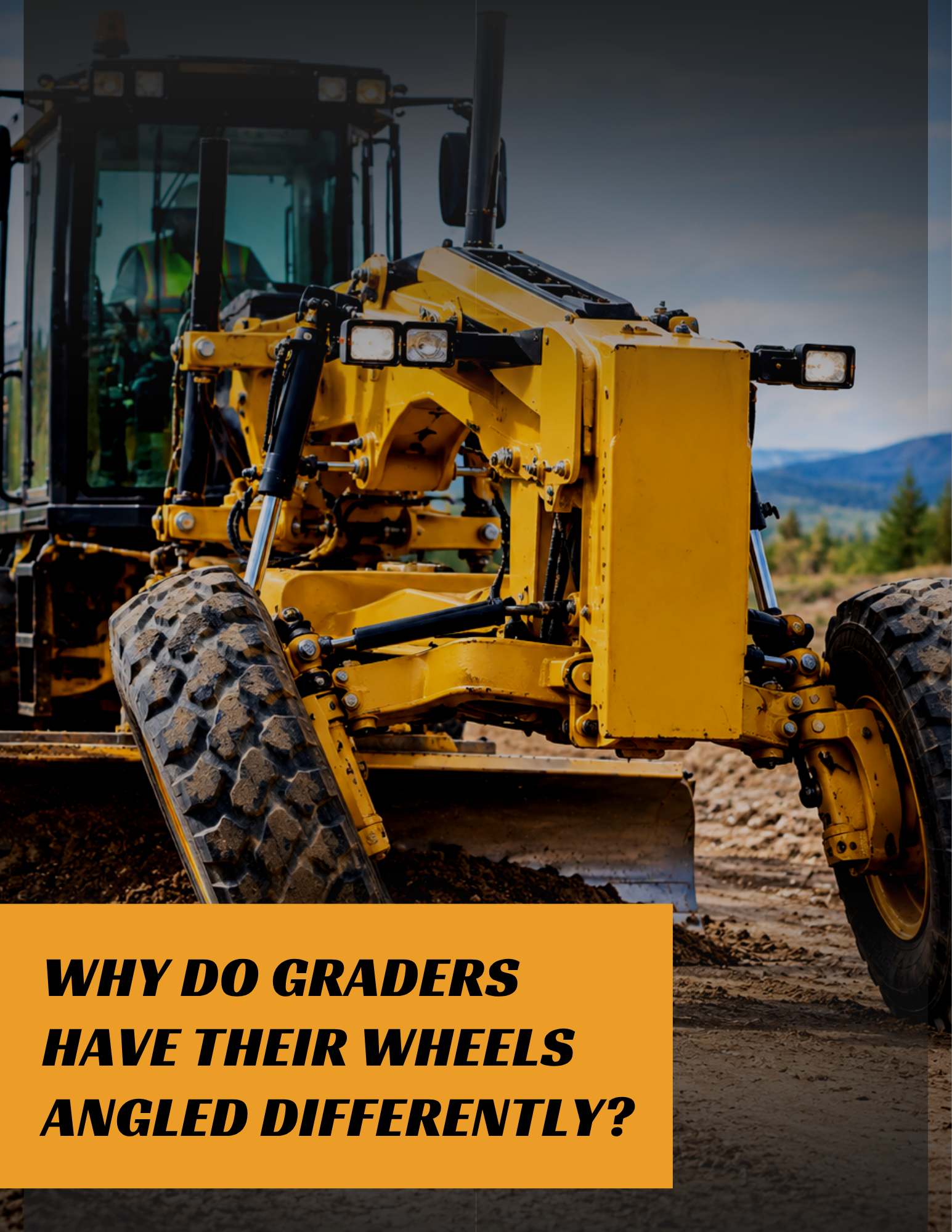
If you have ever watched a motor grader working, you may have noticed something that looks a little unusual: the front wheels often aren't pointing straight ahead. Instead, they can appear to be angled noticeably to one side while the machine is traveling forward.
At first glance, it might seem like the operator is simply steering the machine. But there is considerably more going on.
The unusual-looking wheel angle is an important part of how a motor grader controls the machine while cutting, shaping, and finishing material. It allows the operator to position the grader precisely while the moldboard is doing the actual work.
The Wheels Aren't Just There to Steer
On a conventional vehicle, the front wheels primarily determine the direction of travel. Turn the steering wheel and the front wheels change direction; the vehicle follows.
A motor grader is different because its job isn't simply to travel from Point A to Point B.
Its job is to move and precisely control material.
The moldboard—the long blade positioned between the front axle and the rear tandem axles—is responsible for cutting, carrying, mixing, and spreading material. The operator may need to maintain a very precise blade position while the machine itself is traveling at an angle relative to the direction of the blade.
That is where the front-wheel steering becomes particularly useful.
What Happens When the Wheels Are Angled?
When a grader's front wheels are turned, the front axle can effectively be positioned at an angle relative to the machine's centerline.
This helps the operator compensate for the forces generated by the moldboard.
Imagine the blade is cutting aggressively into compacted soil. As the moldboard encounters resistance, it generates a side force. Instead of allowing that force to push the machine sideways, the operator can use the steering and articulation systems to control the grader's position.
The result can look strange from outside the cab: the grader may be traveling generally straight while its front wheels are pointed significantly to one side.
That isn't necessarily a mistake.
It can be exactly what the operator wants.
The Famous "Crab" Position
One of the most recognizable grader techniques is often called crabbing.
In a crabbed configuration, the front wheels are steered in one direction while the machine's frame and/or articulation are positioned so the grader can travel with a controlled sideways component.
The machine isn't literally moving sideways like a crab. Instead, the different steering and articulation angles allow the operator to establish a path that helps counteract blade forces.
This can be particularly useful when working with a heavy side load on the moldboard.
For example, when the blade is carrying a substantial amount of material toward one side, that material creates resistance against the moldboard. The operator can adjust the front wheels, articulation, blade angle and machine position to keep the grader tracking where it needs to go.
Why Not Just Keep the Wheels Straight?
Because the grader would have a harder time resisting the lateral forces created by the blade.
A motor grader is essentially working with a long lever system. The moldboard is positioned between the front axle and the rear tandem axles, and changing the blade's angle changes how material forces act on the machine.
The operator has several controls available to manage those forces:
- Front-wheel steering
- Frame articulation
- Moldboard angle
- Moldboard height
- Moldboard side shift
- Circle rotation
- Machine speed
- Blade pitch
The important point is that the front wheels are part of the grading system, not simply a steering mechanism.
Articulation Makes It Even More Interesting
Modern graders commonly have an articulated frame. The front portion of the machine can pivot relative to the rear portion.
This gives the operator another way to control the machine's relationship with the moldboard.
The combination of front-wheel steering and articulation allows an experienced operator to put the machine in a position where the moldboard can do its job without constantly fighting the machine's tendency to drift.
This is one reason graders can perform extremely precise work despite their size.
Angling the Wheels Can Improve Control
When material is being pushed laterally by the moldboard, the grader can experience a force that wants to move the machine sideways.
The operator can steer into that force.
This is sometimes described as counter-steering or steering against the blade's side force. The exact technique depends on the material, blade position, slope, machine configuration and operating conditions.
The objective is simple:
Keep the machine under control while keeping the moldboard exactly where it needs to be.
An experienced operator may make continuous, relatively small steering and articulation adjustments that aren't obvious to someone watching from a distance.
Graders Can Work at an Angle
Another reason the wheels may look unusual is that graders don't always need to travel perfectly parallel to the road or surface they're constructing.
When building or maintaining a road crown, shoulder, ditch, or slope, the moldboard may be positioned at a considerable angle to the machine.
The front wheels can then be positioned to help the machine follow the desired path while maintaining the correct blade geometry.
This becomes especially important during ditching and slope work.
The grader isn't simply driving over a surface and flattening it. The operator is manipulating the blade in three dimensions while maintaining the desired grade.
It's About Blade Geometry
The real magic of a motor grader isn't in the wheels.
It's in the relationship between the wheels, frame, articulation, circle and moldboard.
The moldboard can be rotated, tilted, raised, lowered and shifted. The machine can articulate, and the front wheels can steer independently of that articulation.
Together, these adjustments allow the operator to control where the cutting edge contacts the material and where that material ultimately goes.
That's why two graders traveling along what appears to be the same straight line can have their front wheels pointed in completely different directions.
Their operators may be compensating for completely different blade loads and material conditions.
Wheel Lean Is Another Feature
There is another detail that can make grader wheels look even stranger: wheel lean.
Many motor graders allow the front wheels to lean laterally. This is different from simply turning the wheels left or right.
Wheel lean can help the operator maintain control when working on slopes or when lateral forces are being generated by the moldboard.
Leaning the wheels changes the geometry of the front axle and steering system and can help the machine resist side forces.
For an operator, it becomes another tool for maintaining stability and directional control.
Why Grader Operators Make It Look Easy
A skilled grader operator is constantly balancing several variables.
They have to think about:
Where is the cutting edge?
What is the desired grade?
How much material is on the blade?
Which direction is the material trying to push the machine?
How much articulation is needed?
Where should the front wheels be pointing?
What does the surface need to look like several metres behind the machine?
And they're doing much of this while moving.
That's why motor grading is often considered one of the more demanding jobs in heavy equipment operation. The controls aren't simply about moving a machine—they're about manipulating material with considerable precision.
So, Why Are Grader Wheels Angled Differently?
Because a motor grader isn't designed to behave like a car or truck.
The front wheels are angled to help control the machine, counteract forces from the moldboard, maintain the desired travel path and allow the operator to perform precise grading work.
When you see a grader moving down a road with its front wheels pointed noticeably sideways, don't assume something is wrong.
The operator may be doing exactly what is required to keep hundreds of horsepower, several tonnes of steel and a long cutting edge working together to produce a surface that can be accurate to a surprisingly small tolerance.
And that's one of the things that makes a motor grader such an interesting piece of equipment: the machine may look like it's going one way while its wheels, frame and blade are all working together in slightly different directions.