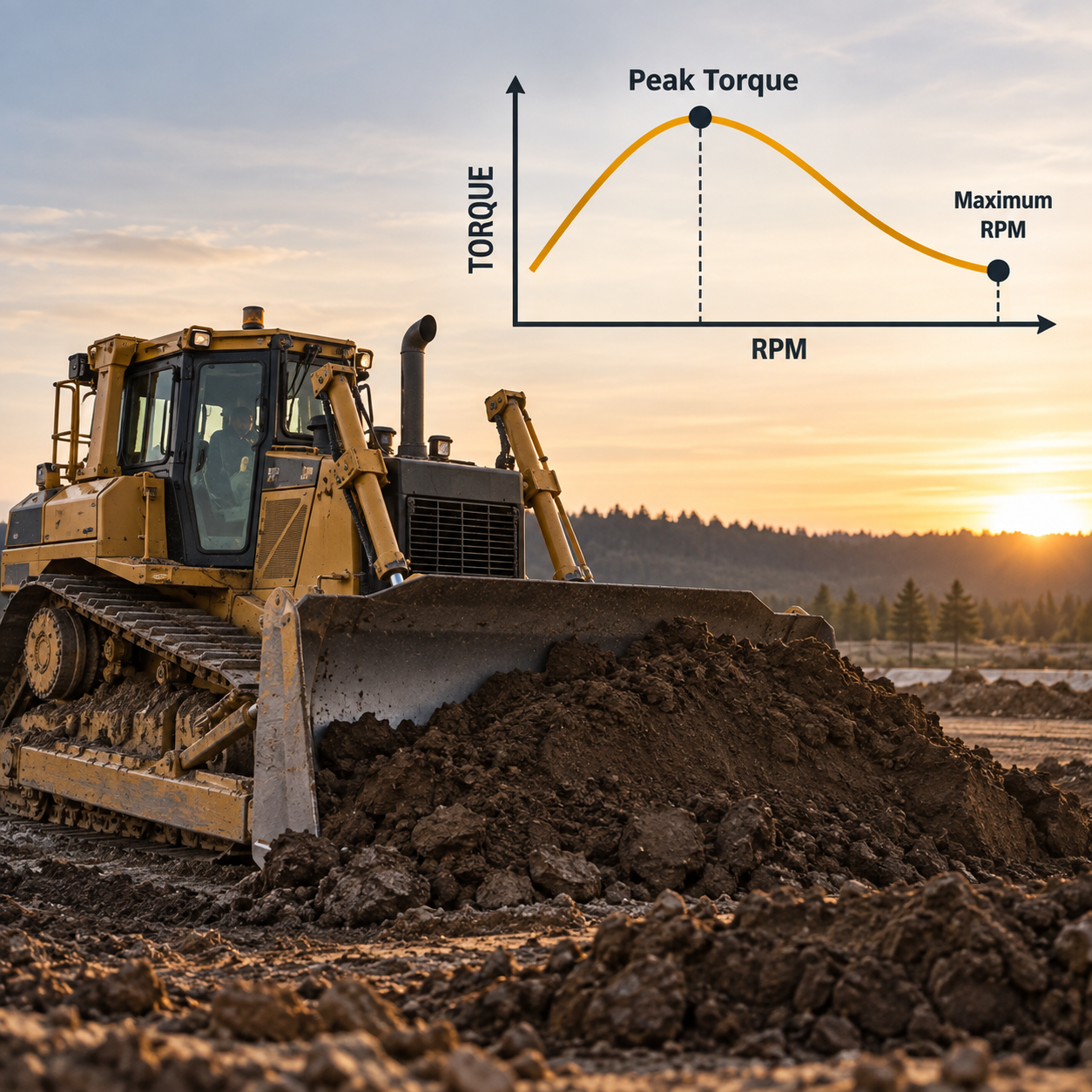
Why Do Diesel Engines Make Their Best Torque Below Maximum RPM?
Look at the specifications for almost any diesel engine used in heavy equipment and you’ll notice something interesting: maximum torque usually arrives well before maximum engine speed.
A diesel might produce its strongest pulling force somewhere around 1,200–1,600 RPM, while its rated power occurs closer to 1,800–2,200 RPM. Keep increasing engine speed and horsepower may continue to rise for a while, but torque has already begun to fall.
That isn’t a weakness. It is exactly what the engine was designed to do.
For an excavator, dozer, loader or haul truck, the ability to keep working when the load suddenly increases is far more important than being able to spin to extremely high RPM.
Torque and Horsepower Aren't the Same Thing
Torque is the twisting force produced at the crankshaft. Horsepower describes how quickly that torque can perform work.
The two are directly related:
Horsepower = Torque × RPM ÷ 5,252
That relationship explains something that can initially seem strange. An engine can reach peak torque at a relatively low RPM but continue gaining horsepower as RPM rises.
Imagine an engine producing:
| Engine Speed | Torque | Horsepower |
| 1,200 RPM | 1,000 lb-ft | 228 hp |
| 1,500 RPM | 1,200 lb-ft | 343 hp |
| 1,800 RPM | 1,100 lb-ft | 377 hp |
| 2,100 RPM | 950 lb-ft | 380 hp |
These are only illustrative numbers, but notice what happens. Peak torque occurs at 1,500 RPM, while peak horsepower doesn't arrive until much later.
The engine is making less torque at 2,100 RPM, but it's producing that torque more frequently because the crankshaft is turning faster.
Why Does Torque Peak in the Middle?
An engine's ability to produce torque depends heavily on how effectively it fills its cylinders with air, injects fuel and converts combustion pressure into force on the pistons.
At very low RPM, the engine isn't necessarily operating at its most efficient point. Turbocharger boost may be lower, airflow may be limited and the fuel system may restrict fueling to control smoke and exhaust temperatures.
As RPM increases, conditions improve.
The turbocharger moves into a more productive operating range. The cylinders receive more air, more fuel can be burned efficiently, and combustion pressure produces increasingly strong torque.
Eventually the engine reaches its peak torque RPM.
Beyond that point, however, increasing engine speed starts working against it.
There is less time available to fill each cylinder. Frictional and pumping losses increase. The turbocharger and intake system have airflow limits. Combustion also has less time to occur during each cycle.
Torque therefore begins to decline.
Heavy Equipment Wants Torque Down Low
This characteristic is particularly useful in heavy equipment because machine loads are constantly changing.
Picture a dozer moving through relatively easy material at governed engine speed. Suddenly, the blade encounters a much heavier section.
The load on the engine increases.
Engine RPM begins to fall.
But instead of immediately becoming weaker, the diesel moves toward the part of its torque curve where it can actually produce more torque.
That characteristic is often described as torque rise.
If an engine produces 1,000 lb-ft at rated speed but reaches 1,200 lb-ft as it slows under load, it has a 20% torque rise.
That extra torque helps the machine continue pushing without the operator immediately having to reduce the load or change gears.
The Engine Can "Dig In"
This is one reason a good industrial diesel can feel surprisingly strong when its RPM starts dropping.
With many engines, falling RPM sounds like trouble.
With a heavy-equipment diesel operating within its intended range, some RPM drop under load is expected.
The engine governor and electronic controls respond to the increased load, while the engine moves toward its stronger torque range. Instead of simply stalling as resistance increases, it has a reserve of additional torque available.
Operators often experience this as the engine lugging down and pulling through the load.
There is obviously a limit. Drag the engine below its useful operating range and torque will eventually fall sharply. Excessive lugging can also increase thermal and mechanical stress.
But within its designed operating band, that drop from rated speed toward peak torque can be useful.
Why Not Just Make Peak Torque at Maximum RPM?
Because that would remove much of the engine's ability to respond to increasing load.
Suppose a dozer's engine produced maximum torque at its maximum operating RPM. The instant the blade encountered additional resistance and RPM fell, torque would fall too.
Now the engine would be caught in an unpleasant cycle:
More load → lower RPM → less torque → even lower RPM.
Designing the engine so that torque rises as RPM initially falls creates a much more useful response:
More load → lower RPM → more available torque → better ability to carry the load.
For a working machine, that is a valuable characteristic.
Automotive Engines Have Different Priorities
Passenger-vehicle engines operate under a different set of requirements.
Cars and light trucks need good acceleration across a broad speed range, low emissions, quiet operation, fuel economy and responsive highway performance.
Their transmissions also provide numerous ratios that can keep the engine near an efficient operating point.
Heavy equipment often spends hours doing something completely different: working against sustained resistance.
A dozer pushes.
An excavator drives hydraulic pumps.
A wheel loader repeatedly fills a bucket.
A grader pulls a moldboard through material.
A haul truck climbs long grades carrying enormous loads.
These machines don't need an engine that feels exciting at 5,000 RPM. They need one that can produce substantial torque continuously at relatively low engine speeds.
Industrial diesels are therefore generally designed around a comparatively narrow and useful operating range.
Hydraulics Change the Equation Too
In hydraulic equipment, the diesel engine usually isn't driving the tracks, boom or bucket directly. It's powering hydraulic pumps.
Those pumps convert engine power into hydraulic flow and pressure.
When an excavator digs into difficult material or performs several hydraulic functions simultaneously, pump demand can increase dramatically. Modern machine controls coordinate engine speed, pump displacement and hydraulic demand so the engine remains in a productive operating range.
A broad low-speed torque curve gives the system room to respond without the engine immediately bogging down.
The engine and hydraulic system are therefore designed as parts of the same machine rather than as completely separate systems.
Why Diesels Don't Need Huge RPM
There are other advantages to producing substantial torque at relatively low engine speeds.
Large diesel engines contain heavy pistons, connecting rods, crankshafts and valvetrain components. Increasing RPM dramatically increases how often those components accelerate, stop and change direction.
Higher speeds can mean greater friction, heat and mechanical loading.
Heavy-equipment engines are also expected to operate under substantial load for thousands of hours. Producing useful power at lower RPM helps engineers balance performance with fuel consumption, cooling requirements, durability and service life.
The goal isn't maximum RPM.
It's useful work for a very long time.
The Shape of the Curve Matters More Than the Peak
A specification sheet advertising enormous peak torque can be impressive, but the single highest number doesn't tell the entire story.
What matters to a working machine is the shape of the torque curve.
An engine that maintains strong torque across several hundred RPM can be much easier to work with than one producing an enormous peak over a very narrow range.
That's why engineers pay attention not only to peak torque, but also to torque rise, rated speed, peak-power speed and the engine's usable operating range.
The machine needs enough reserve to handle changing loads without constantly forcing the transmission, hydraulic system or operator to compensate.
It's Designed to Slow Down — A Little
When a diesel engine in a piece of heavy equipment drops several hundred RPM under load, it isn't necessarily running out of strength.
In many cases, it is moving toward the strongest part of its torque curve.
That is one of the fundamental differences between an engine designed primarily to move a vehicle quickly and one designed to spend its life pushing dirt, lifting loads, powering hydraulics or climbing grades.
Maximum RPM gets attention.
But in heavy equipment, some of the engine's most useful work happens well below it.