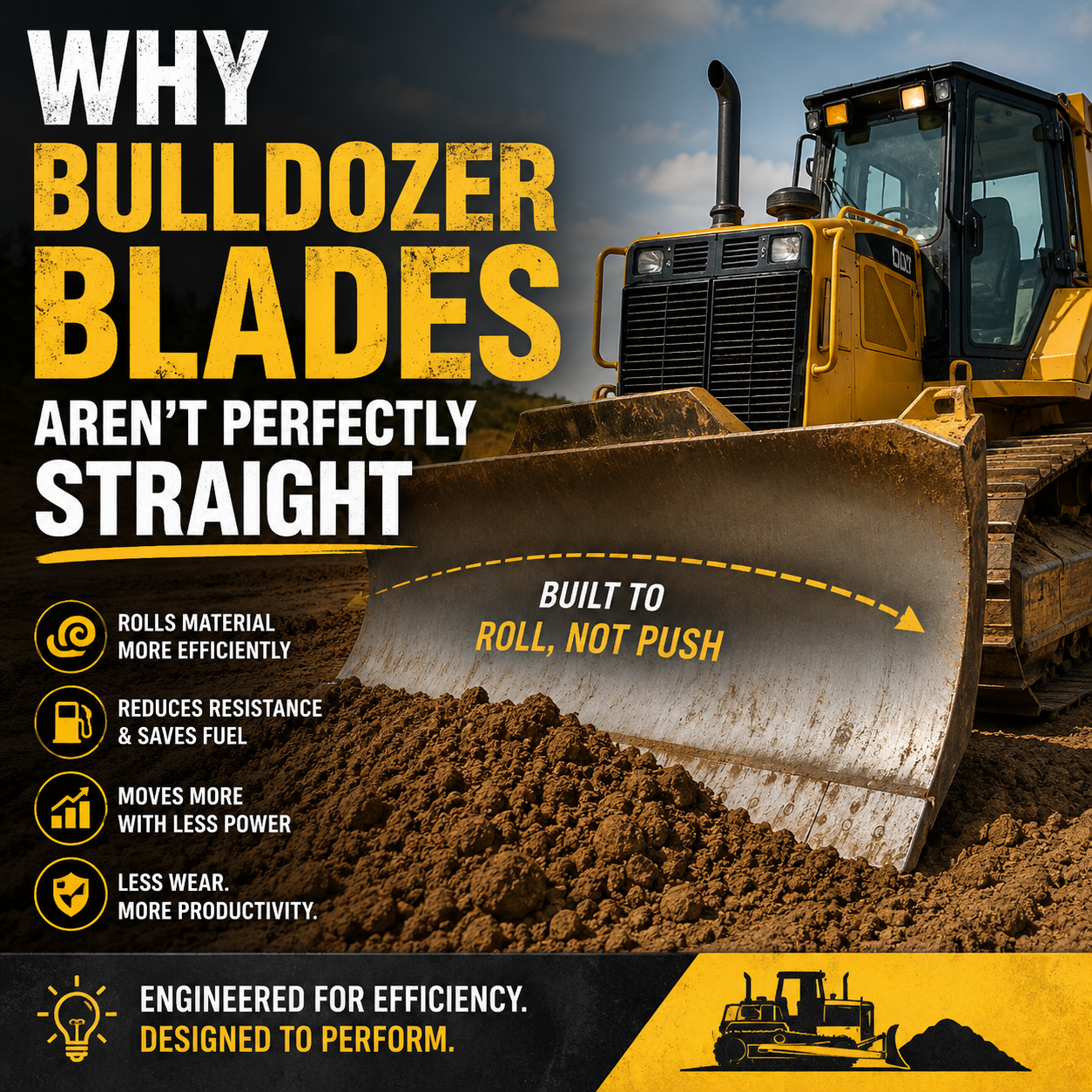
Why Bulldozer Blades Aren't Perfectly Straight
At first glance, a bulldozer blade appears to be nothing more than a massive slab of steel mounted to the front of a machine. Look a little closer, however, and you'll notice something interesting: the blade isn't perfectly straight.
Instead, nearly every modern bulldozer features a blade with a gentle curve across its face. This isn't simply for appearance—it's the result of decades of engineering designed to move more material with less effort.
Whether you're watching a dozer push dirt on a construction site or examining a vintage machine at a show, understanding the shape of the blade reveals just how much thought goes into one of the world's toughest machines.
A Blade Designed to Roll Material
The primary purpose of a bulldozer blade is to move loose material efficiently.
If the blade were perfectly flat like a wall, soil would simply pile up in front of it until resistance became enormous. The machine would need significantly more power to continue pushing.
Instead, the blade's curved profile encourages material to:
- Roll upward
- Fold over itself
- Continuously tumble forward
Engineers call this a rolling material flow.
This rolling action reduces friction between the blade and the material while allowing the bulldozer to push a larger load with less horsepower.
Think of rolling a snowball versus trying to shove an entire pile of snow like a brick. Rolling is far more efficient.
Less Resistance Means More Productivity
Every pound of resistance the blade creates translates into additional strain on:
- The engine
- The transmission
- The tracks or tires
- Fuel consumption
The curved moldboard helps reduce that resistance.
Instead of forcing dirt to slide across steel, much of the material rolls against itself. Soil rubbing against soil creates less drag than soil scraping against steel.
The result is:
- Lower fuel usage
- Faster cycle times
- Reduced wear
- Greater production
Keeping Material in Front of the Machine
Have you ever noticed how dirt tends to stay in front of a bulldozer instead of spilling out immediately?
The blade's curvature helps "carry" the load.
As material climbs the blade, gravity naturally pulls it back toward the center of the rolling mass instead of allowing it to spill forward.
Many blades also include side wings that further help retain material.
Without the curved shape, operators would lose much of every load before reaching their destination.
Different Blade Shapes for Different Jobs
Not every bulldozer blade has the same amount of curvature.
Different jobs require different designs.
Straight Blade (S-Blade)
The straight blade has relatively little side curvature and short wings.
Best for:
- Fine grading
- Precision work
- Short-distance pushing
- Stumping
Because it carries less material, it provides excellent control.
Universal Blade (U-Blade)
The Universal blade has a much more pronounced curve and tall side wings.
It excels at:
- Long pushes
- Large volumes of soil
- Coal handling
- Stockpile work
Its shape allows it to carry enormous amounts of loose material.
Semi-Universal Blade (SU-Blade)
The SU blade combines features of both designs.
It offers:
- Good penetration
- Excellent carrying ability
- Versatility across many job sites
That's why it's one of the most common blade styles found on modern crawler dozers.
Curvature Improves Cutting Performance
The blade doesn't just push—it cuts.
When lowering the blade into compacted soil, the curved surface helps lift loosened material upward after the cutting edge breaks it free.
Instead of compacting against the blade, excavated material naturally flows upward.
This reduces plugging and keeps production moving.
The Cutting Edge Does Most of the Work
Interestingly, the thick steel blade isn't what actually contacts the ground.
Bolted to the bottom is a replaceable cutting edge.
These hardened steel segments:
- Penetrate the soil
- Protect the expensive moldboard
- Can be replaced after wear
- Come in different profiles for different applications
The curved blade works together with this cutting edge to maximize efficiency.
Blade Curvature Changes with Machine Size
Small dozers and massive mining dozers don't use identical blade geometry.
Engineers adjust:
- Radius of curvature
- Blade height
- Width
- Side wing angle
- Moldboard depth
These changes reflect the types of material each machine is expected to move.
A compact dozer working on residential sites needs very different blade characteristics than a giant mining tractor pushing thousands of tons every shift.
Operators Notice the Difference
Experienced operators quickly recognize how blade shape affects machine performance.
A properly designed blade:
- Holds more material
- Releases loads smoothly
- Cuts consistently
- Requires fewer passes
- Makes grading easier
Much of an operator's productivity comes from understanding how to use the blade's natural rolling action instead of fighting against it.
It's a Design Refined Over Generations
Early bulldozers often used relatively simple blade designs.
As earthmoving technology advanced, manufacturers experimented extensively with:
- Blade curvature
- Wing design
- Cutting angles
- Lift geometry
- Material flow
Modern blades represent decades of testing in real-world conditions.
Computer modeling has refined designs even further, but the underlying principle remains the same: help material roll rather than slide.
Fun Fact
If you compare a modern bulldozer blade to one from the 1930s, you'll notice today's blades are generally taller, more curved, and better at retaining material. These improvements allow modern machines to move significantly more earth with greater efficiency than their early predecessors—even when engine power hasn't increased proportionally.
The Marvel of Engineering
The curved shape of a bulldozer blade is a perfect example of engineering that often goes unnoticed. What looks like a simple piece of steel is actually a carefully designed tool that improves material flow, reduces resistance, increases productivity, and lowers operating costs.
Next time you watch a bulldozer at work, pay attention to how the soil rolls up the face of the blade instead of simply piling against it. That smooth, continuous motion is exactly what engineers intended—and it's one of the reasons bulldozers remain among the most effective earthmoving machines ever built.