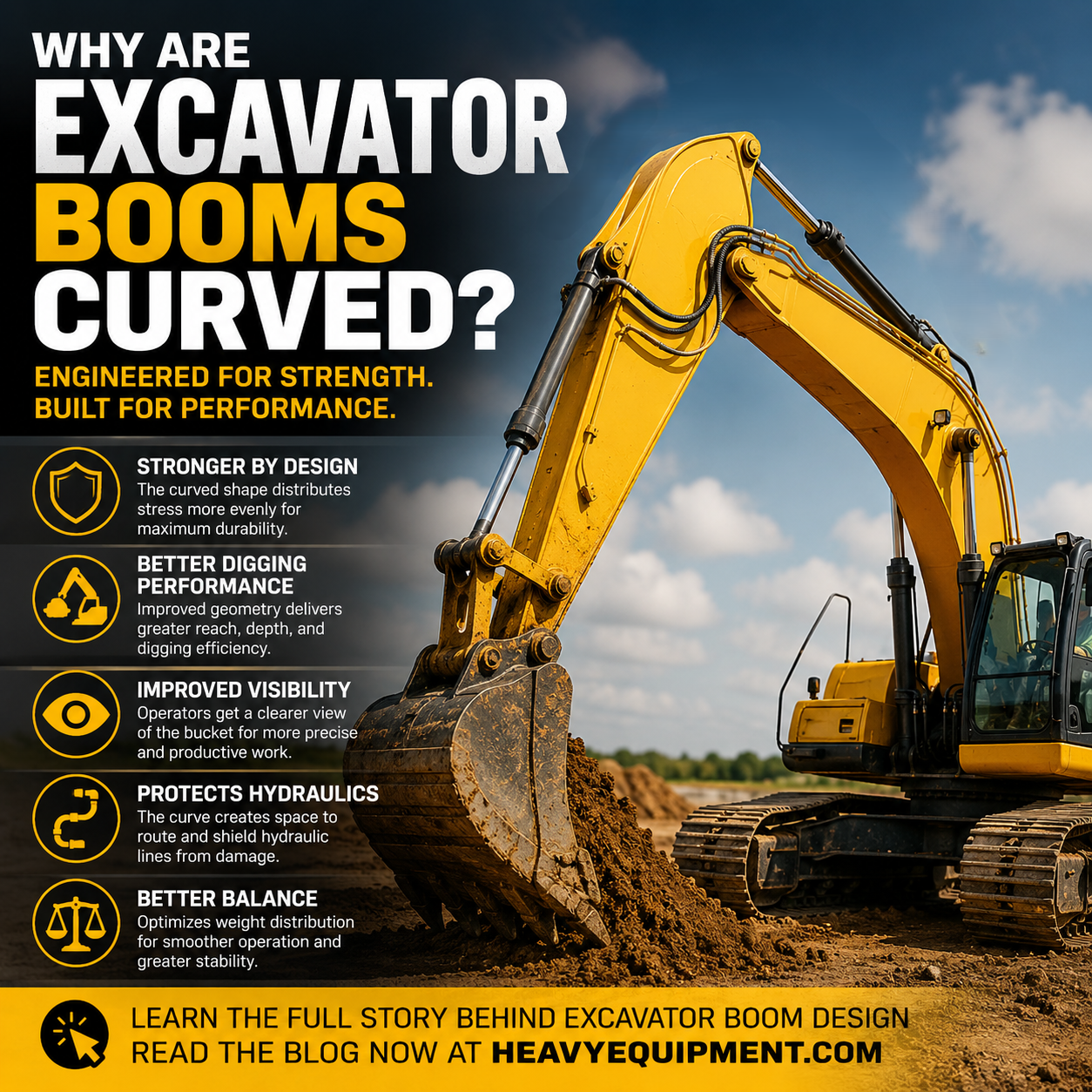
Why Are Excavator Booms Curved?
If you've spent any time around excavators, you've probably noticed one distinctive design feature: the boom isn't straight. Instead, it has a noticeable curve or bend. While it may look like a stylistic choice at first glance, that curved boom is actually the result of decades of engineering refinement aimed at improving performance, durability, and operator visibility.
So why are excavator booms curved? The answer lies in physics, strength, and practicality.
It's All About Strength
An excavator boom is subjected to tremendous forces every time the machine digs, lifts, or breaks through tough material. Every movement transfers stress through the boom, especially where it connects to the machine and at the pivot points.
The curved shape helps distribute these loads more evenly than a completely straight design. By reducing stress concentrations, engineers can minimize fatigue and extend the boom's service life.
Think of it like an arch in a bridge. Curves often handle heavy loads more efficiently than straight structures.
Better Digging Geometry
The curve also improves the excavator's working geometry.
With a curved boom, the stick and bucket can move through a wider range of motion while maintaining optimal digging angles. This allows operators to:
- Dig deeper trenches
- Reach farther from the machine
- Load trucks more efficiently
- Pull material toward the machine with greater control
The result is a more versatile excavator that can perform a wider variety of tasks without sacrificing power.
Improved Visibility
Anyone who has operated an excavator knows that visibility matters.
A curved boom can improve the operator's line of sight to the bucket, especially when digging close to the machine. Better visibility means operators can position the bucket more accurately, reducing guesswork and increasing productivity.
This becomes especially important during precision work like:
- Utility trenching
- Foundation excavation
- Landscaping
- Pipe installation
Seeing the cutting edge clearly can save both time and costly mistakes.
More Clearance Around the Cab
The boom has to move through a large arc during operation.
A curved design provides additional clearance between the boom and the cab, allowing the boom to tuck in closer without interfering with the machine's structure. This helps maximize the excavator's working range while protecting critical components.
Space for Hydraulic Components
Modern excavators rely on powerful hydraulic cylinders and hoses that control every movement of the boom.
The curve creates a natural path for these hydraulic lines, helping protect them from damage caused by debris, falling material, or accidental impacts. It also allows engineers to position hydraulic cylinders in locations where they can generate maximum lifting force.
Protecting hydraulic lines reduces downtime and maintenance costs over the life of the machine.
Better Weight Distribution
The boom is one of the heaviest moving components on an excavator.
Its shape influences how weight is distributed throughout the machine during lifting and digging operations.
A properly engineered curved boom helps balance loads more effectively, reducing unnecessary stress on the swing bearing, undercarriage, and hydraulic system. Better balance also contributes to smoother operation and improved machine stability.
It's the Result of Years of Evolution
Early excavators and cable-operated machines often featured much straighter booms because they relied on different lifting mechanisms.
As hydraulic technology advanced, manufacturers discovered that curved booms offered significant advantages in strength, efficiency, and performance. Today's designs represent decades of testing, computer modeling, and real-world experience.
Although different manufacturers use slightly different boom profiles, the overall curved shape has become an industry standard because it simply works.
Are All Excavator Booms Curved?
Not exactly.
The amount of curvature varies depending on the machine's intended purpose.
For example:
- Standard excavators use moderately curved booms for general construction.
- Long-reach excavators have specially engineered booms designed for extended reach while minimizing flex.
- Demolition excavators often feature reinforced booms capable of supporting heavy attachments at significant heights.
- Forestry and material handling excavators may use unique boom designs optimized for their specialized applications.
Each design balances strength, reach, visibility, and lifting capacity for its specific job.
Engineered for Strength
The curved boom isn't just a design trademark—it's a critical engineering feature that improves nearly every aspect of an excavator's performance. From distributing stress more effectively and increasing digging efficiency to enhancing visibility and protecting hydraulic components, the curved boom helps modern excavators perform the demanding work they're built for.
The next time you watch an excavator at work, take a closer look at that graceful curve. It's not there for appearance—it's there because decades of engineering have proven it's one of the smartest ways to build a stronger, more capable machine.