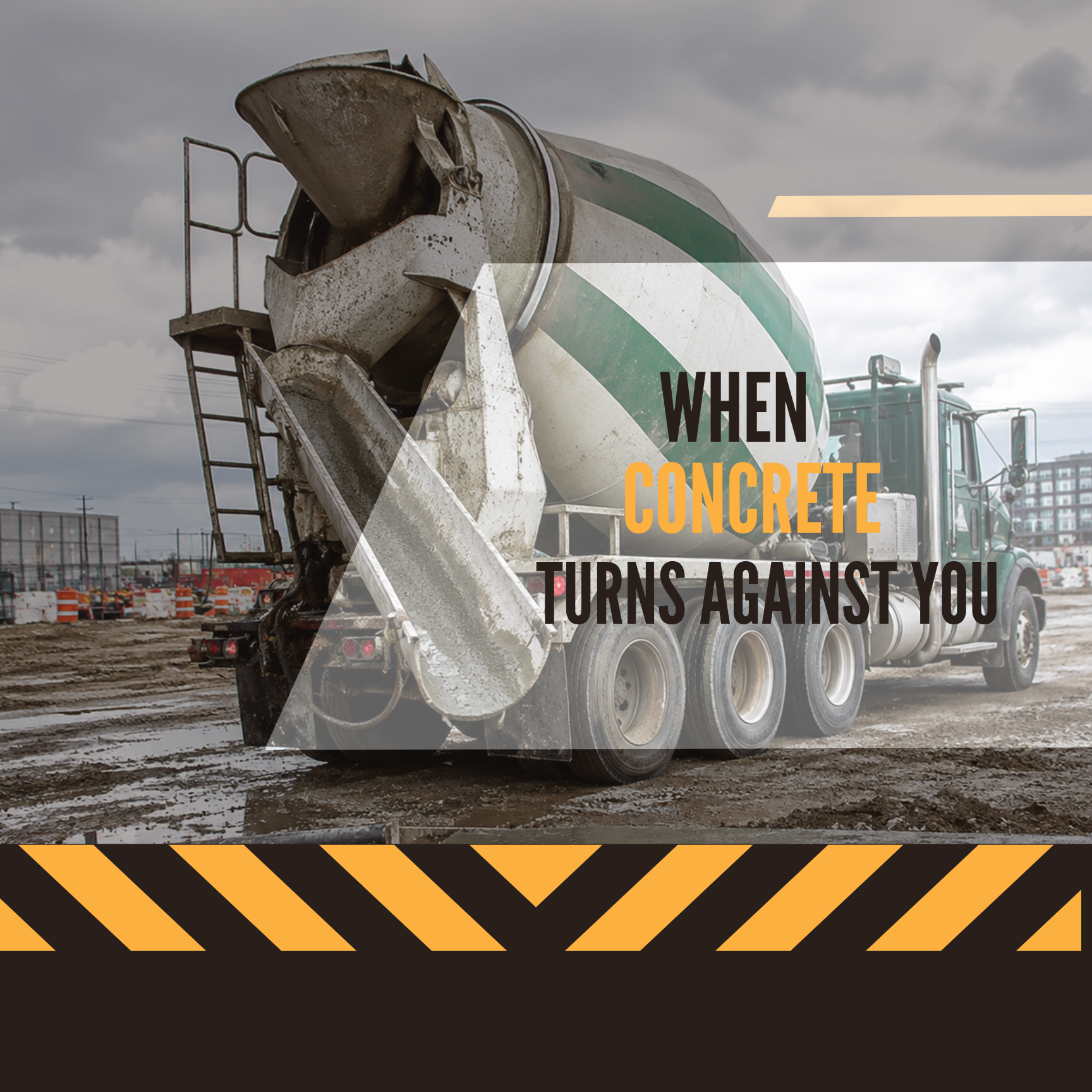
When Concrete Turns Against You: The Race Inside a Mixer
Enthusiast Corner
When Concrete Turns Against You: The Race Inside a Mixer Truck
A concrete mixer truck looks deceptively simple.
There’s a rotating drum, a truck underneath it, and a load of concrete slowly turning around inside. From the outside, it can seem like one of the less complicated pieces of equipment on a construction site.
But inside that drum, there’s a race against time.
Once water is added to cement, a chemical reaction begins. The concrete gradually changes from a workable mixture into a solid mass. The mixer’s job isn't simply to transport concrete—it has to keep the mixture workable, uniform and moving until it reaches the jobsite and can be placed.
And when something goes wrong, the consequences can be expensive.
Concrete Isn't Just Sitting There
One of the biggest misconceptions about ready-mix concrete is that the drum is simply carrying a liquid from the batch plant to the jobsite.
Concrete is constantly changing.
Cement begins hydrating as soon as it comes into contact with water. The mixture gradually becomes less workable, eventually reaching a point where it can no longer be properly placed and finished.
That's why the rotating drum is so important.
The internal blades continually move the material, helping keep the mixture consistent and preventing the heavier components from simply settling toward the bottom.
The drum also allows the concrete to be mixed or agitated depending on the stage of the delivery.
It's essentially a mobile processing plant traveling down the highway.
The Clock Is Always Running
Every concrete mixer driver has something that a dump truck driver doesn't have to worry about to the same degree:
the load has a clock on it.
Traffic jams, mechanical problems, long distances and delays at the jobsite can all create problems.
The longer the concrete sits, the more its properties can change.
This is one reason concrete deliveries are carefully scheduled. The batch plant, mixer truck, pump operator, placing crew and finishing crew may all need to work together to keep the operation moving.
A truck stuck in traffic isn't merely late.
Its cargo may be getting progressively harder to use.
What Happens When Concrete Hardens in the Drum?
This is where things get interesting.
Concrete that has begun hardening inside a mixer drum can become a serious equipment problem.
A small amount of hardened material may accumulate on the drum blades or interior surfaces. Over time, repeated loads can cause that buildup to become substantial.
Eventually, the drum's usable capacity can decrease.
Even worse, a significant amount of hardened concrete can dramatically increase the weight of the drum and place additional stress on the truck and its components.
In extreme cases, concrete can harden into a massive solid mass inside the drum.
At that point, the mixer isn't carrying concrete anymore.
It's carrying a giant chunk of artificial rock.
Removing it can require specialized equipment, mechanical chipping, hydraulic breakers or other labor-intensive methods. It's not something a driver can simply hose out.
Why You Should Never Underestimate Mixer Maintenance
The drum is the obvious component to watch, but mixer trucks have many other systems working hard.
The hydraulic system that rotates the drum has to operate reliably. The drive system must handle significant loads. Water systems need to function properly. Chutes need to remain operational, and the truck itself still has all the maintenance requirements of a heavy highway vehicle.
The mixer is also constantly exposed to one of construction's most aggressive materials.
Concrete residue can accumulate in places that aren't always obvious.
That makes cleaning and inspection more than an issue of appearance.
It's equipment preservation.
The Operator Has a Big Job
A concrete mixer operator isn't simply a truck driver delivering a load.
They have to pay attention to drum rotation, traffic, jobsite access, chute positioning, cleanup, hydraulic systems and the condition of the load.
They may also be working around pumps, conveyors, excavators, loaders, workers and other equipment once they arrive at the jobsite.
And then there's the deceptively difficult task of positioning the truck exactly where it needs to be.
A mixer may have to back into a tight construction site while avoiding workers, forms, rebar, excavation edges and other equipment.
The truck might be large, but the space available to maneuver it isn't always large.
Why Are Mixer Drums Shaped the Way They Are?
The familiar tapered, rotating drum isn't just a stylistic choice.
Its shape and internal blades are designed to move the concrete as the drum rotates.
Depending on the direction and speed of rotation, the blades can move material toward different areas of the drum. This allows the same basic system to mix, agitate or discharge the concrete.
That discharge process is another reason the mixer is such an interesting machine.
The truck doesn't simply dump its load.
The rotating drum works with its internal blades to push concrete toward the opening, where it travels through the chute and into the form, pump hopper or other placement system.
It's a remarkably efficient mechanical process.
A Mixer Truck Is Really a Mobile Construction Machine
We tend to think of heavy equipment as excavators, bulldozers, graders and wheel loaders.
But concrete mixer trucks deserve a place in that conversation.
They combine a highway truck with a hydraulic drive system, rotating processing drum, material-handling system and water system—all while carrying a load that is chemically changing during transportation.
That's a pretty sophisticated piece of equipment hiding behind what looks like a simple spinning drum.
And perhaps the most impressive part is that the entire system has to work within a relatively narrow window.
The concrete has to arrive at the right place, in the right condition, at the right time.
Because once concrete decides it's ready to become a building, there isn't much the mixer operator can do to convince it otherwise.