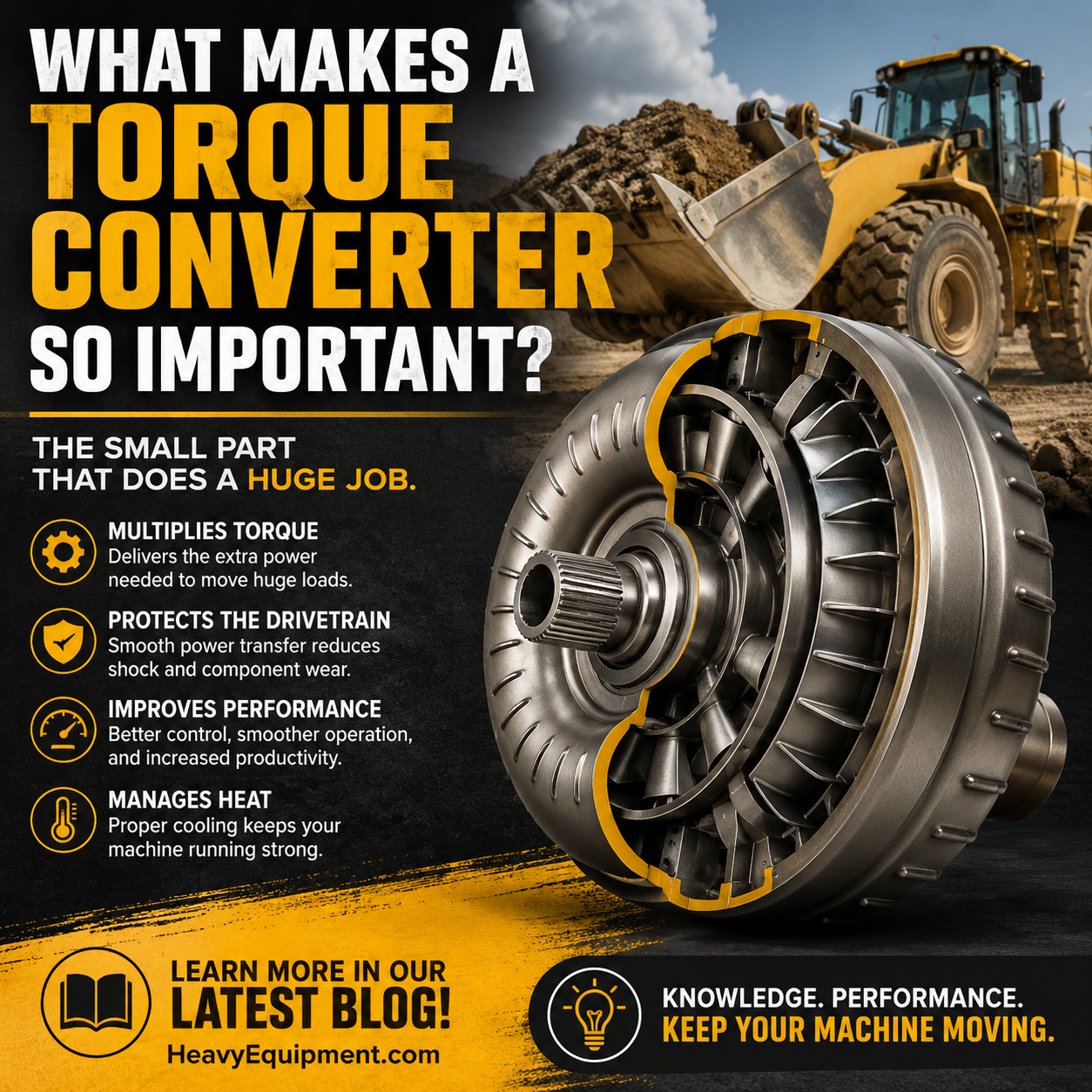
What Makes a Torque Converter So Important?
If you've ever operated a wheel loader, articulated dump truck, bulldozer, motor grader, or other heavy machine, you've relied on one of the most overlooked components in the drivetrain: the torque converter. While it rarely gets the attention given to engines or hydraulics, the torque converter is a key reason heavy equipment can smoothly move massive loads from a complete stop without stalling the engine.
Without a torque converter, many of the machines used in construction, mining, forestry, and agriculture would be much more difficult—and less efficient—to operate.
Let's take a closer look at what a torque converter does and why it's such an important piece of engineering.
What Is a Torque Converter?
A torque converter is a fluid coupling that transfers engine power to the transmission. It performs many of the same functions as a clutch in a manual transmission but does so automatically using hydraulic fluid instead of direct mechanical contact.
Unlike a mechanical clutch, a torque converter allows the engine to continue running even when the machine is stopped. More importantly for heavy equipment, it can multiply engine torque when the machine is starting under heavy load.
This combination of smooth power delivery and torque multiplication makes it ideal for demanding work environments.
The Three Main Components
Although torque converters vary by manufacturer, most contain three primary elements:
Impeller (Pump)
Connected directly to the engine's flywheel, the impeller spins whenever the engine is running. As it rotates, it throws transmission fluid outward using centrifugal force.
Turbine
The turbine is connected to the transmission input shaft. Fluid from the impeller strikes the turbine blades, causing the transmission to rotate and move the machine.
Stator
The stator sits between the impeller and turbine and is the real secret behind torque multiplication. It redirects returning fluid so it assists the impeller rather than resisting it.
Without the stator, a torque converter would simply transfer power—it wouldn't amplify it.
Why Torque Multiplication Matters
Imagine a fully loaded wheel loader pushing into a gravel pile.
Starting from a dead stop requires enormous force. Rather than forcing the engine to do all the work directly, the torque converter multiplies engine torque during low-speed operation.
Depending on the design, a torque converter can multiply engine torque by two to three times during initial acceleration.
This extra twisting force allows machines to:
- Push into dense material
- Climb steep grades
- Start moving heavy loads
- Reduce engine strain
- Prevent stalling
As vehicle speed increases, torque multiplication gradually decreases until the converter behaves primarily as a fluid coupling.
Smooth Starts Protect the Drivetrain
Heavy equipment experiences tremendous stress every time it begins moving.
If engine power were transferred instantly through rigid gears, shock loads could damage transmissions, driveshafts, axles, and differentials.
Instead, the hydraulic fluid inside the torque converter cushions these forces, providing gradual power transfer.
Benefits include:
- Less drivetrain shock
- Reduced component wear
- Improved operator comfort
- Longer transmission life
This smooth engagement is especially valuable on rough terrain where traction constantly changes.
Better Performance During Variable Loads
Construction sites rarely provide consistent working conditions.
Operators constantly transition between:
- Soft soil
- Hard-packed gravel
- Mud
- Sand
- Asphalt
- Steep slopes
A torque converter automatically adjusts to changing resistance without requiring the operator to engage or disengage a clutch.
That means:
- Smoother operation
- Fewer stalls
- Easier control
- Increased productivity
Operators can focus on the work instead of managing the drivetrain.
Heat: The Biggest Enemy
Because a torque converter relies on moving hydraulic fluid, it naturally generates heat.
Excessive slipping creates even more heat, which can damage:
- Transmission fluid
- Bearings
- Seals
- Internal clutch packs
- Transmission components
That's why heavy equipment uses dedicated transmission coolers and carefully designed hydraulic systems to maintain safe operating temperatures.
Overheating transmission fluid is one of the fastest ways to shorten drivetrain life.
Lock-Up Torque Converters
Many newer machines use lock-up torque converters.
Once the machine reaches cruising speed, an internal clutch mechanically connects the engine directly to the transmission.
This eliminates fluid slippage, improving:
- Fuel economy
- Power transfer
- Engine efficiency
- Reduced heat generation
The system combines the best of both worlds:
- Torque multiplication during startup
- Direct mechanical efficiency while traveling
Which Machines Use Torque Converters?
Torque converters are commonly found in:
- Wheel loaders
- Bulldozers
- Articulated dump trucks
- Motor graders
- Backhoe loaders
- Some forklifts
- Certain forestry equipment
- Some mining haul trucks
Machines that require frequent stopping, starting, pushing, or loading benefit most from hydraulic torque multiplication.
Common Signs of Torque Converter Problems
Like any drivetrain component, torque converters eventually wear.
Symptoms may include:
- Sluggish acceleration
- Loss of pushing power
- Overheating transmission
- Shuddering during acceleration
- Unusual whining noises
- Delayed engagement when shifting
- Burnt transmission fluid
Because many of these symptoms overlap with transmission issues, diagnosing the exact cause often requires professional inspection.
Maintenance Tips
While torque converters require little direct maintenance, operators can significantly extend their lifespan by:
- Changing transmission fluid on schedule
- Replacing transmission filters
- Keeping cooling systems clean
- Avoiding excessive slipping under heavy loads
- Monitoring transmission temperatures
- Using the manufacturer-recommended transmission fluid
Clean fluid is essential because the torque converter depends entirely on hydraulic flow to function efficiently.
Why It Matters
The torque converter quietly performs one of the hardest jobs in any heavy machine. It allows massive equipment to move smoothly from a standstill, protects expensive drivetrain components, and delivers the extra torque needed for demanding applications—all without requiring constant operator input.
Whether you're loading aggregate, grading roads, pushing earth, or hauling material across rough terrain, the torque converter is working behind the scenes to make every movement smoother, more efficient, and more reliable.
It may never be the most visible component on a machine, but it's certainly one of the most important.