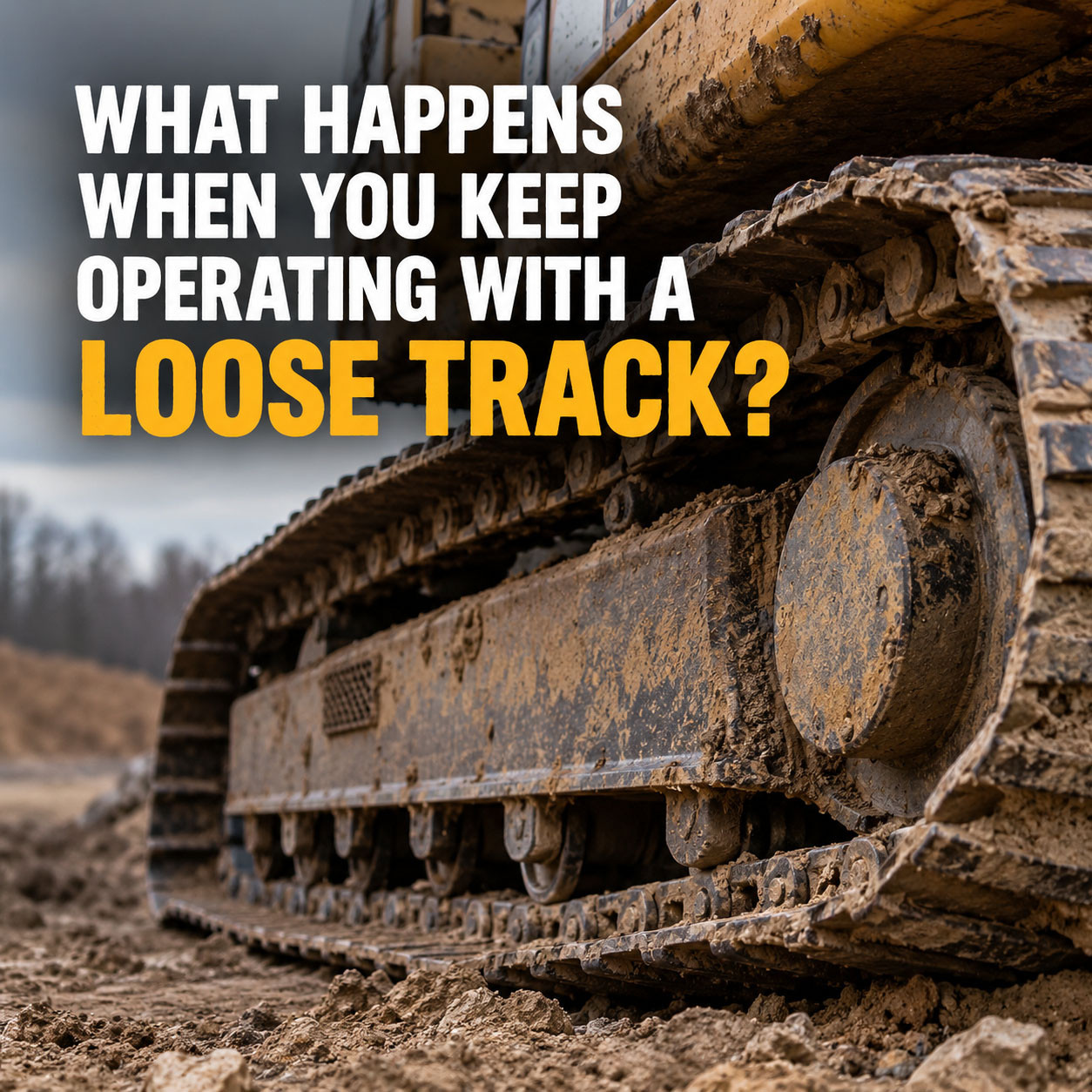
What Happens When You Keep Operating With a Loose Track?
A little track sag is normal. In fact, crawler machines are designed to operate with a specified amount of slack in the track system.
But there is a big difference between proper track sag and a track that is genuinely too loose.
When track tension falls outside the manufacturer's specification, the machine may continue to travel and work seemingly normally. That can make it tempting to finish the shift and deal with it later.
The problem is that a loose track changes the way the entire undercarriage works.
And the longer you run it, the greater the chance that a relatively simple adjustment turns into damaged components—or a machine sitting on the ground with a track off.
Why Tracks Need Some Slack
Crawler tracks aren't supposed to be stretched tight.
As the machine travels, the track chain has to articulate around the sprocket, idler and rollers. Manufacturers specify a certain amount of sag so the system can move properly without creating excessive tension.
Too tight can accelerate wear and place unnecessary loads on undercarriage components.
Too loose creates a different set of problems.
The correct tension depends on the machine, track design and operating conditions, which is why track sag should always be checked according to the manufacturer's procedure rather than judged by appearance alone.
What Changes When the Track Gets Too Loose?
A properly adjusted track follows a relatively controlled path around the undercarriage.
When excessive slack develops, the chain has more freedom to move.
Instead of remaining properly engaged and aligned with the sprocket, rollers and idler, the track can move laterally, climb components or slap against parts of the undercarriage.
That movement becomes especially important when the machine turns, travels across uneven terrain or works on slopes.
Those conditions can push an already loose track even farther out of alignment.
The Risk of Throwing a Track Increases
One of the most obvious consequences of excessive track slack is derailment, commonly called throwing a track.
During a turn, the track experiences substantial side loading. If there is too much slack, the chain may begin moving sideways relative to the rollers or idler.
Once part of the track starts climbing away from its intended path, continued movement can pull progressively more of the track out of alignment.
Eventually, the track may come completely off.
At that point, the machine isn't going anywhere under its own power.
Putting a track back on can range from an inconvenient field repair to a difficult recovery requiring additional equipment, depending on the machine and where the derailment occurs.
Sprocket Engagement Can Suffer
The drive sprocket transfers power from the final drive into the track chain.
For that system to work properly, the sprocket teeth and track components need to engage correctly.
Excessive track slack can interfere with that relationship.
Instead of entering and leaving the sprocket smoothly, the track can move or climb in ways it wasn't intended to. Repeated poor engagement can contribute to abnormal wear on sprocket teeth, bushings and other track components.
The problem can become self-reinforcing.
As undercarriage components wear, track pitch and engagement can deteriorate further, potentially accelerating additional wear.
Rollers and Idlers Take the Abuse Too
A loose track doesn't only affect the sprocket.
The rollers and idler are responsible for guiding the track through its path around the undercarriage. Excessive movement can increase impact and side loading on those components.
That may contribute to abnormal wear on roller flanges, track links and idler surfaces.
Instead of loads being distributed the way the undercarriage was designed to handle them, components may repeatedly contact one another in undesirable ways.
Over hundreds or thousands of track revolutions, relatively small problems can become expensive ones.
Turns Can Make Everything Worse
Straight-line travel is generally easier on an undercarriage than aggressive turning.
When a tracked machine turns, the tracks experience substantial forces from the ground. Counter-rotation, sharp steering inputs and working across uneven surfaces can increase those forces considerably.
Add excessive track slack and there is more opportunity for lateral movement.
That's why a track that seems acceptable while travelling straight across a smooth yard may suddenly become a problem when the machine turns in rough ground.
Debris Complicates Track Tension
Mud, clay, snow, rocks and other material can pack into an undercarriage and change effective track tension.
This is one reason operators shouldn't simply tighten a track whenever it appears loose.
Track tension should be checked using the manufacturer's recommended procedure and under the specified machine conditions.
If a track is adjusted too tightly and then packed with material during operation, loads on the undercarriage can increase dramatically.
Track adjustment is therefore not about making the track "look tight." It's about putting it within the correct specification.
A Loose Track May Be Telling You Something
If a track repeatedly becomes loose after being correctly adjusted, simply tightening it again may not address the actual problem.
Recurring slack can indicate wear or a problem somewhere in the tensioning system or undercarriage.
Depending on the machine, possible areas to inspect can include:
Track chains and pins/bushings
Sprockets
Front idlers
Track rollers
Track adjuster components
Recoil mechanism
Seals and grease tensioning systems
Undercarriage components wear together as a system, so one measurement rarely tells the entire story.
The Expensive Part Isn't Always the Loose Track
A track that needs adjustment may be a relatively routine maintenance issue.
The expensive part can be what happens when the machine continues operating after the track is significantly outside specification.
What begins as excessive sag can contribute to abnormal component wear, poor sprocket engagement, damaged rollers or idlers and eventually a derailment.
And once the track comes off, the repair cost may be only part of the problem.
There is also downtime, lost production and potentially the challenge of recovering a disabled machine from wherever it happened to stop.
Operators Are Often the First Warning System
Operators see and feel the machine every day.
Changes in track noise, unusual movement, visible sag or a machine that suddenly behaves differently while turning can all justify a closer inspection.
A quick undercarriage walk-around can catch problems long before they become dramatic.
The important thing is not to assume that because the machine can still move, the track condition is harmless.
Heavy equipment can continue working while something is wearing itself out.
The Bottom Line
Tracks need slack—but they need the right amount of slack.
Operating with a track that is significantly too loose can allow excessive movement through the undercarriage, contribute to abnormal wear, reduce proper sprocket engagement and increase the possibility of throwing a track.
The correct response isn't simply to tighten it as much as possible. Track tension should be inspected and adjusted according to the manufacturer's specifications, while repeated loss of tension should be investigated rather than continually corrected.
Because when a loose track finally becomes obvious from the operator's seat, the problem may have already moved well beyond a simple adjustment.