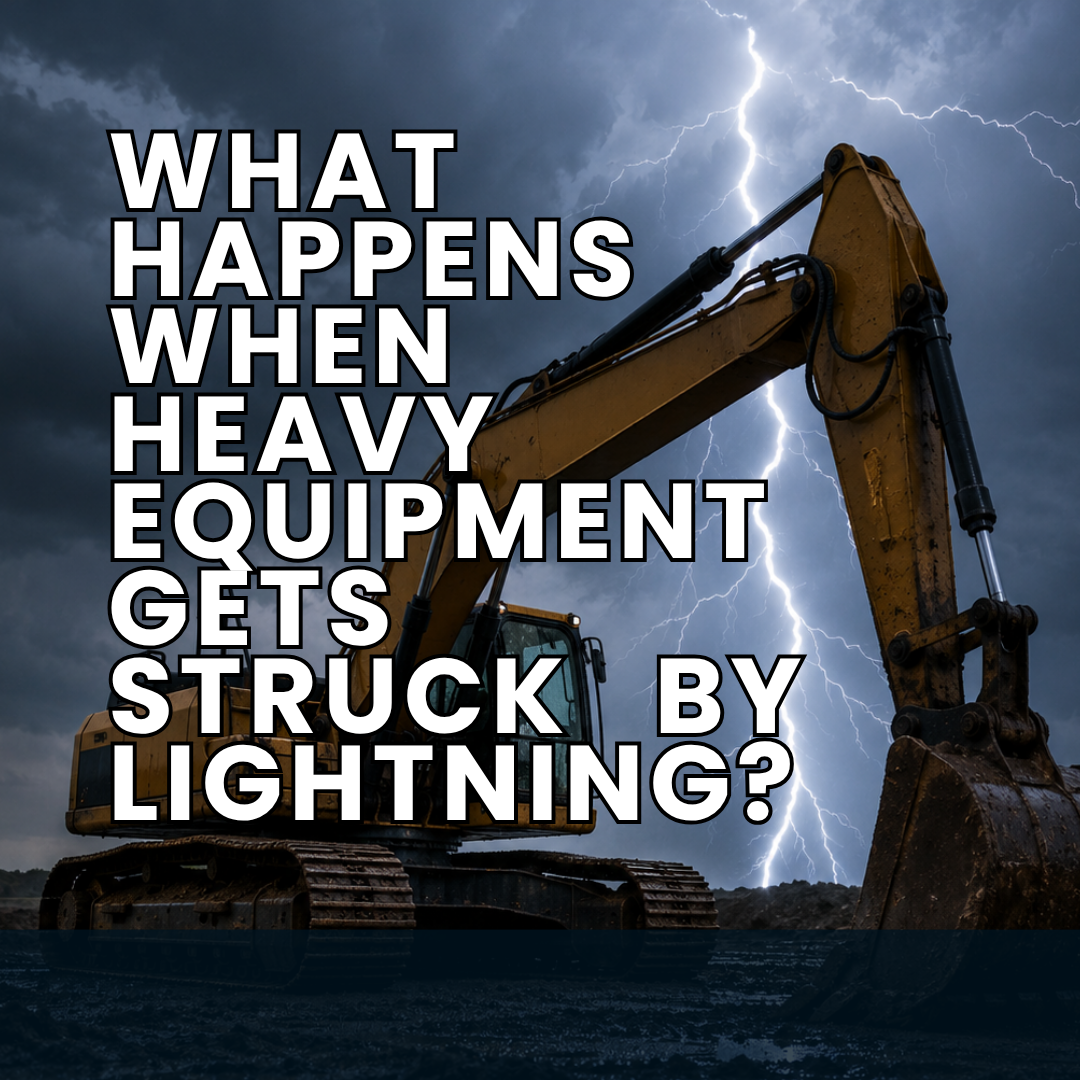
What Happens When Heavy Equipment Gets Struck by Lightning?
A 50-ton excavator is essentially a giant mass of steel sitting outdoors, often with a boom or attachment extending high above the surrounding terrain.
So what happens if lightning actually hits it?
The obvious assumption might be that the electricity simply travels through the steel machine and into the ground. Sometimes, that's roughly what happens.
But a lightning strike can take multiple paths through a machine, and some of the resulting damage may not become obvious until long after the storm has passed.
Modern heavy equipment is particularly interesting because underneath all that steel are electronic control modules, sensors, wiring harnesses, bearings, hydraulic components and communication networks that were never intended to deal with the enormous electrical energy associated with lightning.
Where Does the Electricity Go?
Lightning doesn't necessarily follow one neat path.
When a machine is struck, electrical current can spread across conductive structures as it seeks paths toward ground. The boom, frame, cab structure, axles, tracks and attachments can all become part of those paths.
On a tracked machine, current may eventually pass through the undercarriage and tracks to the ground. On rubber-tired equipment, the path can become more complicated.
The important point is that the machine doesn't have to conduct all of the lightning current through one component. The electrical energy can divide among several available paths.
That makes lightning damage notoriously unpredictable.
Two apparently identical machines struck under similar circumstances could experience very different damage.
Doesn't the Metal Cab Protect the Operator?
A substantial enclosed metal cab can provide protection through a principle similar to a Faraday cage.
Electrical current tends to travel through the conductive exterior structure rather than through the space inside it. That's one reason remaining inside an enclosed vehicle or machine can be safer than climbing out during an active lightning storm.
But heavy equipment isn't a perfect laboratory Faraday cage.
Machines have windows, wiring, antennas, hydraulic lines and numerous other systems passing through the structure. Operators should avoid touching conductive components connected to the exterior and follow the manufacturer's lightning and severe-weather procedures.
And getting out of the machine during an electrical storm can introduce another danger: becoming part of the electrical path between the machine and the ground.
Electronics Can Take a Serious Hit
Older mechanical equipment may have comparatively little electronics to damage.
Modern equipment is another story.
A contemporary machine can contain numerous electronic control modules along with sensors, displays, GPS equipment, telematics systems, cameras and electronically controlled hydraulic or powertrain systems.
A lightning strike can create enormous voltage differences and electromagnetic fields around the machine. Those conditions can induce voltage into wiring without the lightning current necessarily travelling directly through every wire.
Potential casualties can include:
• Engine and transmission control modules
• Electronic displays
• Sensors
• Communication networks such as CAN bus systems
• GPS and machine-control equipment
• Telematics hardware
• Alternators and charging systems
• Radios and antennas
• Cameras and monitoring systems
Sometimes the failure is immediate. The machine simply won't start or suddenly produces a screen full of fault codes.
Other times the damage is subtler.
An electronic component weakened by an electrical surge may continue operating before failing later. That can make diagnosing a lightning-damaged machine particularly frustrating.
Wiring Can Be Damaged Without Looking Burned
People often expect lightning damage to leave dramatic evidence—burned wires, melted connectors or blackened components.
It can, but it doesn't have to.
A high-energy electrical event can damage insulation, connector terminals or sensitive circuits without leaving an obvious external mark. A wiring harness may look perfectly normal while electrical testing reveals problems.
This is one reason a machine that has experienced a confirmed or suspected lightning strike deserves more than a quick visual inspection.
Bearings Can Become an Unexpected Casualty
One of the more interesting potential effects involves bearings.
If electrical current passes through a bearing, it can jump across the microscopic contact area between the rolling elements and raceways.
That electrical discharge can create tiny pits in the metal surfaces.
One pit isn't necessarily catastrophic. Thousands of microscopic electrical discharges, however, can damage the bearing surface. Over time, this can contribute to roughness, noise, vibration and premature bearing failure.
Electrical bearing damage is already a recognized phenomenon in equipment involving stray electrical currents. Lightning represents a much more extreme electrical event.
Possible areas of concern could include wheel, axle, drivetrain or other bearings if they happened to form part of the current path.
The difficult part is knowing exactly where the current travelled.
What About the Tires?
Rubber tires do not make a machine lightning-proof.
The voltage involved in lightning is far beyond what we normally think about when describing rubber as an electrical insulator.
If current travels through a tire on its way to ground, intense localized heating can occur. Moisture inside the tire or surrounding components can rapidly turn to vapor, while electrical arcing can damage rubber and reinforcement materials.
The result can range from relatively inconspicuous internal damage to obvious burning, rupturing or catastrophic tire failure.
That creates another concern: a tire that appears acceptable immediately after a strike may still warrant professional inspection before the machine returns to service.
Tracks Aren't a Magic Solution Either
Steel-tracked equipment provides an obvious conductive connection with the ground, but that doesn't mean the rest of the machine is protected.
The current still has to travel from the strike point to the ground.
If lightning enters through the boom of an excavator, for example, portions of the upper structure, carbody and undercarriage may become part of the conductive path.
Electrical arcing can also occur where conductive components are separated by small gaps or where resistance changes along the path.
A giant steel machine may conduct electricity extremely well—but that's not the same thing as saying every component survives the event unharmed.
Hydraulic Systems Add Another Layer
Hydraulic oil is generally a poor electrical conductor compared with steel, but hydraulic systems contain plenty of conductive components.
Cylinders, rods, valve bodies, fittings, tubes and other metallic components may become part of an electrical path depending on the strike.
Electrical arcing across component interfaces could potentially damage surfaces. Sensitive electronically controlled valves, pressure sensors and hydraulic controllers may also be vulnerable to surge-related damage.
Once again, the actual consequences depend heavily on where the lightning entered and how the current dispersed through the machine.
The Ground Around the Machine Can Be Dangerous Too
The machine itself isn't the only concern.
When lightning current enters the earth, voltage can vary dramatically across relatively short distances along the ground. This produces what's known as step potential.
If a person is standing with their feet separated across two areas at different electrical potentials, current can travel through their body.
That's one reason immediately jumping down from a struck machine can be dangerous during an ongoing lightning event.
If an emergency requires someone to leave an energized or potentially energized machine, specialized electrical-safety procedures may be necessary.
Otherwise, the safest course is generally to remain inside the enclosed cab until the lightning threat has passed and follow applicable manufacturer and workplace procedures.
A Machine Can Look Fine and Still Have Problems
Perhaps the strangest thing about lightning damage is how little evidence it can leave.
A direct strike might produce obvious burn marks, failed electronics or tire damage.
Or the machine might start normally.
That doesn't necessarily mean nothing happened.
Damage could exist in electronic modules, charging systems, wiring, bearings, tires or other components that were involved in the electrical path. Problems might surface hours, days or even weeks later.
For a machine known or strongly suspected to have taken a direct strike, documenting the event and performing an appropriate inspection can be important before returning it to normal operation.
A Giant Lightning Conductor on Tracks
Heavy equipment seems almost built to attract our curiosity about lightning: enormous steel structures, tall booms, sophisticated electronics and constant exposure to outdoor weather.
But being made of metal isn't necessarily the problem.
In some respects, that conductive metal structure can help carry electrical current around the operator. The bigger issue is what happens as tremendous electrical energy finds its way through—and eventually out of—the machine.
The lightning may be over in a fraction of a second.
The troubleshooting might take considerably longer.