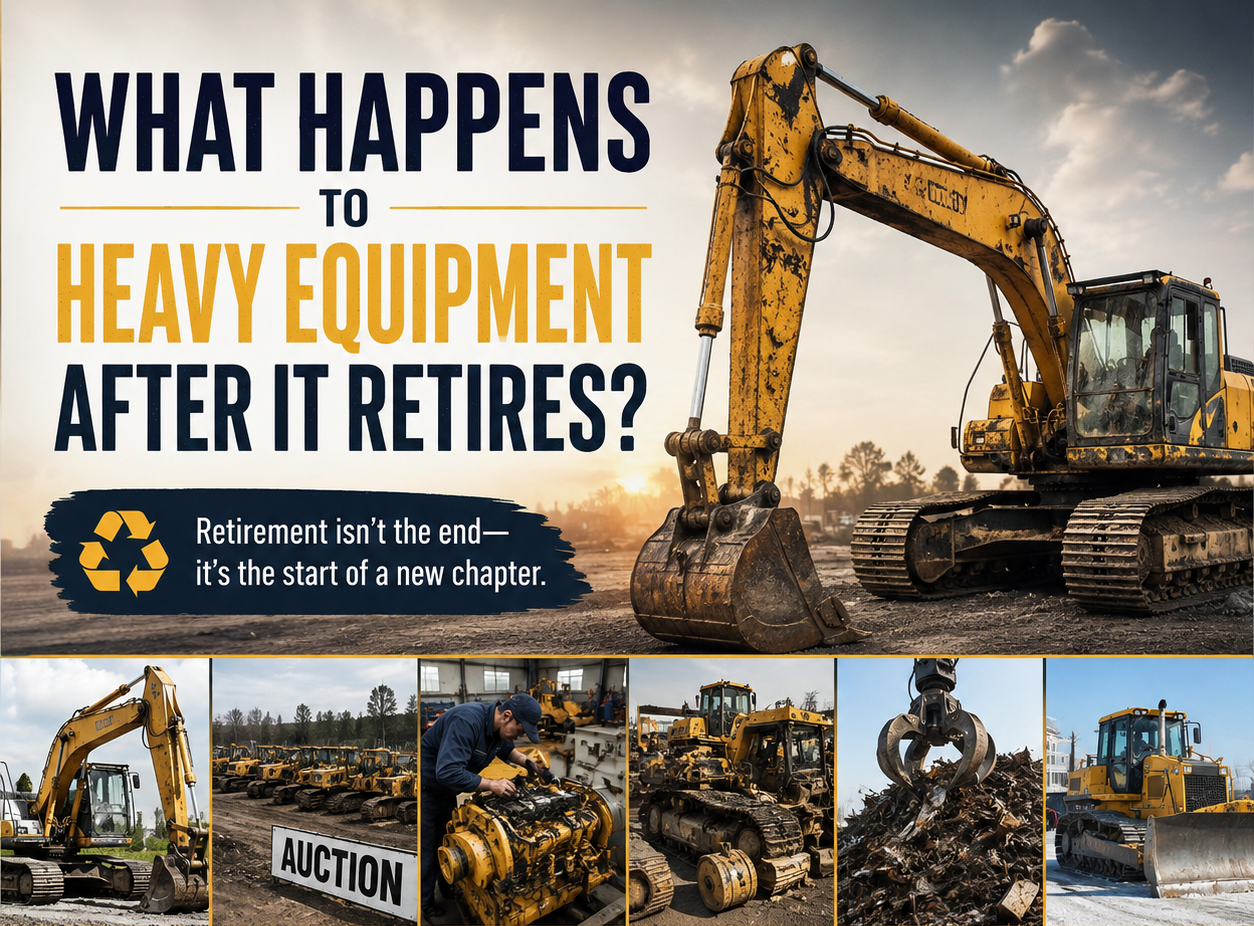
What Happens to Heavy Equipment After It Retires?
Heavy equipment doesn’t simply “disappear” when it reaches the end of its working life. Excavators, bulldozers, loaders, cranes, and graders are built to last for thousands of operating hours, but eventually wear, inefficiency, and maintenance costs push them toward retirement. What happens next depends on the machine’s condition, market demand, and the decisions of owners, dealers, and recyclers.
Here’s a look at the full lifecycle after heavy equipment is taken out of active service.
Resale Into Secondary Markets
Not all “retired” machines are actually done working.
Many units are sold into secondary or international markets where lower operating costs and less demanding workloads make continued use practical. A machine that’s no longer economical on a large North American construction site might still be valuable in:
- Small-scale construction operations
- Developing infrastructure projects
- Agricultural or forestry applications
- Rental fleets with light-duty cycles
Before resale, these machines are typically inspected, repaired, and sometimes refurbished to extend their usable life.
Auction or Dealer Liquidation
One of the most common outcomes is auction.
Retired machines are frequently sold through equipment auctions or dealer liquidation events. Buyers include contractors, fleet managers, and resellers looking for parts or rebuild candidates.
Auctions are especially common when companies:
- Upgrade entire fleets
- Close job sites or divisions
- Downsize operations
- Liquidate assets after bankruptcy or restructuring
Some machines sell “as-is,” while others have partial servicing or inspection reports attached.
Rebuild and Remanufacturing
If the core structure of the machine is still solid, it may be rebuilt instead of replaced.
Rebuild programs often include:
- Engine overhaul or replacement
- Hydraulic system refurbishment
- Electrical system upgrades
- Cabin restoration
- Structural reinforcement or repainting
Manufacturers and specialized shops sometimes offer “reman” programs where the machine is essentially restored to near-new condition. This option is often cheaper than buying new and extends the machine’s lifecycle significantly.
Parts Salvage
When a machine is too worn or damaged to justify repair, it may be dismantled for parts.
Usable components are removed and sold individually, including:
- Engines
- Hydraulic pumps and cylinders
- Undercarriages and tracks
- Attachments (buckets, blades, breakers)
- Electronic control modules
This process is highly efficient because even non-operational machines can contain thousands of dollars in reusable components.
Recycling and Scrap Processing
Once all usable parts have been stripped, the remaining machine is typically sent to a metal recycler.
Heavy equipment is mostly made of steel, iron, aluminum, and other recyclable metals. The process involves:
- Draining fluids and safely removing hazardous materials
- Dismantling large sections of the machine
- Crushing or shredding the remaining structure
- Separating metals for reuse in manufacturing
Recycling helps reduce environmental impact and feeds raw material back into industrial production cycles.
Conversion to Specialized or Non-Standard Use
Some retired machines find a “second life” outside traditional construction roles. Depending on design and condition, equipment may be repurposed for:
- Mining support roles
- Industrial material handling
- Snow removal or municipal use
- Stationary power or hydraulic systems
- Creative engineering projects or demonstrations
While less common, this path highlights the adaptability of heavy machinery.
Abandonment (Rare but Possible)
In rare cases—usually in remote locations or during project shutdowns—equipment may be abandoned. However, environmental regulations and scrap value make this increasingly uncommon. Most owners recover at least some value through resale or recycling.
Why Heavy Equipment Has Strong End-of-Life Value
Unlike many consumer machines, heavy equipment retains value even when it is no longer operational. That’s because:
- Steel and components are highly recyclable
- Parts demand is consistently strong
- Rebuild programs extend lifecycle economics
- Global secondary markets are active and competitive
This means “retirement” is rarely the end—it’s usually a transition into a new phase of value recovery.
Heavy equipment is engineered for longevity, and its retirement is more of a redistribution than an ending. Whether it’s rebuilt, parted out, auctioned, or recycled, these machines continue contributing value long after their final job on the construction site.
For owners and operators, understanding these end-of-life pathways can help maximize return on investment and make smarter fleet decisions over time.