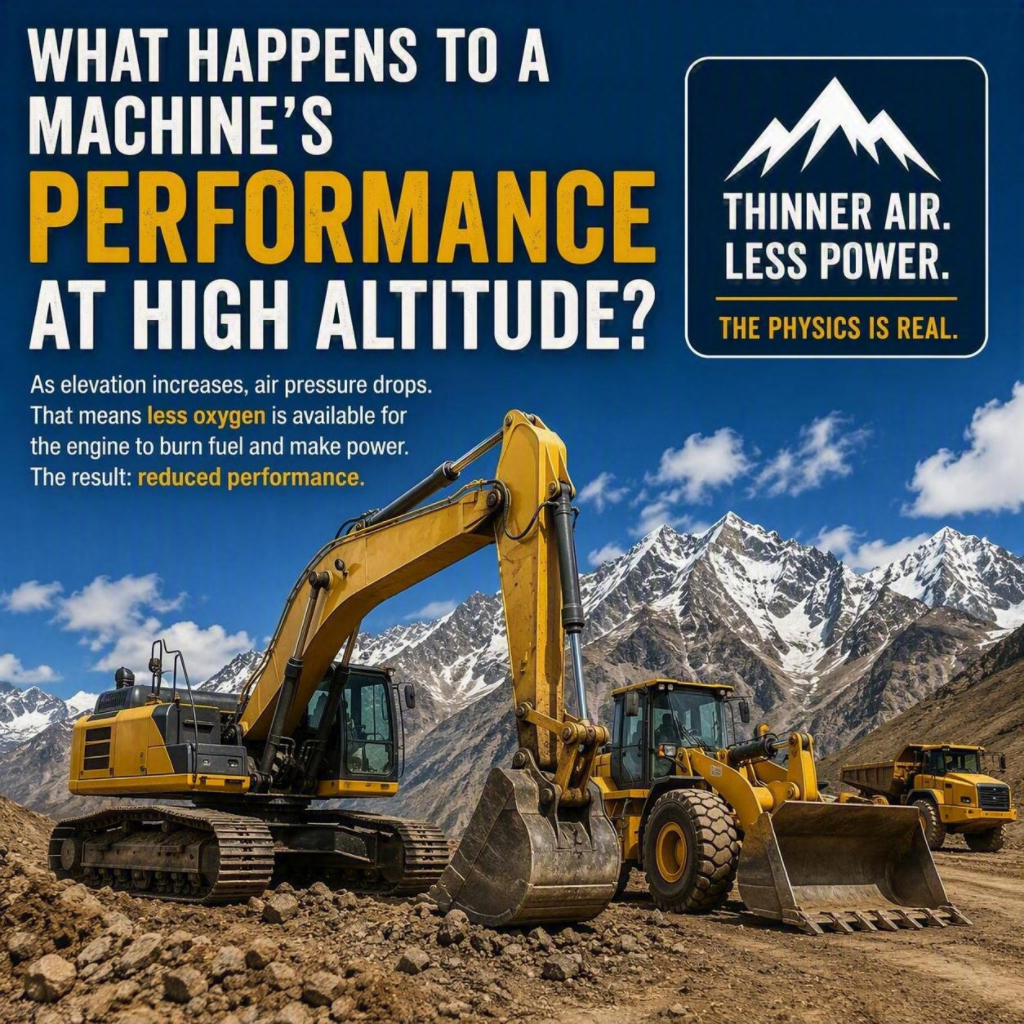
What Happens to a Machine’s Performance at High Altitude?
Take the same excavator, wheel loader, dozer, or haul truck from sea level and operate it several thousand feet higher, and you may notice something strange: the machine just doesn't seem to have the same power.
The engine hasn't changed. The hydraulic system hasn't changed. The machine may have been operating perfectly at sea level.
So what happened?
The answer is sitting in the air around you.
At high altitude, air pressure decreases, which means there is less oxygen available for the engine to use. For heavy equipment that relies on large diesel engines to produce serious horsepower, that thinner air can have a noticeable effect on performance.
Less Air Means Less Oxygen
A diesel engine needs three basic things to make power: fuel, oxygen, and compression.
Unlike a gasoline engine, a diesel doesn't normally control power by restricting the amount of incoming air. Instead, the engine takes in as much air as it can and controls power largely by changing how much fuel is injected.
At sea level, the atmosphere contains plenty of oxygen and provides relatively high air pressure.
As elevation increases, atmospheric pressure drops.
That means each intake stroke brings in fewer oxygen molecules than it would at sea level.
For example, air at roughly 10,000 feet contains significantly less oxygen per unit volume than air at sea level. The engine can still draw in roughly the same volume of air, but that air contains fewer oxygen molecules.
And that's where things get interesting.
Why Can't You Just Add More Fuel?
More fuel doesn't automatically mean more horsepower.
A diesel engine needs enough oxygen to burn that fuel efficiently. If the engine injects additional fuel without enough oxygen available, combustion becomes less efficient and exhaust temperatures can rise.
The result can be:
- Reduced horsepower
- Increased smoke
- Higher exhaust gas temperatures
- Reduced fuel efficiency
- Increased thermal stress
- Potential damage if the engine is operated improperly
Modern engines are designed to manage this problem electronically.
The engine control system can monitor air pressure, boost pressure, temperatures, fuel delivery and other parameters, then adjust fueling to keep the engine operating within its limits.
Older mechanically governed engines may not have the same level of automatic compensation.
Turbochargers Help—But They Don't Defeat Physics
This is where the turbocharger becomes extremely important.
A turbocharger uses exhaust energy to spin a turbine, which drives a compressor. The compressor forces more air into the engine than it could normally draw in naturally.
That additional air helps compensate for the lower atmospheric pressure at altitude.
This is why turbocharged diesel engines generally handle high altitude much better than naturally aspirated engines.
But a turbocharger doesn't make altitude irrelevant.
The turbocharger has to work harder to achieve the required boost pressure when the surrounding atmospheric pressure is lower.
Imagine trying to inflate a tire. At sea level, the compressor starts with relatively high-pressure air. At high altitude, it starts with lower-pressure air and has to compress it further to deliver the same absolute pressure to the engine.
That can increase turbocharger speed and thermal load.
The Intercooler Matters Too
Turbocharging compresses air, and compressing air makes it hotter.
Hot air is less dense than cooler air, which means it contains fewer oxygen molecules for the same volume.
That's why many heavy equipment engines use an intercooler or charge-air cooler.
The system cools the compressed intake air before it enters the engine. Cooler air is denser, allowing more oxygen to enter the cylinders.
At high altitude, maintaining effective charge-air cooling becomes particularly important because the turbocharger may be working harder.
So a machine operating at elevation isn't simply dealing with "less oxygen." It's dealing with an entire chain of changes involving atmospheric pressure, turbocharger operation, intake temperature and engine management.
Horsepower Can Drop
The exact performance loss depends heavily on the engine and its design.
A naturally aspirated engine can experience a substantial reduction in available power as altitude increases.
Turbocharged and electronically controlled engines are much better at compensating, but they can still eventually reach a point where they cannot maintain their rated sea-level power.
Manufacturers sometimes provide altitude derating information for their engines and machines.
This is important because two machines with the same horsepower rating at sea level may behave quite differently at 8,000 or 10,000 feet.
One may maintain most of its rated power while another experiences a noticeable reduction.
Hydraulics Can Be Affected—But Not Directly by Thin Air
It's easy to assume that high altitude automatically makes hydraulic systems weaker.
That's not quite how it works.
A hydraulic pump doesn't suddenly lose hydraulic pressure simply because the machine is sitting at a higher elevation.
However, the engine driving that pump may have less available power.
If the engine can't produce the same horsepower, there may be less power available to operate hydraulic functions simultaneously.
For example, an excavator might still produce the hydraulic pressure required to operate a function, but the engine may struggle more when the operator is:
- Swinging the machine
- Traveling
- Operating the boom
- Crowding the bucket
- Running multiple hydraulic functions simultaneously
The operator may notice that the machine feels slower or struggles more under combined loads.
The hydraulic system isn't necessarily the problem. The engine may simply have less power available to drive it.
Cooling Can Become More Difficult
Here's another high-altitude problem that doesn't always get enough attention.
Lower atmospheric pressure means there is less air mass moving through the cooling system for a given volume of airflow.
That can reduce the effectiveness of the radiator and other heat exchangers.
At the same time, the engine may be working harder to maintain performance because the turbocharger is working harder and the available oxygen is reduced.
That combination can increase the importance of keeping the cooling system clean and functioning properly.
A plugged radiator, dirty charge-air cooler, restricted air filter or damaged fan can become much more significant when a machine is already operating in a challenging environment.
Air Filters Become Even More Important
A dirty air filter is never a good thing.
At high altitude, however, restricting the engine's already limited airflow can make the situation worse.
The engine needs to move a significant amount of air to produce power. Any unnecessary restriction makes it harder for the turbocharger and engine to get the air they need.
This is one reason altitude work makes basic maintenance particularly important.
A machine headed into the mountains should not be treated exactly like a machine working at sea level.
Check the:
- Air filter
- Intake system
- Turbocharger
- Charge-air cooler
- Radiator
- Cooling fan
- Belts and hoses
- Engine oil and filters
A small maintenance problem at sea level can become a much bigger performance problem at elevation.
It's Not Just the Engine
High altitude can affect more than engine performance.
Depending on the machine and operating environment, operators may also encounter changes involving:
Starting: Cold temperatures commonly associated with high elevations can make starting more difficult.
Cooling: Reduced air density can affect heat rejection.
Fuel consumption: The engine's operating strategy and load can affect fuel consumption as it works to maintain performance.
Turbocharger operation: The turbocharger may operate at higher speeds or pressures to compensate for reduced atmospheric pressure.
Hydraulic performance: Reduced engine power can limit how much hydraulic work can be performed simultaneously.
Machine productivity: Cycle times can increase when the engine is unable to maintain the same power under heavy loads.
For a haul truck climbing a long grade, these differences can become particularly obvious.
The Operator May Notice It Before the Numbers Do
One of the interesting things about altitude is that an experienced operator may recognize the problem before looking at a gauge.
The machine may feel different.
A loader might take longer to accelerate with a full bucket. A dozer may lose some pushing ability. An excavator may feel less responsive when several hydraulic functions are being used together.
A haul truck may require lower gears on a grade it normally climbs without difficulty.
None of these necessarily mean the machine has developed a mechanical problem.
Sometimes, the machine is simply operating in an environment where its engine cannot produce the same amount of power it could at sea level.
Altitude Ratings Matter
When equipment is being sent to a high-elevation project, altitude should be considered during equipment selection.
Manufacturers may specify maximum operating elevations, power derating schedules or special configurations for high-altitude applications.
Some engines and machines can be configured specifically for high-altitude operation.
This is especially important for equipment that will spend its entire working life at elevation rather than simply making an occasional trip into the mountains.
A machine selected for a project at 10,000 feet should not necessarily be chosen based solely on its sea-level horsepower rating.
So How High Is "High Altitude"?
There isn't a single elevation where every machine suddenly starts losing power.
The effects begin gradually as atmospheric pressure decreases.
For some equipment, the difference may be barely noticeable at a few thousand feet. At much higher elevations, however, the effects can become significant.
The exact point depends on:
- Engine design
- Turbocharger configuration
- Engine controls
- Rated power
- Cooling system
- Manufacturer's altitude strategy
- Machine load
- Ambient temperature
And remember that altitude and temperature can compound each other.
A machine working at high elevation on a hot day can face a much more demanding situation than the same machine working at that elevation on a cool day.
The Bottom Line
High altitude doesn't make a machine "weak." It changes the environment in which the machine has to produce its power.
Less atmospheric pressure means less oxygen entering the engine.
Turbochargers, intercoolers and electronic engine controls compensate for much of that loss, but they have limits. Eventually, the engine may have to be derated to keep temperatures, pressures and combustion within safe operating parameters.
For heavy equipment operators, the practical lesson is simple:
Know the altitude. Know the machine's rating. And don't assume that a machine producing 400 horsepower at sea level will necessarily produce the same performance on top of a mountain.
At elevation, the air may be thinner—but the workload certainly isn't.