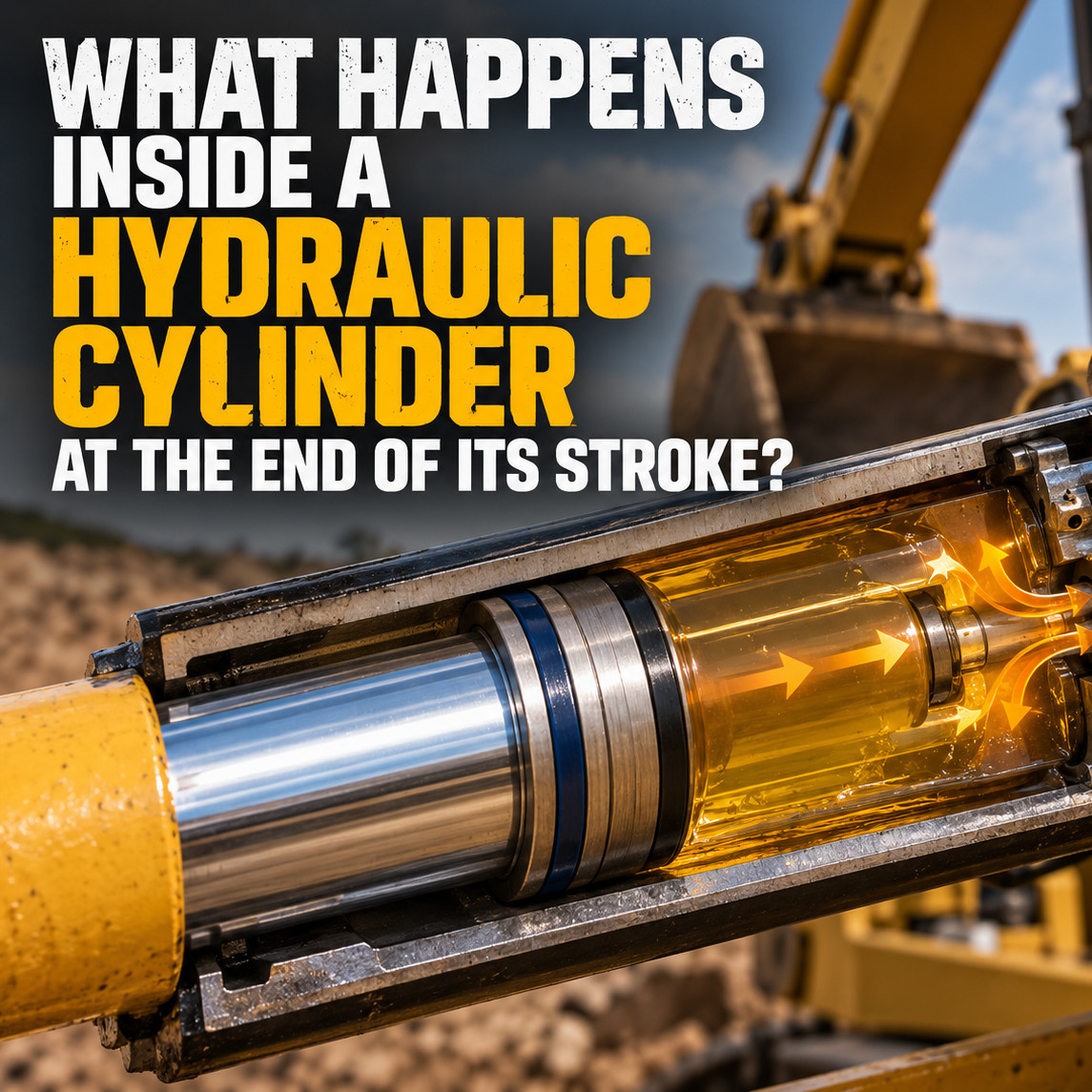
What Happens Inside a Hydraulic Cylinder at the End of Its Stroke?
A hydraulic cylinder looks deceptively simple. Pressurized oil enters one side, a piston moves through the barrel, and the rod extends or retracts. But what happens when that piston reaches the end of its available travel?
If you've ever operated an excavator, loader, dozer or other hydraulic machine, you've probably felt it happen. The attachment reaches its limit, movement stops, and the hydraulic system may briefly change sound as pressure rises.
Inside the cylinder—and elsewhere in the hydraulic circuit—several things can happen in a very short period of time.
The Piston Reaches the End of Its Travel
Inside a typical double-acting hydraulic cylinder, the piston divides the cylinder barrel into two chambers. Hydraulic oil is directed into one chamber while oil from the opposite chamber is allowed to return to the hydraulic system.
As oil enters, pressure acting against the piston creates force and moves the piston and rod.
Eventually, however, the piston runs out of room.
At full extension or full retraction, the piston reaches the physical limit designed into the cylinder. The rod can no longer move in that direction.
But the hydraulic pump may still be trying to supply oil.
That's where things get interesting.
The Oil Doesn't Simply Stop Being Pressurized
Hydraulic oil is often described as incompressible. In practical hydraulic calculations that's a useful assumption, although real hydraulic fluid does compress slightly under high pressure, and hoses and other components can expand slightly as well.
When the cylinder stops moving but the control valve continues commanding movement, pump flow can no longer produce additional cylinder travel.
Pressure in that portion of the hydraulic circuit rises rapidly.
This condition is sometimes referred to as deadheading the cylinder.
The cylinder isn't creating additional movement, but the hydraulic system is still producing pressure.
Without some method of limiting that pressure, components could be damaged.
The Relief System Takes Over
Hydraulic systems are designed with pressure-control mechanisms to prevent pressure from climbing indefinitely.
Depending on the machine and circuit design, this may involve a main system relief valve, port relief valve, pump pressure control or a combination of components.
Once pressure reaches the system's predetermined limit, the hydraulic system responds.
On a conventional open-center system, for example, a relief valve may open and divert excess pump flow back toward the tank. On many modern machines using variable-displacement pumps and load-sensing or pressure-compensated systems, the pump can reduce its displacement when the required pressure is reached.
Either way, the basic goal is the same:
Stop pressure from exceeding what the hydraulic system is designed to handle.
That doesn't mean holding a cylinder against its stop is harmless.
Maintaining a hydraulic command after the cylinder has reached the end of its stroke can waste energy and generate heat. Depending on the hydraulic design, oil may be flowing across a relief valve or the pump may remain at high pressure while reducing its output.
That's one reason experienced operators generally don't hold a hydraulic function against its mechanical limit unnecessarily.
What About the Impact Inside the Cylinder?
Pressure isn't the only issue.
A heavily loaded piston moving quickly through a cylinder has momentum. If it simply slammed into the end of its travel at full speed, the resulting shock could place considerable stress on the cylinder and connected components.
Some hydraulic cylinders therefore incorporate end-of-stroke cushioning.
A cushioned cylinder deliberately slows the piston during the final portion of its travel.
One common design uses a cushion spear or plunger attached to the piston assembly. As the piston approaches the end cap, the cushion component enters a corresponding passage and restricts the normal route for outgoing oil.
The remaining oil must escape through a smaller, controlled passage.
That restriction creates backpressure, which decelerates the piston before it reaches the end of its stroke.
Instead of:
move → move → move → STOP
the piston experiences something closer to:
move → move → slow → stop
The operator may barely notice it, but inside the cylinder the difference can be significant.
Not Every Cylinder Is Cushioned
End-of-stroke cushioning isn't required—or desirable—in every hydraulic cylinder.
Cylinder design depends on the machine, expected loads, operating speed, duty cycle and how the equipment is intended to function.
In some applications, external machine geometry, hydraulic control systems or other components manage deceleration instead. Electronic controls can also reduce hydraulic flow as a machine approaches certain limits.
Modern equipment may combine hydraulic and electronic strategies to produce smoother movement while protecting components.
The result is that two cylinders that look similar from the outside may behave quite differently near the end of their strokes.
Why Does a Machine Sometimes Jolt at Full Stroke?
If a hydraulic function hits its limit abruptly, several factors could be involved.
The cylinder may not have internal cushioning. The operator may be commanding the function at high speed. The load may have significant momentum. The machine's hydraulic controls may not provide automatic deceleration.
Wear or damage can also change how a cylinder behaves.
On cylinders equipped with cushioning, problems with cushion components or internal wear may make the end of the stroke feel harsher than intended.
There's another factor: hydraulic shock.
Rapidly stopping moving oil can create short-duration pressure spikes. Hydraulic systems are designed to tolerate normal transient pressures, but repeated severe shock loads aren't desirable for hoses, fittings, seals, valves or cylinder components.
It's one reason smooth hydraulic operation isn't simply about operator comfort. It can affect machine longevity.
What Happens to the Cylinder Seals?
At the end of the stroke, cylinder pressure may be near the machine's maximum operating pressure—especially if the operator continues holding the control.
That pressure acts on the piston seals and, depending on the direction of movement, other sealing components within the cylinder.
Healthy seals are designed to handle normal system pressures. But repeated pressure spikes, excessive temperatures, contamination and operation beyond design limits can accelerate wear.
Over time, piston seals may begin allowing oil to bypass internally.
When that happens, a cylinder may struggle to hold a load or may slowly drift even though there is no obvious external leak.
A cylinder can therefore be leaking hydraulically without leaving a puddle underneath the machine.
The Rod End and Cap End Behave Differently
There's another interesting detail hidden inside a hydraulic cylinder.
The two sides of the piston don't have equal effective areas.
On the cap end, hydraulic pressure generally acts against the full piston area. On the rod end, the rod occupies part of that area.
That difference affects both cylinder force and speed.
For the same pressure, a typical single-rod cylinder can produce greater force while extending than while retracting because pressure on the cap end acts over a larger effective area.
For a given flow rate, however, the smaller effective area on the rod side generally means the cylinder retracts faster than it extends.
These differences also influence what happens dynamically as the piston approaches either end of its stroke.
Why Operators Should Care
Reaching the end of a cylinder's stroke is completely normal. Excavators curl buckets fully. Loaders reach lift limits. Dozers angle blades. Dump bodies extend their hoist cylinders.
The problem isn't reaching the end.
It's what happens after the cylinder gets there.
Continuing to command a hydraulic function against its limit can keep the hydraulic system operating at very high pressure without accomplishing useful work. Depending on the system design, that energy ultimately becomes heat and additional stress on hydraulic components.
Repeated unnecessarily aggressive operation can contribute to higher oil temperatures and increased wear.
Smooth operation isn't just about looking skilled from the cab. It's also about understanding what the machine is doing underneath you.
A Lot Happens in the Last Few Millimetres
From the operator's seat, the end of a hydraulic cylinder's stroke may feel like nothing more than the attachment reaching its limit.
Inside the machine, it's much more complicated.
The piston reaches the end of its available travel. Moving oil must decelerate. Pressure rises. Cushioning may slow the piston. Pressure-control components protect the circuit. The pump or relief system reacts to a command that can no longer produce movement.
All of it can happen almost instantly.
A hydraulic cylinder may be one of the simplest-looking components on a piece of heavy equipment, but those final few millimetres of travel reveal just how much engineering is hiding inside it.