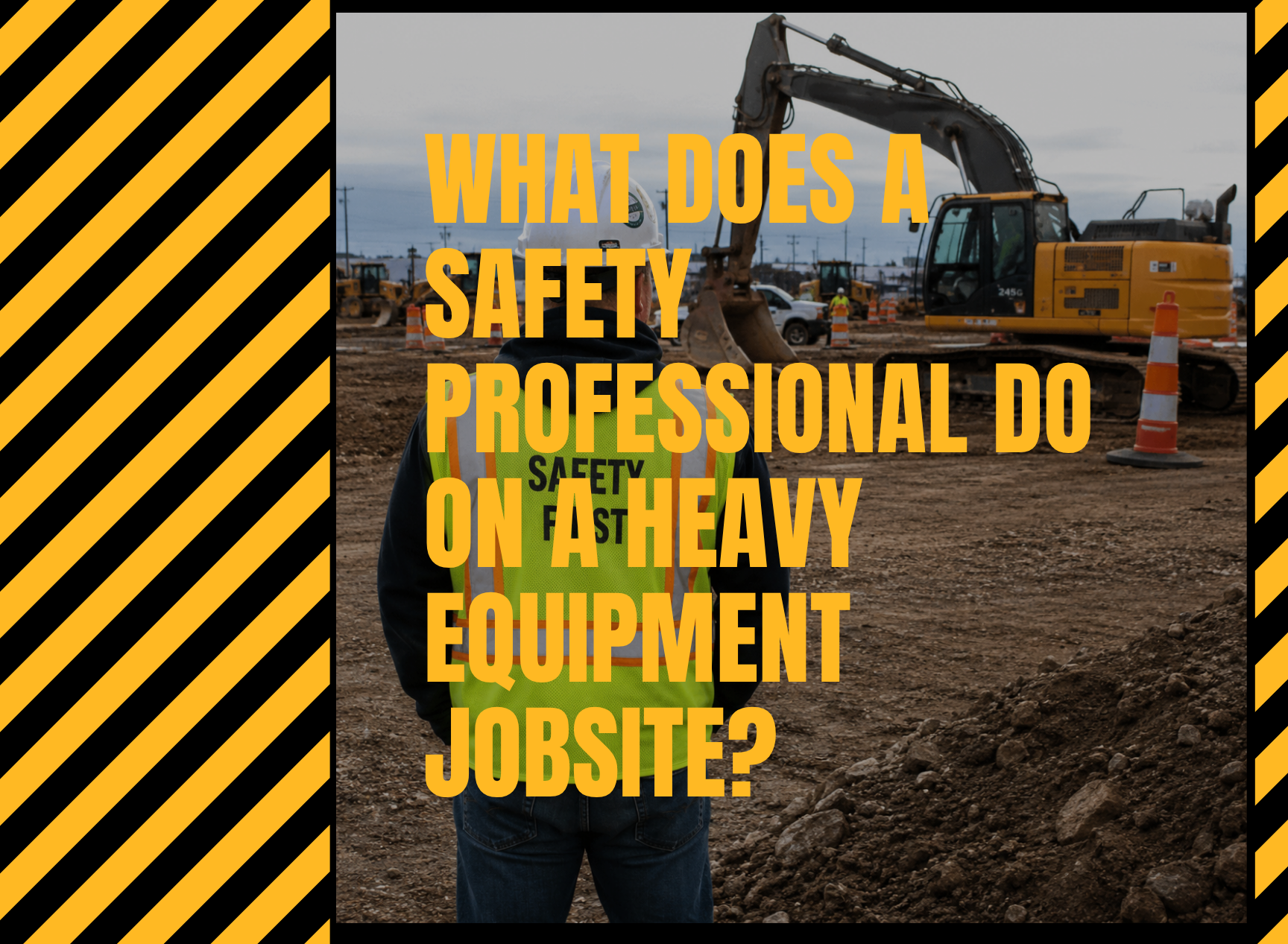
What Does a Safety Professional Do on a Heavy Equipment Jobsite?
Walk onto a heavy equipment jobsite and you’ll see operators moving dirt, trucks hauling material, mechanics working on machines, supervisors coordinating crews, and workers completing dozens of tasks at once.
You may also see someone wearing a different-colored vest, carrying a clipboard or tablet, walking around the site and talking to workers.
So, what exactly does that person do?
A Safety Professional is there to help identify hazards, prevent injuries, ensure regulatory requirements are being met, and help everyone go home safely at the end of the day.
But the job is much more than simply handing out safety violations or telling people to wear their PPE.
Safety Starts Before the Equipment Starts
A good safety professional isn't waiting for something to go wrong.
Much of the work happens before the crew even starts working.
Depending on the type of project, a safety professional may review:
- Job hazard analyses (JHAs) or hazard assessments
- Safe work procedures
- Equipment inspection requirements
- Emergency response plans
- Traffic control plans
- Fall protection plans
- Lockout/tagout procedures
- Ground disturbance procedures
- Environmental conditions
- Worker training and competency
- Site-specific safety requirements
The goal is to identify potential problems before someone gets hurt.
For example, if an excavator will be working near a trench, the safety professional may look at the excavation, access and egress, overhead hazards, underground utilities, equipment positioning, spoil pile locations, and the potential for workers to enter the equipment's swing radius.
That's prevention—not paperwork for the sake of paperwork.
Walking the Jobsite
One of the most visible parts of a safety professional's job is the site inspection.
But a site walk isn't simply a search for someone who forgot their safety glasses.
A safety professional may be looking at the entire operation.
They might ask:
- Are workers positioned safely around operating equipment?
- Are pedestrians separated from mobile equipment?
- Are equipment operators maintaining adequate visibility?
- Are seat belts being used?
- Are machines being inspected before use?
- Are workers staying outside swing and travel zones?
- Are excavations properly protected?
- Are access routes safe?
- Are materials stored securely?
- Are housekeeping standards being maintained?
- Are workers following established procedures?
- Have site conditions changed since the work began?
Conditions can change quickly on a heavy equipment site.
A work area that was safe at 8:00 a.m. might look very different at 2:00 p.m. after several machines have moved material, a trench has become deeper, or weather conditions have changed.
That's why safety needs to be an ongoing process.
Watching the Work, Not Just the Workers
A common misconception is that safety professionals are primarily watching workers to catch them doing something wrong.
The better approach is to observe the work system.
If an operator repeatedly has difficulty seeing pedestrians around a machine, the solution may not simply be telling the operator to "be more careful."
There may be a larger problem.
Could the work area be redesigned?
Could pedestrians be separated from equipment?
Could additional communication methods be used?
Could the machine be repositioned?
Could the traffic pattern be changed?
Could visibility be improved?
A strong safety professional looks beyond the immediate behavior and asks:
"Why is this happening, and what can we do to prevent it?"
Working With Equipment Operators
Heavy equipment operators are highly skilled professionals.
A safety professional should understand that operators often have valuable knowledge about the hazards associated with their equipment and work environment.
An operator may notice things that aren't obvious to someone standing outside the machine.
For example, an operator may know that:
- A particular access route creates a blind spot.
- Ground conditions become unstable after rain.
- A machine behaves differently when working on a slope.
- Another piece of equipment routinely enters an unsafe area.
- A particular attachment creates visibility problems.
- A specific task requires workers to approach the machine in a certain way.
Safety professionals should listen to that experience.
Safety works best when it's a conversation—not a lecture.
Training and Communication
Safety professionals are often responsible for helping make sure workers understand the hazards associated with their jobs.
This can include:
- Orientation for new workers
- Toolbox talks
- Pre-job meetings
- Equipment-specific training
- Emergency procedures
- Hazard communication
- PPE requirements
- Refresher training
- Incident lessons learned
Training isn't simply about checking a box.
The objective is to make sure workers understand what the hazard is, why it matters, and what they need to do about it.
Investigating Incidents
Unfortunately, even good safety programs don't guarantee that incidents will never happen.
When an incident occurs, a safety professional may be involved in the response and investigation.
That can include determining:
- What happened?
- Who was involved?
- Where did it happen?
- What was happening immediately before the incident?
- What equipment or materials were involved?
- Were procedures being followed?
- Were there environmental or site conditions that contributed?
- Were there communication problems?
- Were there training or competency issues?
- What underlying factors contributed to the event?
- What can be done to prevent a recurrence?
The purpose of a good investigation shouldn't be to automatically find someone to blame.
It's to understand what happened well enough to prevent it from happening again.
Emergency Response
When something goes wrong, the safety professional may become heavily involved in the emergency response.
Depending on the site and the situation, this could involve coordinating or supporting:
- First aid
- Emergency medical services
- Evacuations
- Site shutdowns
- Equipment isolation
- Rescue operations
- Communication with supervisors and management
- Scene preservation
- Incident documentation
- Regulatory notifications
This is one reason emergency plans need to exist before an emergency happens.
When someone is injured, there isn't time to figure out what everyone is supposed to do.
Documentation and Records
Yes, there is paperwork.
Safety professionals may be responsible for maintaining or reviewing records such as:
- Inspection reports
- Training records
- Incident reports
- Corrective actions
- Hazard assessments
- Safety meeting records
- Equipment documentation
- Permits
- Audits
- Regulatory documentation
It may not be the most exciting part of the job, but documentation can be extremely important.
It provides evidence of what was identified, what actions were taken, and whether those actions were completed.
Working With Supervisors and Management
Safety isn't solely the responsibility of the safety department.
Supervisors, managers, project managers, equipment operators, mechanics, laborers, and contractors all have roles to play.
A safety professional may work with supervisors to address hazards, improve procedures, investigate incidents, or develop controls for particularly high-risk work.
They may also advise management about regulatory requirements, safety performance, training needs, and emerging risks.
Importantly, the safety professional generally shouldn't be the only person responsible for making the jobsite safe.
Safety is a shared responsibility.
Stopping Work When Necessary
There are situations where a safety professional may recommend—or have the authority under company procedures to require—that work stop.
This might happen when there is an immediate and serious danger to workers.
For example:
- An unstable excavation
- A serious electrical hazard
- An uncontrolled equipment movement
- A dangerous lifting operation
- Severe weather
- An uncontrolled hazardous energy source
- A missing critical protective system
Stopping work isn't about being difficult.
If continuing the task could result in someone being seriously injured or killed, taking a pause to address the hazard may be the safest decision anyone on the site can make.
A Safety Professional Isn't There to Make the Job Harder
This is probably one of the biggest misconceptions about safety professionals.
Nobody enjoys unnecessary paperwork, pointless rules, or being stopped over something that doesn't actually create a meaningful hazard.
Good safety professionals understand that production matters.
Projects have schedules. Equipment costs money to operate. Crews have deadlines. Customers are waiting.
The goal isn't to prevent people from getting work done.
The goal is to help them get the work done without someone getting hurt in the process.
The best safety programs don't put safety and productivity on opposite sides of the table.
They find ways to make the work safer and more efficient.
The Best Safety Professionals Build Relationships
A safety professional can have an impressive collection of certifications and years of experience, but technical knowledge isn't enough.
They also need to be able to communicate.
A good safety professional should be willing to walk up to an operator and have a conversation rather than immediately start writing someone up.
They should be willing to listen.
They should be willing to admit when they don't know something.
And they should understand that the people performing the work every day often have valuable insight into the hazards involved.
Trust is one of the most powerful tools in a safety professional's toolbox.
When workers trust their safety professional, they're more likely to report hazards, ask questions, and speak up when something doesn't feel right.
That's exactly what you want.
Safety Isn't About Having Zero Problems
A jobsite where nobody reports hazards isn't necessarily a safe jobsite.
It could simply mean nobody feels comfortable reporting them.
A healthy safety culture encourages workers to speak up.
If an operator says, "Something doesn't look right with this setup," the response shouldn't be punishment for slowing down the job.
It should be:
"Let's take a look."
Finding a hazard before it causes an incident is a success—not a failure.
The Bottom Line
So, what does a safety professional do on a heavy equipment jobsite?
They inspect. They observe. They train. They investigate. They communicate. They document. They help develop procedures. They respond to emergencies. They work with operators and supervisors. And when necessary, they help stop dangerous work before someone gets hurt.
But perhaps their most important job is something that isn't always visible.
They're trying to identify the things that could hurt someone before those things have the opportunity to do it.
On a heavy equipment jobsite, where massive machines, moving vehicles, changing ground conditions, excavations, lifting operations, and numerous other hazards can exist simultaneously, that job matters.
Because at the end of the shift, the most important piece of equipment on the site isn't the excavator, dozer, grader, or loader.
It's the person operating it.