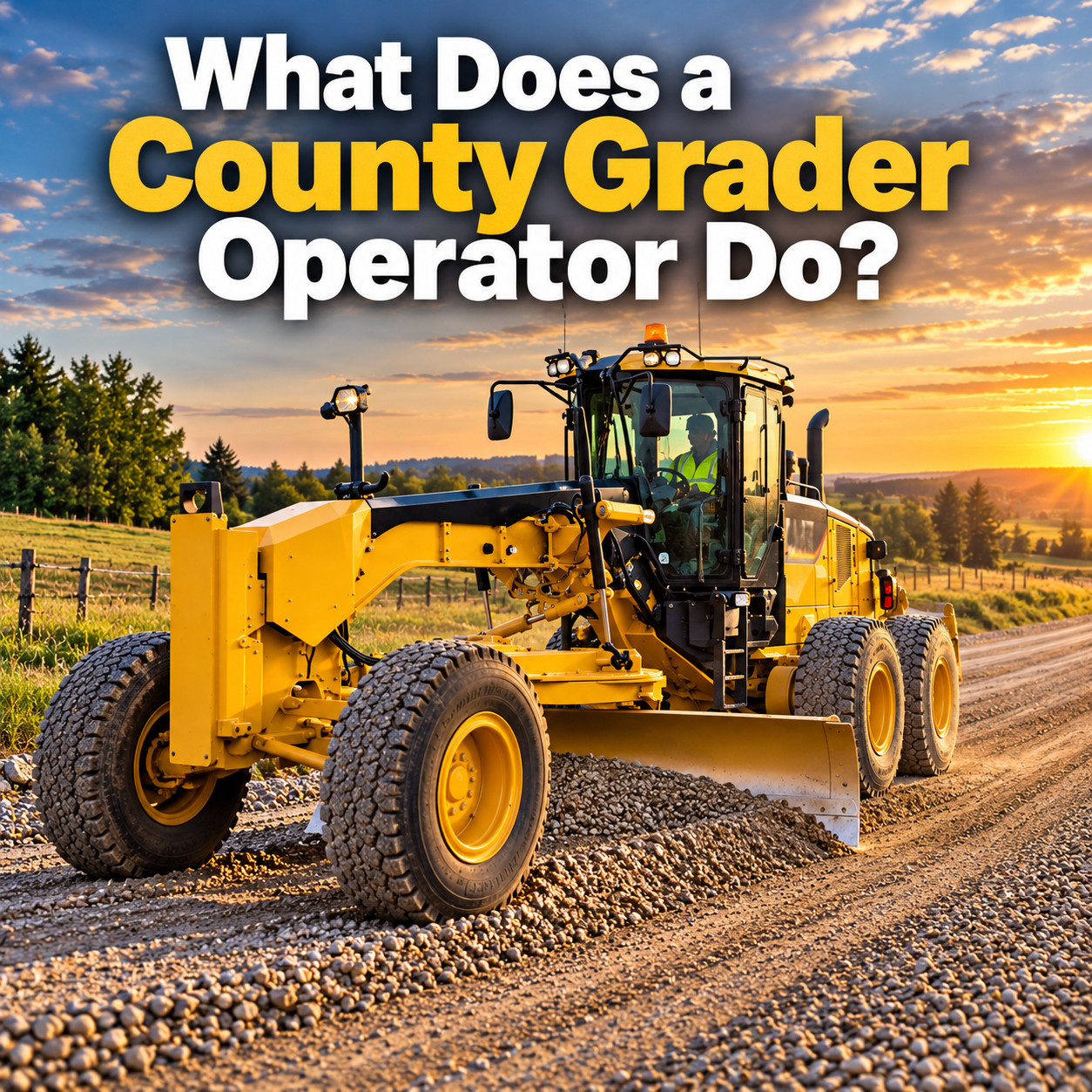
What Does a County Grader Operator Do?
Drive through a rural county and you may barely notice the gravel road beneath your tires—until it gets rough.
Keeping hundreds or even thousands of kilometres of unpaved roads passable is an ongoing job, and one of the most important machines involved is the motor grader. Behind the controls is a grader operator whose work involves far more than simply dragging a blade down the road.
A good county grader operator is part equipment operator, part road builder, part problem solver and, occasionally, part weather forecaster.
Maintaining the Road Surface
The most visible part of the job is maintaining gravel roads.
Traffic, weather and water constantly change the road surface. Vehicles create ruts and washboards. Heavy trucks can push material around. Rain produces soft spots, erosion and potholes. Dry weather can loosen aggregate and create dust.
The grader operator's job is to reshape that surface.
That can mean cutting out potholes rather than simply filling them, removing washboarding, pulling displaced gravel back toward the travelled portion of the road and redistributing material where it is needed.
The goal isn't necessarily to make the road perfectly flat.
In fact, a perfectly flat gravel road can be a problem.
Building and Maintaining the Crown
Most gravel roads are intentionally constructed with a crown, meaning the centre of the road is slightly higher than the edges.
That shape allows water to run toward the shoulders and into the drainage system instead of sitting on the road.
Maintaining that crown is one of the grader operator's most important responsibilities.
Too little crown and water may remain on the road, weakening the surface and contributing to potholes and rutting. Too much crown can make the road uncomfortable to drive and potentially create handling problems.
Experienced operators learn to recognize the shape of the road from the cab and make small adjustments to blade angle, pitch and position as they travel.
Reading the Material
Gravel doesn't behave the same way every day.
Moisture content can dramatically change how easily material cuts, rolls and compacts. Material that works beautifully after a light rain may behave completely differently during a prolonged dry spell.
The operator needs to watch how the aggregate is moving across the moldboard.
Is it rolling properly?
Is the blade cutting too deeply?
Is material spilling somewhere it shouldn't?
Is there enough moisture to reshape the road effectively?
These observations influence constant adjustments to speed, articulation, wheel lean, blade angle and cutting depth.
Grading is rarely a matter of finding one setting and leaving it there.
Dealing With Washboards and Potholes
One of the challenges of gravel-road maintenance is that simply smoothing over a defect may not actually repair it.
Take washboarding.
Those familiar repeating ridges can quickly return if an operator merely skims across their tops. Correcting severe washboarding can require cutting deeply enough to remove the pattern before the material is redistributed.
Potholes present a similar problem.
Pulling loose gravel across the top of a pothole may make the road look better temporarily, but traffic can quickly push that loose material back out. Effective maintenance may require cutting into the affected area and rebuilding the surface.
That takes judgement—and sometimes patience.
Managing the Shoulders
The edge of the road matters almost as much as the middle.
Over time, material can accumulate along the shoulder and form a ridge or berm. That ridge may prevent water from leaving the roadway.
A grader operator may need to reshape the shoulder so water can move away from the driving surface.
But this requires care.
Cut too aggressively and the operator can remove valuable road material, damage the shoulder or create an unsafe drop-off. The goal is to maintain drainage while preserving the structure of the roadway.
Maintaining Ditches and Drainage
Water is one of the biggest enemies of an unpaved road.
That's why county grader work can extend beyond the travelled surface.
Depending on the road and the municipality's maintenance practices, graders may be used to clean or reshape shallow ditches, maintain drainage paths and correct areas where water is being trapped.
Operators also need to recognize when a problem isn't something the grader should fix.
A blocked culvert, major washout, unstable slope or significant drainage failure may require excavators, loaders, trucks or a dedicated road crew.
Knowing when not to keep grading is part of the job too.
Working Around Approaches, Culverts and Intersections
A long, straight stretch of road may be relatively straightforward.
Then comes a driveway.
Then another driveway.
Then an intersection.
Then a culvert.
The operator has to transition through these areas without leaving windrows of gravel where they shouldn't be, blocking drainage or creating abrupt changes in the road surface.
Intersections can be particularly demanding because the grader is suddenly dealing with material moving in several directions while trying to maintain proper road geometry.
The operator is continuously thinking several metres ahead of the blade.
Recovering Gravel From the Road Edge
Traffic gradually moves aggregate toward the outside of the roadway.
Depending on conditions and local maintenance practices, operators may periodically pull usable material back toward the road.
This is one reason grader passes don't always look the same.
One day an operator may primarily be smoothing and maintaining the existing surface. Another operation may involve recovering material, reshaping the crown or performing more substantial maintenance.
The blade position tells part of the story about what the operator is trying to accomplish.
Snow Removal Can Be Part of the Job
In colder regions, the same grader that maintains gravel roads during summer may be working in snow during winter.
Graders can be particularly useful for removing packed snow, widening roads and cutting back accumulated material.
But winter grading presents its own challenges.
The operator needs to understand where the actual road edge is beneath the snow, avoid roadside infrastructure and recognize hazards that may no longer be visible.
A ditch that is obvious in July can look like perfectly level ground in January.
The Operator Is Constantly Adjusting the Machine
Watching an experienced grader operator can make the job look deceptively simple.
It isn't.
The operator may simultaneously control steering, articulation, wheel lean, moldboard angle, sideshift, blade lift and blade pitch while watching traffic, road edges, material flow and changing terrain.
Modern graders may add automated grade-control features and other electronic assistance, but the operator still needs to understand what the machine is doing and why.
On gravel-road maintenance, much of the finished result still depends on judgement.
Every Road Is Different
One road may carry mostly passenger vehicles.
Another may regularly see loaded grain trucks, logging trucks, oilfield traffic, construction equipment or farm machinery.
Some roads sit on excellent foundations. Others develop recurring soft spots every spring. Certain sections dry quickly while shaded sections remain wet. Hills, curves and intersections create additional maintenance challenges.
Over time, operators become familiar with their routes.
They know which hill tends to wash out.
They know where gravel disappears fastest.
They know which section develops washboards.
They may even know which pothole seems determined to return no matter how many times it is repaired.
That local knowledge can be just as valuable as knowing how to operate the grader.
There Is More Skill in a Gravel Road Than You Might Think
A freshly graded road can look simple when the work is finished.
That's partly the point.
The crown isn't supposed to attract attention. Neither is a properly shaped shoulder or a smooth transition through an intersection. Drivers generally notice road maintenance only when something goes wrong.
But creating that seemingly simple surface requires an operator to understand the machine, the material, drainage, road geometry, weather and traffic.
A county grader operator isn't just smoothing gravel.
They're continually rebuilding a road surface that traffic and nature are continually trying to tear apart.