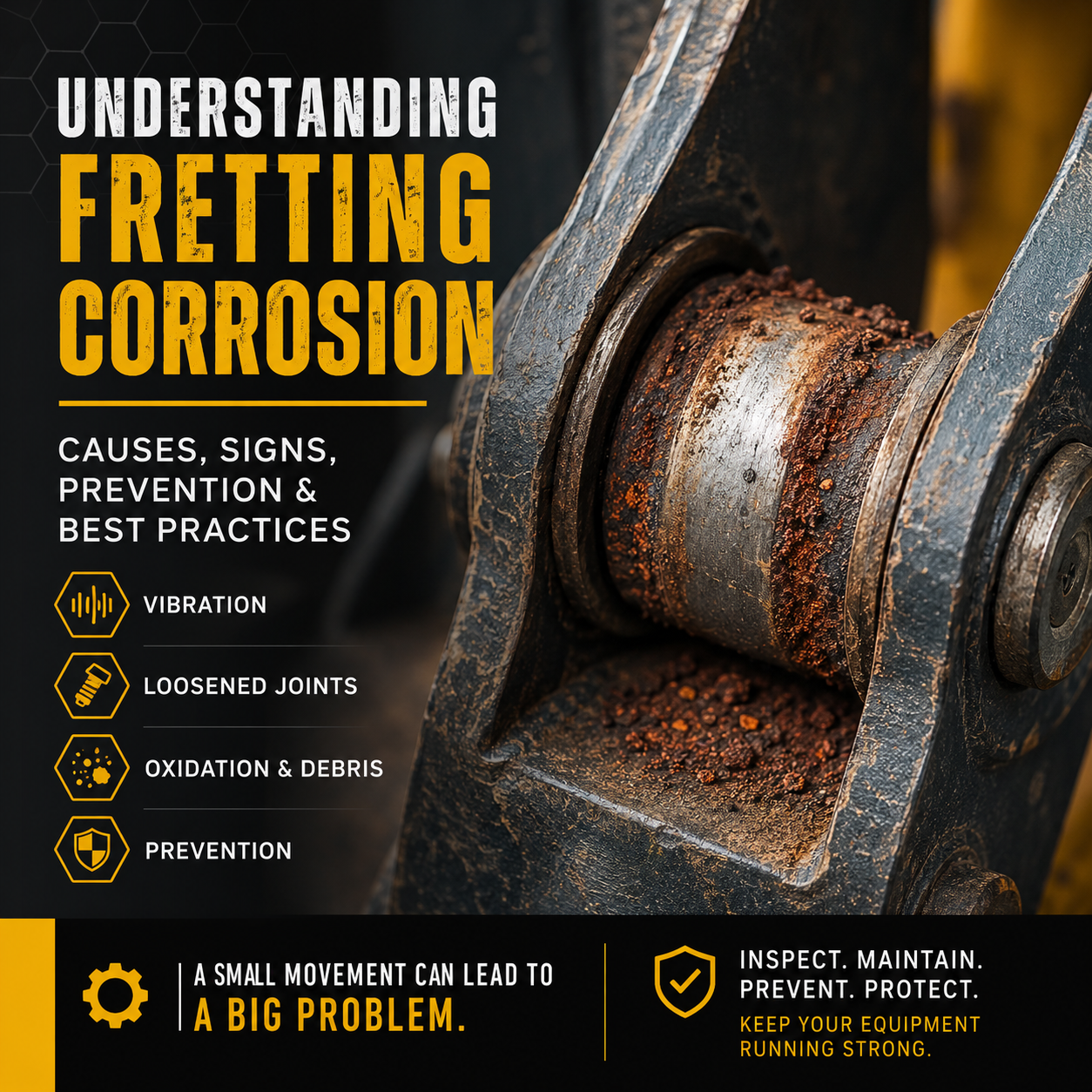
Understanding Fretting Corrosion
Fretting corrosion is a hidden but serious form of wear that can quietly damage heavy equipment components long before obvious failure occurs. It often goes unnoticed until parts loosen, surfaces degrade, or unexpected breakdowns happen in high-load machinery.
For operators, mechanics, and equipment owners, understanding fretting corrosion is key to preventing costly downtime and extending component life.
What Is Fretting Corrosion?
Fretting corrosion is a type of surface damage that occurs when two contacting surfaces experience repeated micro-movements under load. Unlike normal wear, these movements are extremely small—often microscopic—but they happen continuously due to vibration, oscillation, or fluctuating loads.
When this micro-motion occurs:
- Protective oxide layers on metal surfaces break down
- Fresh metal is exposed
- Oxygen and moisture react with the exposed surfaces
- Oxidation (rust-like debris) forms and accumulates
This combination of mechanical wear and chemical reaction is what defines fretting corrosion.
Where It Happens in Heavy Equipment
Fretting corrosion is especially common in equipment exposed to vibration and cyclic loading, such as:
- Pins and bushings in excavators and loaders
- Bolted joints in structural frames
- Track links and undercarriage components
- Hydraulic cylinder mounting points
- Press-fitted bearings and shafts
Even when components are properly tightened, slight movement between mating surfaces can still occur under working conditions.
What It Looks Like
Early-stage fretting corrosion can be subtle. Common signs include:
- Reddish-brown or black debris around joints
- Polished or “burnished” wear marks on metal surfaces
- Surface pitting or rough patches
- Loosening of bolts or press fits over time
- Unusual squeaking or vibration during operation
In advanced cases, the damage can resemble deep corrosion or galling.
Why It’s a Problem
Fretting corrosion doesn’t just affect appearance—it can significantly impact performance and safety.
It can lead to:
- Reduced clamping force in bolted joints
- Fatigue cracking from stress concentration
- Loss of dimensional accuracy in precision fits
- Accelerated wear in moving assemblies
- Unexpected mechanical failure in high-load systems
Because it develops gradually, it often progresses unnoticed until a major issue occurs.
Main Causes
Several conditions contribute to fretting corrosion:
1. Vibration
Continuous machine vibration is the most common trigger, especially in engines, undercarriages, and hydraulic systems.
2. Insufficient Clamping Force
If bolted or press-fit joints are not tight enough, micro-movement becomes more likely.
3. Cyclic Loading
Repeated stress changes during operation can cause slight shifting between contact surfaces.
4. Poor Lubrication
Lack of lubrication increases friction and allows surface breakdown to occur more easily.
5. Misalignment
Even small alignment errors can concentrate stress and promote movement at contact points.
Prevention Strategies
The good news is that fretting corrosion is largely preventable with proper maintenance and design practices.
Improve Joint Design
- Use interference fits where appropriate
- Increase contact surface area
- Avoid unnecessary slip-prone interfaces
Maintain Proper Torque
- Follow manufacturer torque specifications
- Recheck critical fasteners during service intervals
Use Lubricants and Anti-Seize Compounds
- Reduce friction between mating surfaces
- Provide a protective barrier against oxidation
Reduce Vibration
- Inspect and replace worn dampers or mounts
- Balance rotating components
Regular Inspections
- Look for early signs of debris or surface polishing
- Address small issues before they escalate
Repair and Mitigation
Once fretting corrosion has occurred, corrective actions depend on severity:
- Light cases: Cleaning, re-lubrication, and retorquing may be sufficient
- Moderate cases: Surface reconditioning or replacement of fasteners/components
- Severe cases: Machining, rebuilding, or full part replacement may be required
Ignoring fretting damage often leads to faster recurrence, so addressing the root cause is essential.
Small In Scale, Significant Impact
Fretting corrosion may be small in scale, but its impact on heavy equipment can be significant. It thrives in high-vibration environments and develops gradually, making it easy to overlook until damage is advanced.
With proper torque practices, lubrication, alignment, and routine inspections, operators can dramatically reduce the risk and keep machinery running reliably.
Understanding this subtle form of wear is another step toward smarter maintenance and longer-lasting equipment.