Tilt Table Testing: How Engineers Find a Machine's Tipping Point
When you climb into the cab of a wheel loader, excavator, telehandler, skid steer, or other piece of heavy equipment, you probably don't think about just how much testing went into making that machine safe. Before it ever reaches a dealer's lot, engineers have spent thousands of hours evaluating everything from engine performance to structural durability.
One of the most important and visually dramatic tests is tilt table testing.
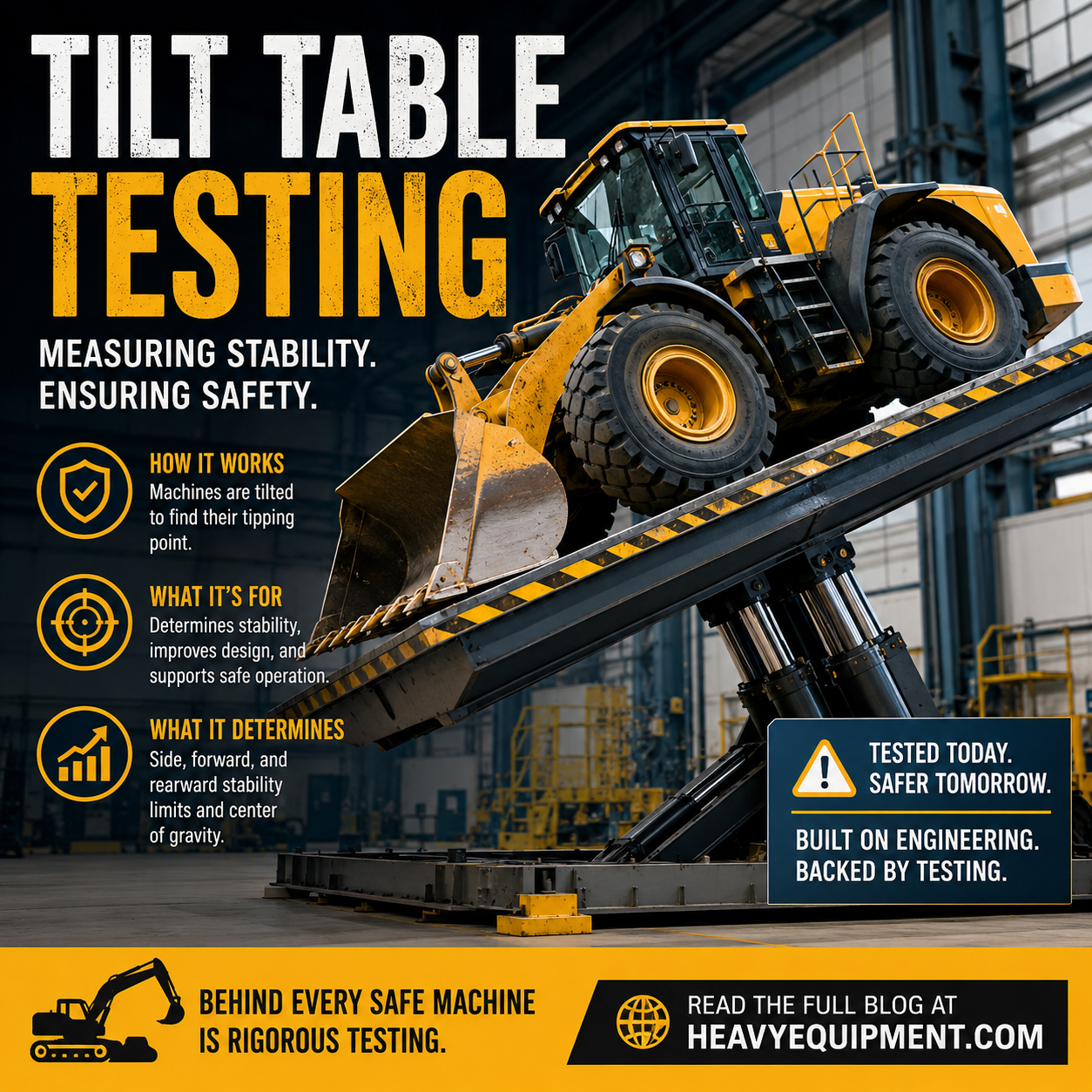
Imagine placing a 50,000-pound machine on a massive platform and slowly lifting one side until the machine is on the verge of tipping over. It may sound like something from a stunt show, but it's actually a carefully controlled engineering procedure that helps manufacturers determine exactly how stable a machine is under different conditions.
What Is Tilt Table Testing?
Tilt table testing is a method used to evaluate a machine's static stability. During the test, the machine sits on a large hydraulic platform capable of tilting in multiple directions while engineers monitor how the machine reacts.
The platform raises gradually, often by fractions of a degree at a time, allowing engineers to identify the exact angle at which one or more wheels or tracks begin to lose contact with the surface.
That angle becomes a valuable measurement for determining the machine's resistance to rollover.
Unlike real world driving, where bumps, acceleration, and sudden turns all affect stability, tilt table testing isolates one variable: gravity.
This allows engineers to study the machine's center of gravity with remarkable precision.
Why Is Stability So Important?
Nearly every type of heavy equipment works on uneven terrain.
Machines routinely operate on:
- Hillsides
- Road embankments
- Construction sites
- Gravel pits
- Mines
- Agricultural fields
- Landfills
- Forestry roads
A machine that becomes unstable too easily can place both the operator and nearby workers at serious risk.
By understanding exactly how much slope a machine can safely tolerate, manufacturers can:
- Improve machine design
- Adjust weight distribution
- Refine suspension geometry
- Modify axle placement
- Recommend safe operating limits
- Develop operator safety guidelines
The goal isn't simply to prevent tipping—it's to understand why tipping occurs and how to maximize the safety margin.
The Massive Tilt Tables Behind the Test
Tilt tables are engineering marvels themselves.
Some are large enough to accommodate enormous articulated dump trucks or agricultural tractors weighing tens of thousands of pounds.
Heavy-duty hydraulic cylinders slowly raise one side of the platform while sensors continuously record:
- Tilt angle
- Wheel loading
- Track loading
- Suspension movement
- Chassis flex
- Center-of-gravity movement
High-speed cameras often capture every stage of the test so engineers can analyze exactly what happens as stability decreases.
The process is slow and deliberate because even a slight change in angle can dramatically affect a machine nearing its tipping point.
Testing in Multiple Directions
A machine doesn't tip the same way in every situation.
That's why manufacturers test multiple orientations.
Side Stability
This is perhaps the most familiar test.
The platform tilts sideways until the uphill wheels become unloaded and the downhill wheels carry nearly all of the machine's weight.
Eventually, the uphill wheels begin to lift.
This determines the machine's lateral stability.
Forward Stability
Forward testing evaluates how the machine behaves when descending steep grades.
Machines with large front attachments—such as loaders or telehandlers—may have very different stability characteristics depending on attachment position.
Rearward Stability
Rearward testing examines stability while climbing steep slopes.
Machines carrying rear-mounted implements or counterweights may react much differently than they do during forward testing.
Attachments Change Everything
One challenge engineers face is that many heavy machines can be equipped with dozens of different attachments.
A skid steer with an empty bucket behaves differently than one carrying:
- Pallet forks
- A trencher
- A snow blower
- A mulcher
- A stump grinder
- A grapple
- A heavy auger
Each attachment changes the machine's center of gravity.
For this reason, manufacturers often perform stability testing using multiple attachment configurations and different load conditions.
Fuel, Fluids, and Cargo Matter Too
Even something as simple as fuel level can slightly alter stability.
Engineers may conduct tests with:
- Empty fuel tanks
- Full fuel tanks
- Loaded buckets
- Empty buckets
- Raised attachments
- Lowered attachments
Machines intended to carry payloads—such as articulated dump trucks or wheel loaders—may also be tested at various load capacities.
A fully loaded machine can behave very differently from an empty one.
Static vs. Dynamic Stability
Tilt table testing measures static stability.
That means the machine isn't moving under its own power.
Real-world operation introduces many additional forces:
- Turning sharply
- Sudden braking
- Rapid acceleration
- Hitting obstacles
- Traveling over rough terrain
- Swinging an excavator's upper structure
- Carrying shifting loads
These dynamic forces can reduce stability well before a machine reaches its static tipping angle.
That's why operators should never assume a published stability rating represents a safe operating angle in real-world conditions.
Manufacturers build significant safety margins into their recommendations.
How Engineers Use the Results
The data collected during tilt testing influences many aspects of machine design.
If testing reveals a machine becomes unstable sooner than expected, engineers might:
- Lower the engine position
- Increase track width
- Widen the axle spacing
- Add counterweights
- Relocate hydraulic components
- Adjust boom geometry
- Modify attachment limits
Sometimes relatively small design changes can produce significant improvements in overall stability.
Industry Standards and Certification
Many categories of heavy equipment must meet industry standards for stability before entering the marketplace.
Testing may be conducted to satisfy requirements established by international standards organizations or regulatory agencies, depending on the machine type and the markets where it will be sold.
Manufacturers also perform extensive in-house testing that often goes well beyond minimum certification requirements.
Critical Insights Gained
Tilt table testing may happen behind the scenes, but it's one of the most important steps in developing modern heavy equipment. By carefully measuring a machine's stability under controlled conditions, engineers gain critical insights into how weight distribution, attachments, and machine geometry affect the risk of rollover.
The next time you see a wheel loader working on a steep stockpile or an excavator perched on uneven ground, remember that its design wasn't based on guesswork. Long before it arrived on the jobsite, it likely spent time on a tilt table, helping engineers understand exactly where its limits lie—and how to make it safer for the people who rely on it every day.