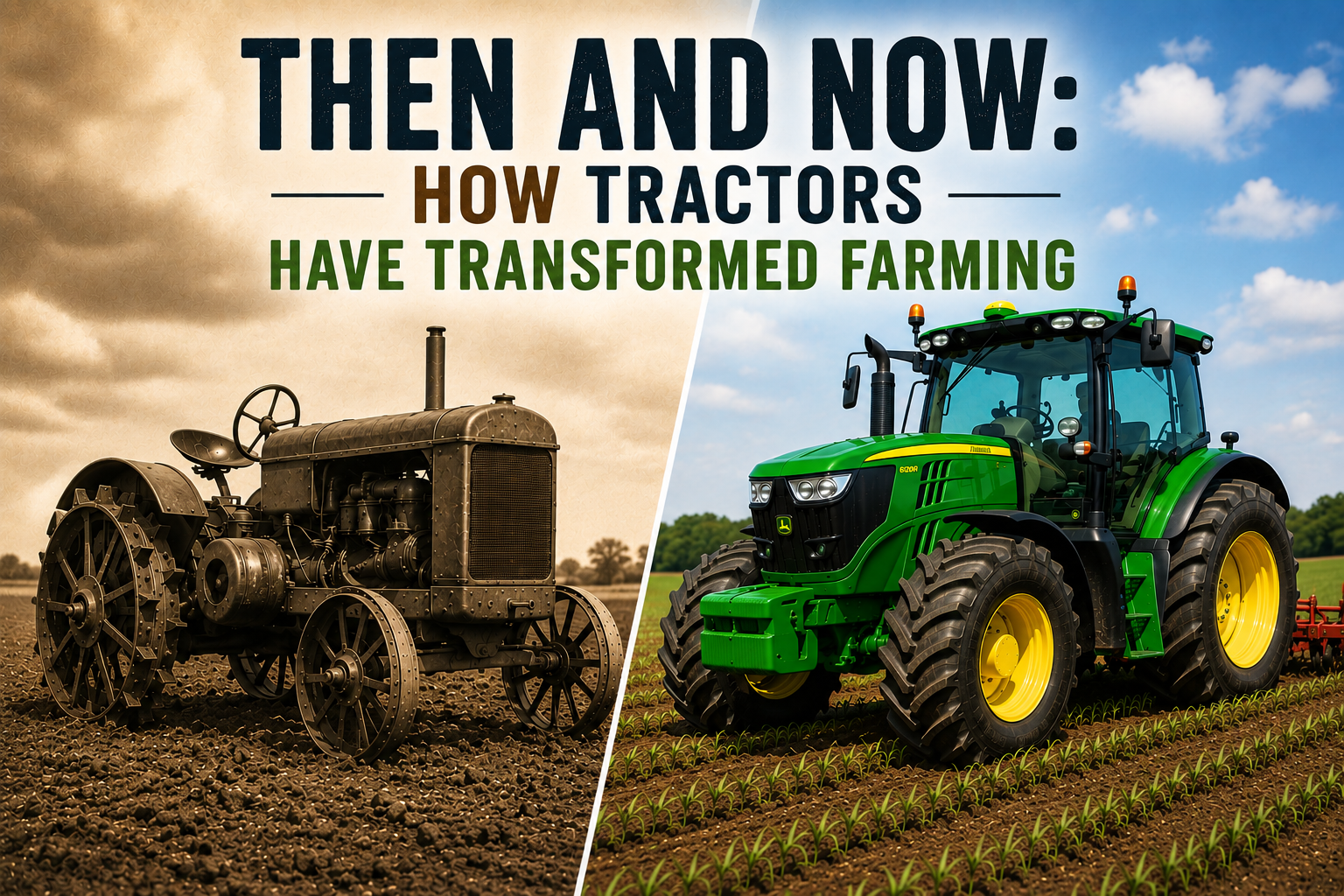
Then and Now: How Tractors Have Transformed Farming
For more than a century, tractors have been at the heart of agriculture, evolving from simple machines designed to replace horse power into highly sophisticated pieces of technology. While the purpose of tractors remains the same, helping farmers work more efficiently, the machines themselves have changed dramatically over the decades.
Then: The Early Days of Tractor Power
In the early 1900s, tractors revolutionized farming by replacing horses and manual labor. Early models were large, heavy and often difficult to operate. Most tractors featured steel wheels, limited comfort and basic mechanical controls.
Operators spent long hours in open-air seats, exposed to the elements with little protection from dust, heat or cold. Steering required significant physical effort, and features that are considered standard today, such as enclosed cabs or air conditioning, did not exist.
Maintenance was also far more hands-on. Farmers often performed repairs themselves, relying on mechanical knowledge and a collection of tools to keep their machines running during critical planting and harvest seasons.
Despite their simplicity, these early tractors dramatically increased productivity and allowed farms to expand their operations.
Now: Smart Machines in the Field
Modern tractors bear little resemblance to their early predecessors. Today's machines combine horsepower, precision technology and operator comfort to help farmers maximize efficiency.
GPS guidance systems, auto-steering capabilities and precision agriculture technologies allow tractors to plant, spray and harvest with exceptional accuracy. Many models can collect and transmit machine and field data in real time, helping farmers make informed management decisions.
Operator comfort has also improved significantly. Today's tractors often feature climate-controlled cabs, ergonomic seating, touchscreen displays and advanced suspension systems designed to reduce fatigue during long workdays.
Safety has become another major focus. Roll-over protection structures, enhanced visibility systems, cameras and integrated monitoring technologies help improve both operator and jobsite safety.
A Side-by-Side Comparison
|
Feature |
Then |
Now |
|
Power Source |
Basic gasoline or steam engines |
Advanced diesel and alternative fuel options |
|
Operator Environment |
Open platform, minimal comfort |
Enclosed, climate-controlled cabs |
|
Steering |
Manual, physically demanding |
Assisted or automated steering |
|
Technology |
Mechanical controls only |
GPS, telematics and precision farming systems |
|
Maintenance |
Primarily manual repairs |
Diagnostic software and remote monitoring |
|
Productivity |
Limited coverage per day |
Greater efficiency and field capacity |
Looking Ahead
The evolution of tractors is far from over. Automation, artificial intelligence and alternative power sources continue to shape the future of agricultural equipment. Autonomous tractors and electrified machines are already beginning to enter the market, offering a glimpse into what farming may look like in the decades ahead.
From steel wheels and open seats to autonomous guidance and connected technology, tractors have come a long way. Yet one thing remains unchanged: tractors continue to play an essential role in helping farmers feed the world.