The Tractor That Ran on Wood Instead of Diesel
How wood-gas generators kept tractors and machinery working when conventional fuel was scarce.
Imagine walking up to a tractor, opening a compartment, and filling it with chunks of firewood instead of pouring diesel into a fuel tank.
It sounds like something invented for a science fiction movie, but during the fuel shortages of World War II, wood-powered tractors were a practical solution to a very real problem.
Across parts of Europe, farmers, mechanics, and equipment manufacturers turned to an unusual technology that allowed internal combustion engines to run on gas produced from burning wood under controlled conditions.
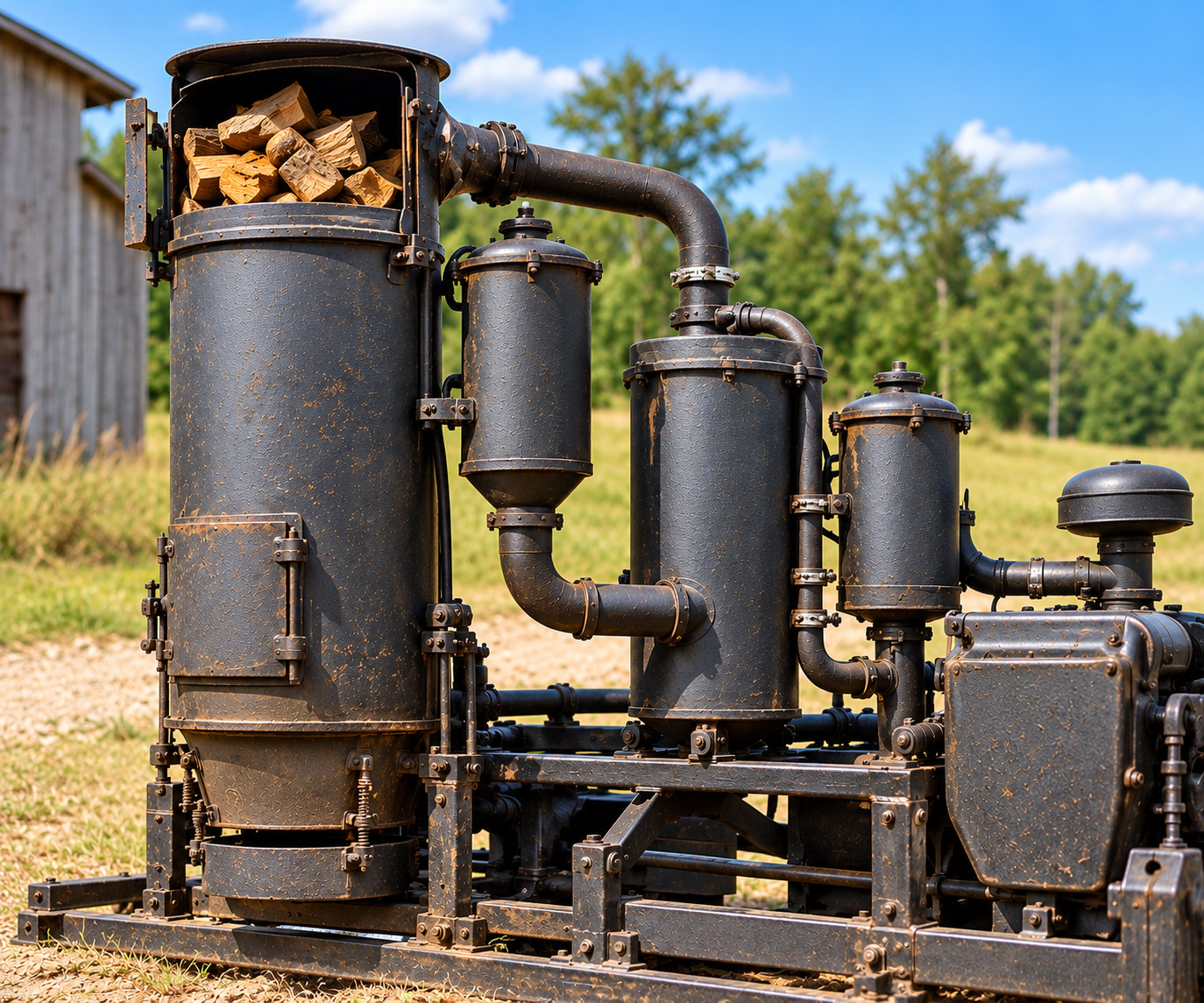
These machines weren't powered by steam, and they didn't simply burn logs inside their engines. Instead, they used a device called a wood-gas generator, which converted solid wood into a combustible gas that could power an engine.
The technology was cumbersome, required considerable maintenance, and delivered less power than conventional fuels. But when gasoline and diesel were difficult or impossible to obtain, a tractor that could run on wood was better than one that couldn't run at all.
Why Would Anyone Power a Tractor With Wood?
During World War II, petroleum supplies became a strategic resource. Gasoline and diesel were heavily rationed in many countries, with available supplies prioritized for military vehicles, transportation, and essential industries.
Agriculture still needed to function.
Fields had to be plowed, crops planted, and harvests brought in. Farmers couldn't simply stop producing food because petroleum fuel was unavailable.
In countries with access to forests but limited petroleum supplies, wood offered an alternative energy source.
Germany, Sweden, Finland, and other European nations made use of producer-gas technology during the war. Although wood gasification had been developed decades earlier, wartime shortages encouraged its widespread adoption.
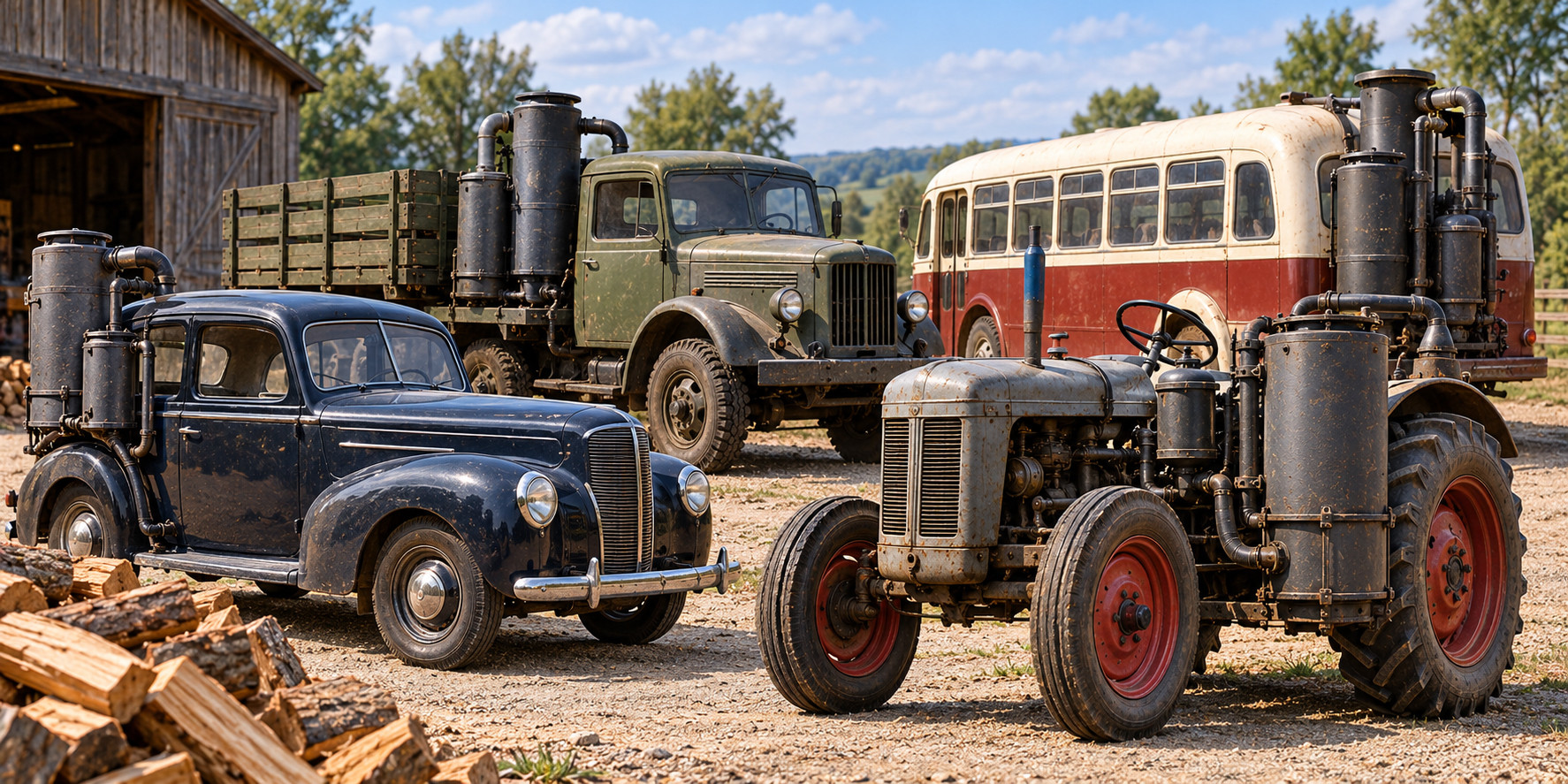
Cars, trucks, buses, and agricultural tractors were among the machines fitted with gas generators.
Instead of relying entirely on liquid petroleum fuels, these vehicles could generate their own combustible gas from wood or charcoal.
For farmers with access to suitable wood, the technology offered something particularly valuable: a fuel source they could potentially prepare themselves.
How Does a Wood-Gas Generator Actually Work?
The principle behind a wood-gas tractor is surprisingly straightforward, although the machinery required to make it work was anything but simple.
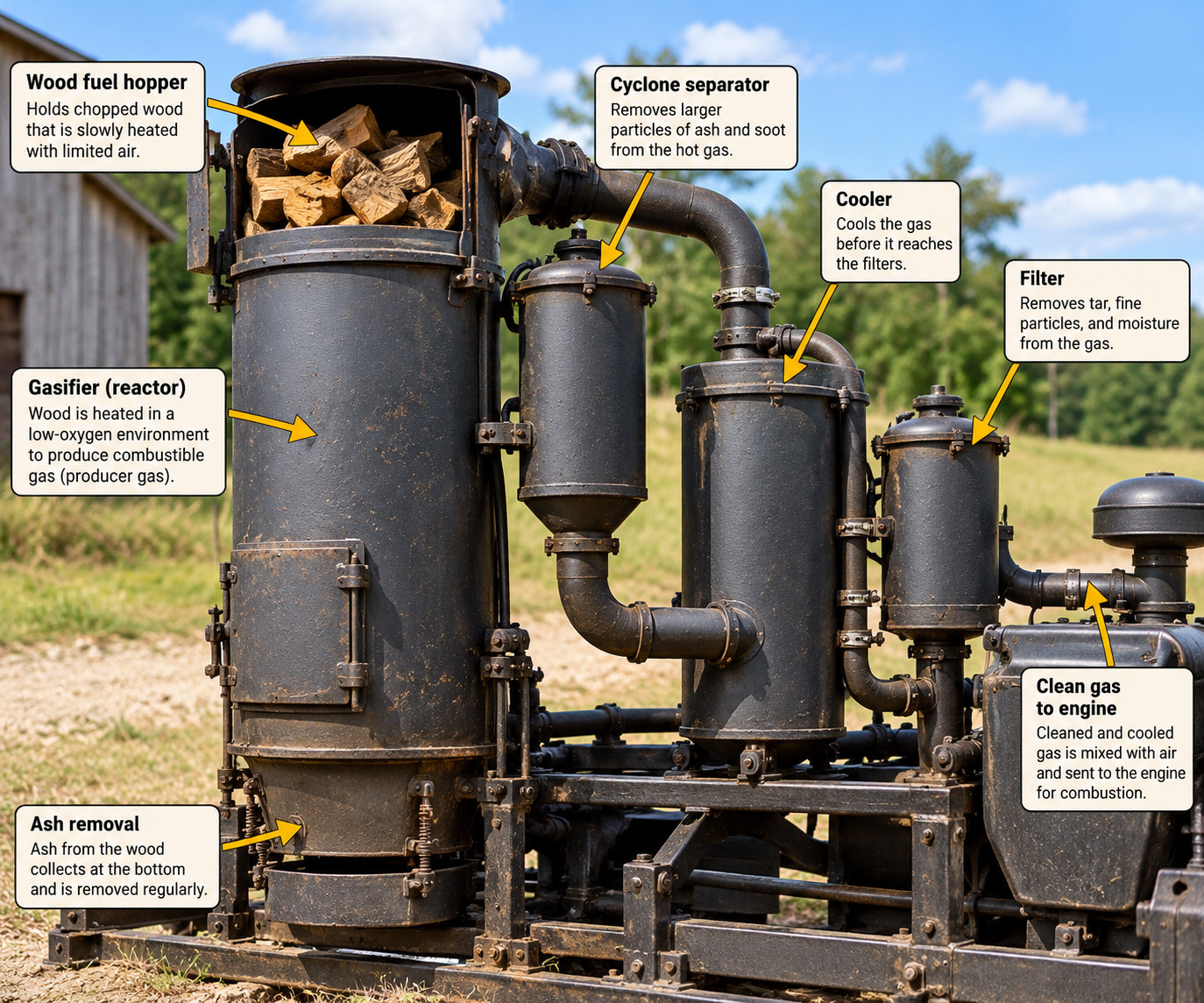
A wood-gas generator, sometimes called a gasifier, uses a process known as gasification.
Rather than allowing wood to burn completely in an open fire, the generator heats it with a controlled, limited supply of air.
Inside the generator, several chemical processes occur. The wood dries, breaks down under heat, and partially combusts. As hot gases pass through the charcoal bed, chemical reactions produce a combustible mixture.
The resulting gas typically contains:
• Carbon monoxide, which can burn and release energy.
• Hydrogen, another combustible gas.
• Small amounts of methane.
• Nitrogen, carbon dioxide, and other gases that contribute little or no useful energy.
The combustible portion of this mixture can be used to run a suitable internal combustion engine.
However, there is a catch.
Gas leaving the generator is hot and may contain ash, soot, tar, moisture, and other contaminants. Feeding that mixture directly into an engine could quickly cause serious mechanical problems.
Before reaching the engine, the gas must pass through a cooling and cleaning system.
Depending on the design, this could include a cyclone separator, cooler, and various filters.
Only after the gas had been sufficiently cooled and cleaned could it be mixed with air and delivered to the engine for combustion.
In other words, the tractor carried a small fuel-processing plant along with its engine.
What Did a Wood-Powered Tractor Look Like?
A conventional tractor of the 1930s or 1940s was already a fairly simple-looking machine compared with modern agricultural equipment.
Add a wood-gas generator, and its appearance changed dramatically.
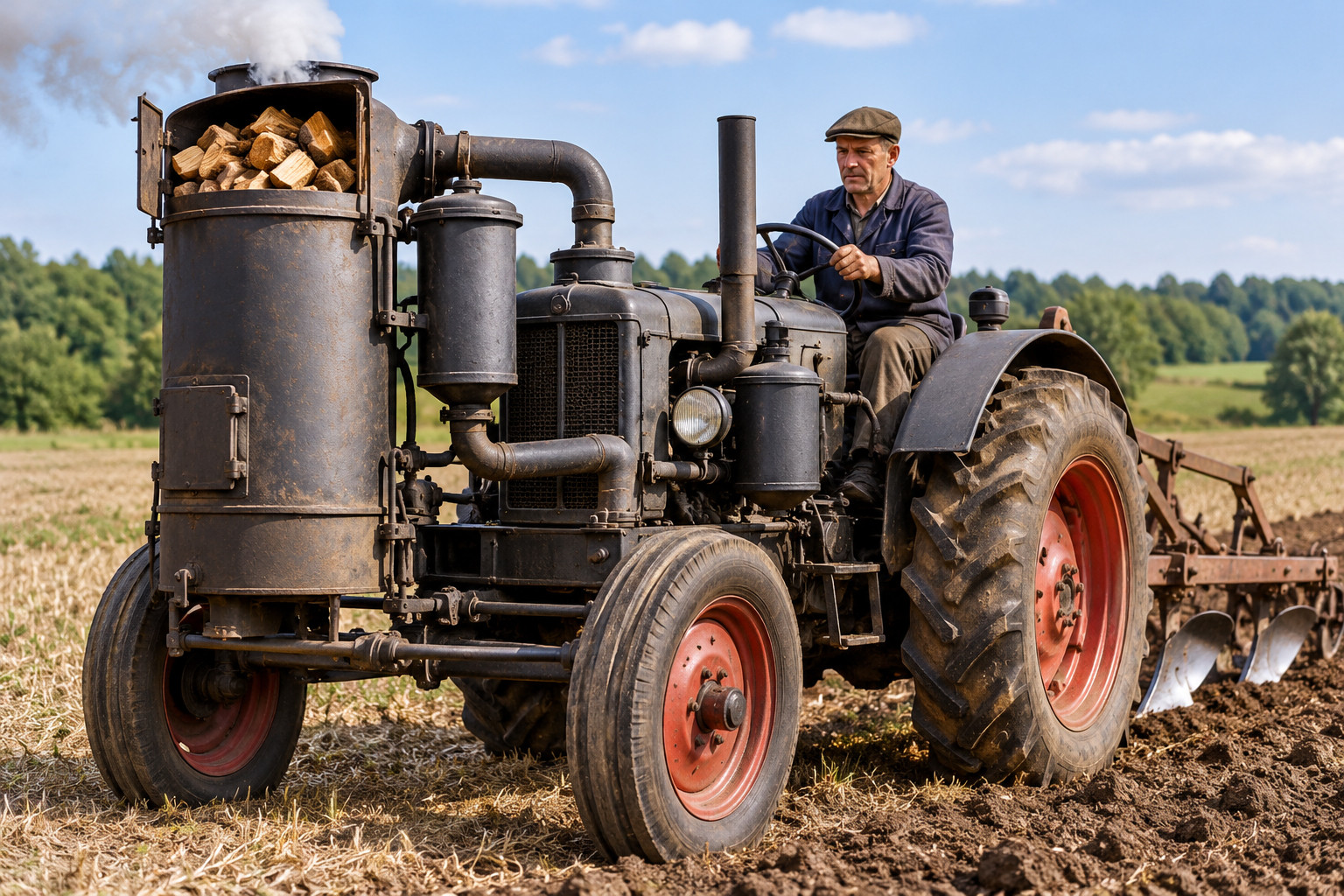
The most noticeable feature was usually a large metal cylinder mounted on the tractor, sometimes toward the front or alongside the engine.
This cylinder was the gasifier, where the wood was heated and converted into combustible gas.
Additional pipes connected it to cooling equipment, filters, and the engine's intake system.
Some tractors had tall, upright generator assemblies that looked almost like industrial furnaces mounted on wheels.
Others had more compact arrangements, although the equipment still added considerable bulk and weight.
The exact configuration depended on the tractor, the generator manufacturer, and whether the installation was factory-built or a retrofit.
On some machines, the equipment could obstruct visibility or make access to mechanical components more difficult.
And while the tractor might look unusual, the basic operating principle remained familiar: the engine burned a gaseous fuel to produce mechanical power, which was transmitted through the drivetrain to the wheels or tracks.
Could a Diesel Tractor Really Run on Wood Gas?
This is where the technology becomes particularly interesting.
Wood gas works relatively well in spark-ignition engines, which normally burn gasoline. With suitable modifications, these engines can ignite a mixture of wood gas and air using their spark plugs.
Diesel engines present a different challenge.
A conventional diesel engine relies on compression ignition. Air is compressed until it becomes hot enough to ignite diesel fuel when it is injected.
Wood gas generally cannot be substituted directly for diesel fuel in an otherwise unmodified diesel engine.
However, certain diesel engines could be adapted to operate in a dual-fuel configuration.
In this arrangement, the engine draws in wood gas mixed with air, but a small quantity of diesel is still injected to initiate combustion.
The burning diesel ignites the wood-gas mixture, allowing the engine to produce power using considerably less liquid fuel.
Other engines could be converted more extensively for spark-ignition operation, although that required significant mechanical changes.
This distinction matters because not every historical wood-gas tractor was truly running without diesel.
Some used no diesel at all, while others substantially reduced diesel consumption without eliminating it.
How Much Power Did These Tractors Lose?
Wood gas provided a way to keep machinery operating, but it came with a major disadvantage: reduced engine performance.
Compared with gasoline or diesel, producer gas contains much less usable energy per unit of gas volume.
Because the engine must draw in a mixture of wood gas and air, less oxygen is available for combustion than when using conventional liquid fuel.
As a result, engines operating on wood gas commonly experienced significant power losses.
Depending on the engine and gasifier arrangement, power reductions of approximately 20–40% were possible, and some installations performed worse.
For an agricultural tractor, that could be a serious limitation.
A tractor that could comfortably pull a plow on conventional fuel might struggle with the same implement when running on wood gas.
Farmers sometimes had to reduce their working depth, use smaller implements, or operate at slower speeds.
Hills and heavy soil conditions made the problem even more noticeable.
Wood-gas tractors weren't necessarily weak machines, but they generally couldn't match the performance they delivered on their original fuels.
Starting a Wood-Gas Tractor Wasn't as Simple as Turning a Key
Modern equipment operators are accustomed to turning a key or pressing a button and having an engine ready to work within seconds.
Operating a wood-gas tractor required more preparation.
Before the engine could run properly, the operator needed to establish the gasification process.
That meant lighting the fuel in the generator and supplying enough airflow to bring the system up to operating temperature.
Some installations used a hand-operated or powered blower to draw air through the gasifier during startup.
The initial gas could be unsuitable for engine operation, so it was commonly vented or burned off until the generator began producing a sufficiently combustible mixture.
Only then could the operator direct the cleaned gas toward the engine and attempt to start it.
Depending on the system, fuel condition, and whether the generator was already warm, startup could take several minutes or considerably longer.
Once running, the operator had to pay attention to the gasifier as well as the tractor itself.
Fuel needed to be replenished, airflow managed, and filters maintained.
Operating a wood-gas tractor meant managing two interconnected machines: the tractor and the gas-producing system that kept it running.
You Couldn't Just Throw Any Old Log Into the Generator
Although wood was the fuel, preparation mattered.
Gasifiers generally worked best with wood cut into reasonably uniform pieces suitable for the generator's design.
The fuel also needed to be sufficiently dry.
Wet wood consumed additional heat as its moisture evaporated, lowering the efficiency of gas production and potentially increasing operational problems.
Poor-quality fuel could contribute to excessive tar formation, inconsistent gas production, and clogged equipment.
Some systems were designed to operate on charcoal rather than raw wood.
Charcoal gasifiers had certain advantages because charcoal had already undergone much of the thermal decomposition that raw wood experiences inside a gasifier.
This could simplify gas cleaning, although producing charcoal required additional processing and consumed some of the original wood's energy.
For farmers, preparing generator fuel could become another routine agricultural chore.
Wood had to be collected, cut, dried, stored, and loaded.
The tractor might have avoided a trip to the fuel supplier, but it certainly hadn't eliminated the work involved in obtaining fuel.
The Hidden Problem: Tar, Soot, and Constant Cleaning
One of the biggest headaches associated with wood-gas technology was keeping the gas clean.
As wood heats and decomposes, it can release complex organic compounds that form tar.
If tar reaches cooler parts of the system, it can condense into a sticky residue.
Inside an engine, this material can foul intake passages, valves, and other components.
Soot and fine ash create additional problems.
For this reason, the gas-cleaning equipment was just as important as the generator itself.
Filters required regular attention, ash had to be removed, and accumulated deposits needed cleaning.
Poor maintenance could lead to reduced gas flow, unreliable engine operation, and mechanical damage.
There was also a serious safety concern.
Wood gas contains carbon monoxide, a highly poisonous gas that can cause fatal poisoning without any noticeable smell or warning.
Leaks, improper ventilation, and handling hot generator equipment presented hazards that operators had to understand.
Wood-gas tractors were ingenious, but they were neither convenient nor inherently safe.
Were Wood-Gas Tractors Actually Manufactured?
Yes. Wood-gas technology was more than a collection of improvised farm experiments.
During the 1930s and 1940s, manufacturers developed gas-generator systems for a variety of vehicles and stationary engines.
Some agricultural tractors were fitted with commercially produced gasifier equipment, while others were modified using locally manufactured or workshop-built installations.
In Germany, manufacturers including Lanz were associated with tractors designed or adapted for producer-gas operation.
The Lanz Bulldog family is particularly interesting because some versions used hot-bulb engines rather than conventional spark-ignition or diesel engines.
Certain gas-operated variants required specialized arrangements to accommodate their different combustion characteristics.
In Sweden, where imported petroleum supplies were constrained during the war, producer-gas systems became especially important for road transportation and other engine applications.
The technology was also used in Finland and elsewhere, where wood was comparatively accessible.
Not every machine was purpose-built. Many existing engines and tractors were adapted to use the fuel systems available at the time.
The result was an unusual period in machinery history when fuel availability sometimes mattered more than efficiency, convenience, or maximum horsepower.
Why Did Wood-Gas Tractors Disappear?
The decline of wood-gas machinery was largely driven by the return of petroleum fuel supplies after World War II.
Once gasoline and diesel became more readily available, the disadvantages of gasifier systems were difficult to justify.
Liquid fuels were easier to store, transport, and dispense.
Engines could start faster, deliver greater power, and operate without the bulky generator assemblies and frequent cleaning requirements.
Operators no longer needed to prepare wood fuel or wait for a gasifier to reach operating temperature.
The added weight and complexity of the systems became unnecessary.
For most agricultural operations, returning to conventional fuel was an obvious choice.
Wood-gas equipment gradually disappeared from everyday use, although the underlying technology never vanished completely.
Gasification continued to attract interest for stationary power generation, biomass energy systems, and applications where locally available solid fuels offered an advantage.
Could a Modern Tractor Run on Wood Gas?
Technically, yes, but the practical challenges would be considerable.
A modern tractor's electronically controlled diesel engine, turbocharging system, emissions equipment, and fuel-management systems are far more complicated than those found on many wartime machines.
Converting such an engine to operate on wood gas would require substantial engineering.
A dual-fuel arrangement might be technically possible for certain engines, but compatibility, engine controls, emissions compliance, and reliable gas cleaning would all need to be addressed.
There would also be major operational disadvantages.
Modern agricultural tractors are expected to deliver high power continuously, often while operating demanding hydraulic equipment and electronic systems.
A bulky wood-gas generator requiring frequent fuel preparation and maintenance would be difficult to integrate into that working environment.
For stationary engines, where space, weight, and mobility are less important, biomass gasification can be more practical.
But for modern mobile agricultural equipment, diesel and other established power systems remain considerably more convenient.
The Tractor That Proved Fuel Doesn't Have to Come From a Pump
The story of the wood-gas tractor is about more than an unusual engine modification.
It's a reminder of how machinery evolves when operators are forced to work with whatever resources are available.
During World War II, farmers still needed to produce food. Equipment still needed to operate. And when conventional fuels became scarce, engineers and mechanics found a way to turn locally available wood into something an internal combustion engine could use.
The resulting machines were bulky, underpowered, slow to start, and demanding to maintain.
But they worked.
They demonstrated that an engine's energy source didn't necessarily have to arrive in a tanker truck or be pumped from an underground petroleum reservoir.
Sometimes, it could arrive in a pile of carefully cut firewood.
Today, the sight of a tractor carrying a large metal gasifier might seem like an eccentric engineering experiment.
During wartime fuel shortages, however, that strange-looking equipment represented something far more important: the ability to keep working when conventional fuel was no longer available.
And in the history of heavy equipment, that makes the wood-gas tractor one of the more fascinating examples of mechanical ingenuity born out of necessity.
