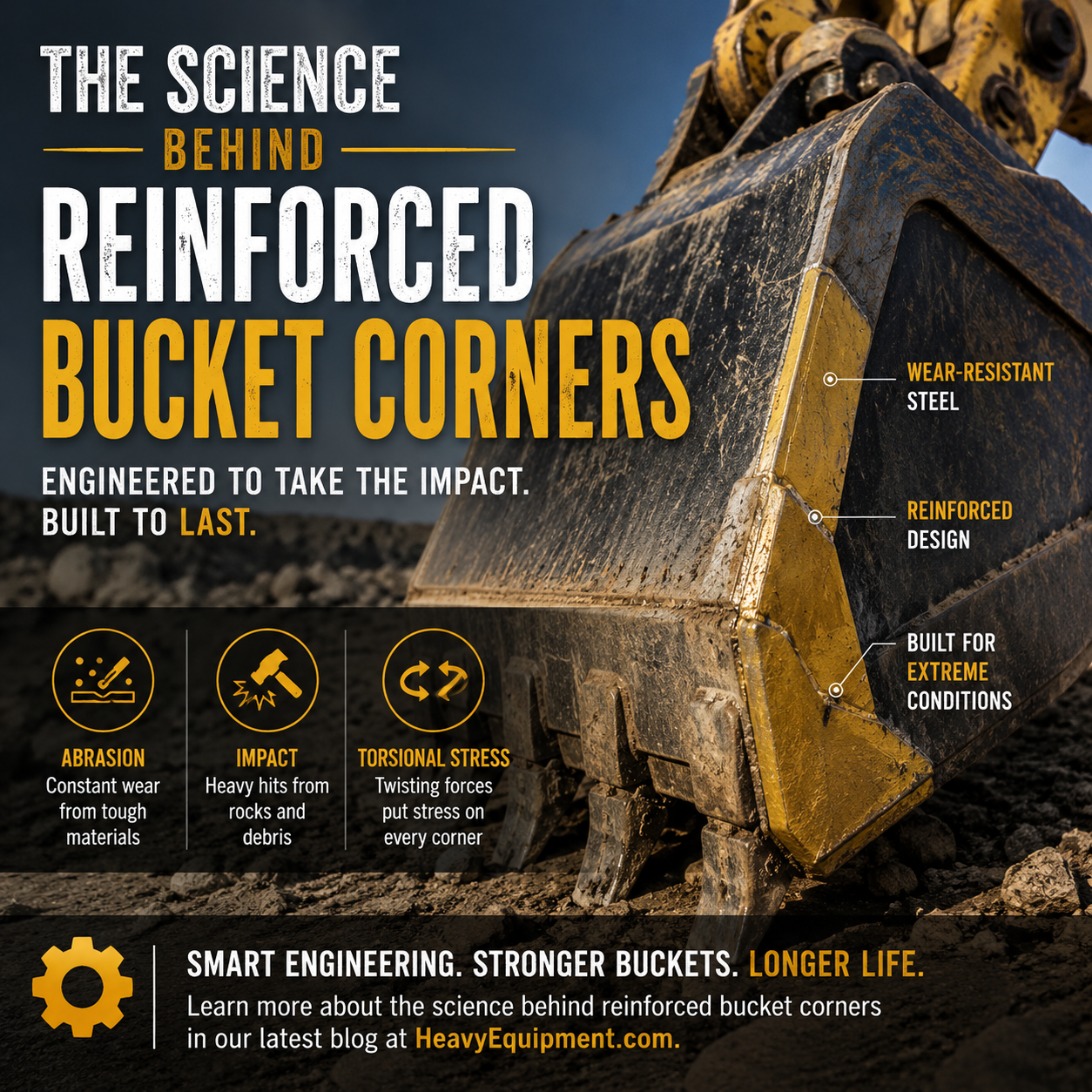
The Science Behind Reinforced Bucket Corners
The reinforced corners of an excavator or loader bucket may not grab as much attention as the cutting edge or bucket teeth, but they play a critical role in extending bucket life. These high-stress areas endure repeated impacts, abrasion, twisting forces, and constant contact with abrasive materials. Without reinforcement, bucket corners would wear prematurely, leading to costly repairs or complete bucket replacement.
Here's a closer look at the engineering behind reinforced bucket corners and why they are essential for heavy equipment working in demanding environments.
The Bucket Corners Take More Abuse Than You Think
When operators dig, load, or scrape material, the bucket rarely wears evenly. The corners often make first contact with the ground, especially when:
- Trenching
- Digging against hard surfaces
- Loading uneven piles
- Working on rocky terrain
- Cleaning ditches or foundations
Even skilled operators naturally place additional stress on one corner depending on the angle of attack and machine positioning.
Over thousands of operating hours, these repeated impacts concentrate wear at the bucket's outer edges.
The Three Types of Forces at Work
Bucket corners are subjected to multiple forces simultaneously.
Abrasion
Sand, gravel, crushed stone, and soil constantly grind away at exposed steel surfaces. Abrasion slowly removes material layer by layer.
Impact
Large rocks or demolition debris can strike bucket corners with tremendous force, creating dents, cracks, or deformation.
Torsional Stress
Buckets often twist slightly while digging through uneven material. This twisting action places extra stress where the bucket sides meet the floor—precisely where the corners are located.
Reinforcement must withstand all three forces simultaneously.
Why Standard Steel Isn't Enough
Standard structural steel provides strength but sacrifices wear resistance.
To combat this, manufacturers use specialized wear-resistant steels that combine:
- High hardness
- Improved toughness
- Better resistance to cracking
- Longer abrasion life
Many premium buckets use abrasion-resistant steel grades such as AR400, AR450, or AR500 in high-wear areas while using more flexible structural steel elsewhere. This balances durability with the ability to absorb impacts without becoming brittle.
Common Corner Reinforcement Designs
Manufacturers use several engineering approaches depending on the bucket's intended application.
Corner Wear Plates
Extra steel plates are welded over vulnerable corners to create sacrificial wear surfaces.
As the outer plate wears down, the underlying bucket remains protected.
Wrap-Around Corner Guards
Some heavy-duty buckets feature corner guards that extend from the side of the bucket underneath the floor.
This protects two wear surfaces simultaneously and greatly increases bucket lifespan.
Cast Corner Sections
Mining and quarry buckets may use specially cast steel corner pieces designed specifically for extreme impact resistance.
Casting allows engineers to create thicker, stronger shapes than fabricated steel alone.
Double-Layer Construction
Some severe-duty buckets reinforce corners with multiple steel layers.
Instead of relying on one thick plate, engineers combine several pieces to distribute stresses more effectively.
Weld Quality Matters
Reinforcement is only as strong as the welds holding it together.
Bucket corners experience repeated stress cycles that can expose weak welds over time.
Manufacturers often use:
- Deep penetration welds
- Continuous weld beads
- Robotic welding for consistency
- Stress-relieving fabrication techniques
Proper weld placement also helps reduce stress concentrations that can lead to fatigue cracks.
The Role of Replaceable Wear Components
Many buckets include replaceable corner wear shrouds or wear bars.
These sacrificial components are designed to wear out before the bucket structure does.
Benefits include:
- Lower repair costs
- Less downtime
- Longer bucket life
- Easier maintenance
Instead of rebuilding an entire bucket, operators simply replace worn wear parts.
Reinforcement Depends on the Application
Not every bucket requires the same level of protection.
Light-Duty Buckets
Designed for:
- Topsoil
- Mulch
- Loose sand
- Landscaping
These buckets use minimal corner reinforcement to reduce weight.
Heavy-Duty Buckets
Designed for:
- Clay
- Gravel
- Mixed soils
- Construction work
They typically feature thicker corner plates and additional wear strips.
Severe-Duty Buckets
Used in:
- Mining
- Quarrying
- Demolition
- Hard rock excavation
These buckets may include cast corners, multiple reinforcement layers, wear packages, and specialized alloys throughout the structure.
Why Operators Should Monitor Bucket Corners
Ignoring corner wear can lead to much larger problems.
Once reinforcement wears away, the bucket itself begins to erode rapidly.
Routine inspections should look for:
- Rounded corners
- Cracks near welds
- Missing wear plates
- Excessive thinning
- Uneven wear between corners
Repairing small issues early is almost always less expensive than rebuilding an entire bucket.
The Cost of Skipping Reinforcement
A bucket with inadequate corner protection may suffer:
- Faster wear
- Reduced digging performance
- More frequent welding repairs
- Lower resale value
- Increased machine downtime
Although reinforced buckets often cost more initially, they frequently deliver a lower total cost of ownership by lasting significantly longer in abrasive conditions.
Engineering That Pays Off
Reinforced bucket corners are a perfect example of thoughtful engineering solving a real-world problem. By combining wear-resistant materials, strategic reinforcement, precision welding, and replaceable wear components, manufacturers create buckets capable of surviving years of punishment in some of the harshest environments on Earth.
The next time you see an excavator or loader digging through rock, gravel, or demolition debris, take a closer look at the bucket's corners. Those seemingly simple reinforcements represent decades of engineering refinement aimed at reducing wear, minimizing downtime, and helping operators get the most from every machine.