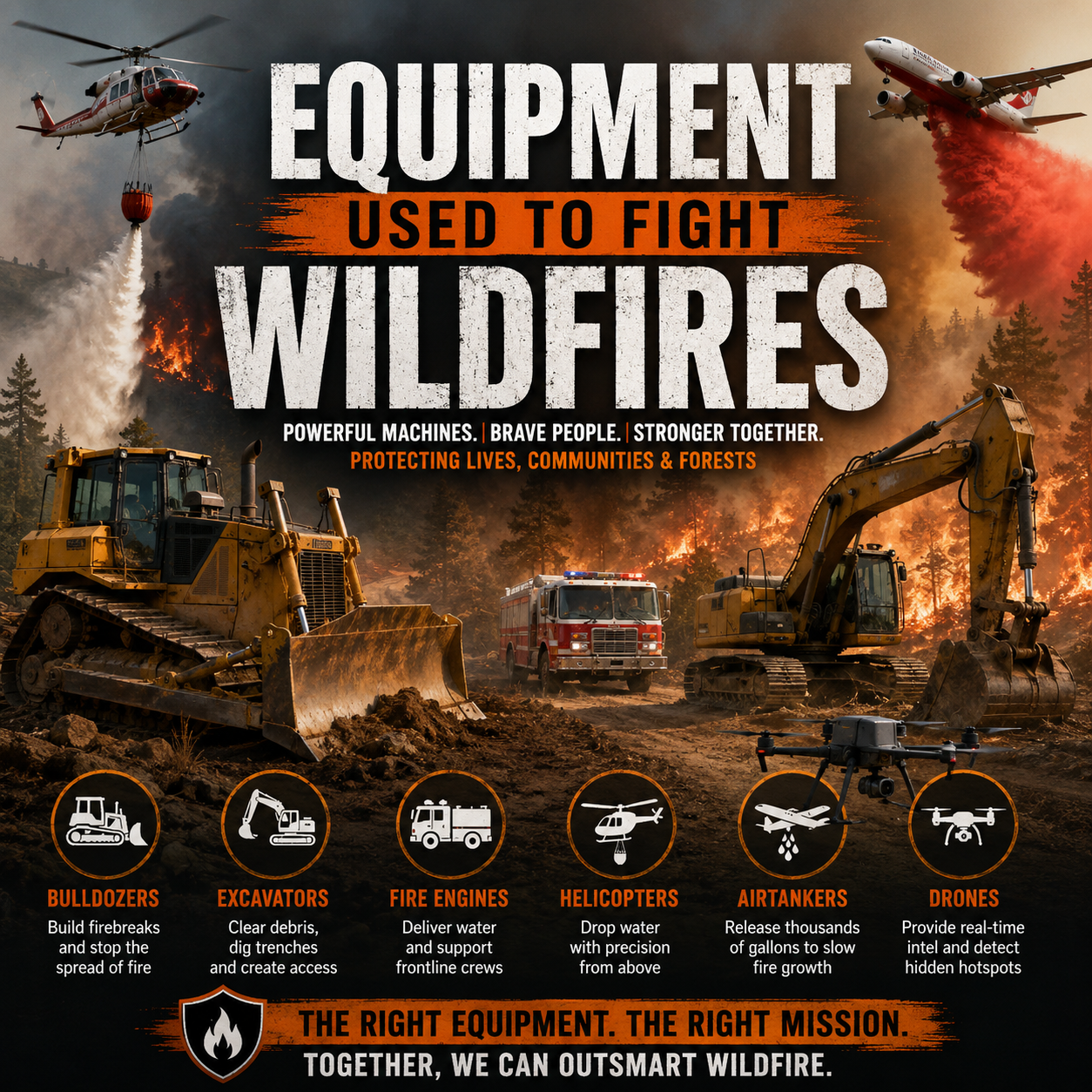
The Role of Heavy Equipment in Fighting Wildfires
Every wildfire season brings dramatic images of firefighters battling towering flames, but behind every successful firefighting operation is an impressive fleet of specialized heavy equipment. From clearing firebreaks to dropping thousands of gallons of water from the sky, these machines play a critical role in containing wildfires and protecting communities.
As climate change, drought, and expanding development in wildfire-prone areas contribute to increasingly severe fire seasons, the equipment used to combat these blazes has become more advanced than ever. Here's a look at some of the most important machines that help firefighters take on nature's most destructive force.
Bulldozers: Building the Front Line
Few pieces of equipment are as indispensable during a wildfire as the bulldozer. Their primary mission isn't extinguishing flames—it's stopping them from spreading.
Bulldozers create firebreaks, strips of cleared land where all vegetation has been removed. Without fuel to burn, the fire often slows or stops altogether.
Wildfire dozers are often equipped with:
- Heavy-duty blade protection
- Reinforced cooling systems
- Fire-resistant cab shielding
- Emergency escape features
- Protective screens over windows and radiators
Experienced operators work in dangerous conditions, sometimes just yards ahead of advancing flames. Precision is critical because an improperly placed firebreak may be ineffective or even worsen erosion after the fire.
Excavators: Precision in Difficult Terrain
While bulldozers are ideal for wide firebreaks, excavators excel in areas where precision matters.
Excavators are commonly used to:
- Remove burning trees
- Dig containment trenches
- Clear hazardous debris
- Create access routes for firefighters
- Remove fuel sources near structures
Tracked excavators are especially valuable on steep slopes and uneven terrain where wheeled equipment struggles.
Motor Graders: Expanding Existing Roads
Motor graders help widen logging roads and forest access routes, allowing fire engines and emergency vehicles to reach remote locations more safely.
They can also:
- Smooth temporary access roads
- Create secondary firebreaks
- Improve drainage after firefighting efforts
In large wildfire campaigns, logistics are just as important as suppression, and graders help keep equipment moving efficiently.
Water Tenders: Mobile Water Supply
Wildfires often occur far from municipal water systems.
Water tenders transport thousands of gallons of water to firefighters working in remote areas. Unlike fire engines, their primary role is supplying water rather than directly fighting flames.
Many include:
- High-capacity pumps
- Portable water tanks
- Quick-fill connections
- Off-road capability
Water tenders become essential lifelines during extended firefighting operations.
Fire Engines Built for the Wildland
Wildland fire engines differ significantly from the large structural fire trucks seen in cities.
Designed specifically for rugged terrain, they feature:
- Four-wheel drive
- High ground clearance
- Smaller, more maneuverable frames
- Specialized hose systems
- Water tanks typically ranging from 200 to 1,000 gallons
Their ability to navigate narrow forest roads makes them one of the first pieces of equipment deployed to new fires.
Skid Steers and Compact Track Loaders
Compact equipment fills an important niche where larger machines simply won't fit.
Skid steers and compact track loaders can:
- Remove brush
- Clear vegetation around homes
- Build defensible space
- Move supplies
- Support mop-up operations after the fire passes
Their versatility makes them valuable throughout every phase of wildfire response.
Helicopters: Precision Firefighting from Above
Helicopters provide flexibility that no ground equipment can match.
Using suspended water buckets or fixed tanks, helicopters can:
- Drop water with remarkable accuracy
- Transport firefighters
- Deliver supplies
- Conduct aerial reconnaissance
- Evacuate injured personnel
They are especially effective during the early stages of a wildfire before it grows beyond initial containment efforts.
Airtankers: Massive Aerial Support
Large fixed-wing aircraft are among the most recognizable wildfire-fighting machines.
These aircraft drop thousands of gallons of:
- Water
- Fire retardant
- Suppressant foam
Rather than extinguishing fires outright, retardant slows fire growth, giving ground crews valuable time to establish containment lines.
Some of the world's largest airtankers can release more than 15,000 gallons in a single pass.
Drone Technology Is Changing Firefighting
Unmanned aerial vehicles (UAVs), commonly known as drones, have rapidly become valuable firefighting tools.
Equipped with thermal cameras, drones can:
- Detect hidden hotspots
- Map fire perimeters
- Monitor fire behavior
- Identify dangerous terrain
- Operate during nighttime hours
Because drones reduce the need to send personnel into hazardous areas, they improve both safety and situational awareness.
Forwarders and Forestry Equipment
In heavily forested regions, forestry equipment often joins wildfire operations.
Machines such as:
- Forwarders
- Feller bunchers
- Mulchers
- Harvesters
can remove hazardous fuel loads, clear emergency access corridors, and assist with long-term forest management projects designed to reduce wildfire risk.
Preventative fuel reduction has become one of the most effective strategies for limiting catastrophic wildfire intensity.
Aircraft Support Vehicles
Air operations depend on more than aircraft alone.
Ground support equipment includes:
- Fuel trucks
- Mobile maintenance units
- Retardant mixing systems
- Aircraft loaders
- Portable command centers
These support vehicles keep aerial firefighting operations running around the clock during major wildfire incidents.
The Human Element
Despite incredible advances in equipment, machines alone cannot stop wildfires.
Success depends on the coordinated efforts of:
- Heavy equipment operators
- Wildland firefighters
- Aviation crews
- Incident commanders
- Mechanics
- Engineers
- Meteorologists
- Emergency management personnel
Every machine requires skilled professionals who understand both the equipment and the unpredictable nature of wildfire behavior.
Technology Is Making Equipment Smarter
Modern wildfire equipment increasingly incorporates advanced technology such as:
- GPS machine guidance
- Real-time fleet tracking
- Satellite communications
- Thermal imaging
- Remote weather monitoring
- AI-assisted fire prediction models
These innovations allow incident commanders to deploy resources more efficiently while improving firefighter safety.
------------------------------------------------------------------------------------------------------------------
Wildfires are among the most challenging natural disasters to combat, requiring a coordinated response from specialized equipment on the ground and in the air. Bulldozers carve life-saving firebreaks, excavators remove dangerous obstacles, helicopters deliver precision water drops, and advanced drones provide critical intelligence that wasn't possible just a decade ago.
As wildfire seasons continue to grow longer and more intense around the world, the role of heavy equipment will only become more important. Behind every containment line and every protected community is an extraordinary combination of engineering, skilled operators, and determination working together against one of nature's most powerful forces.