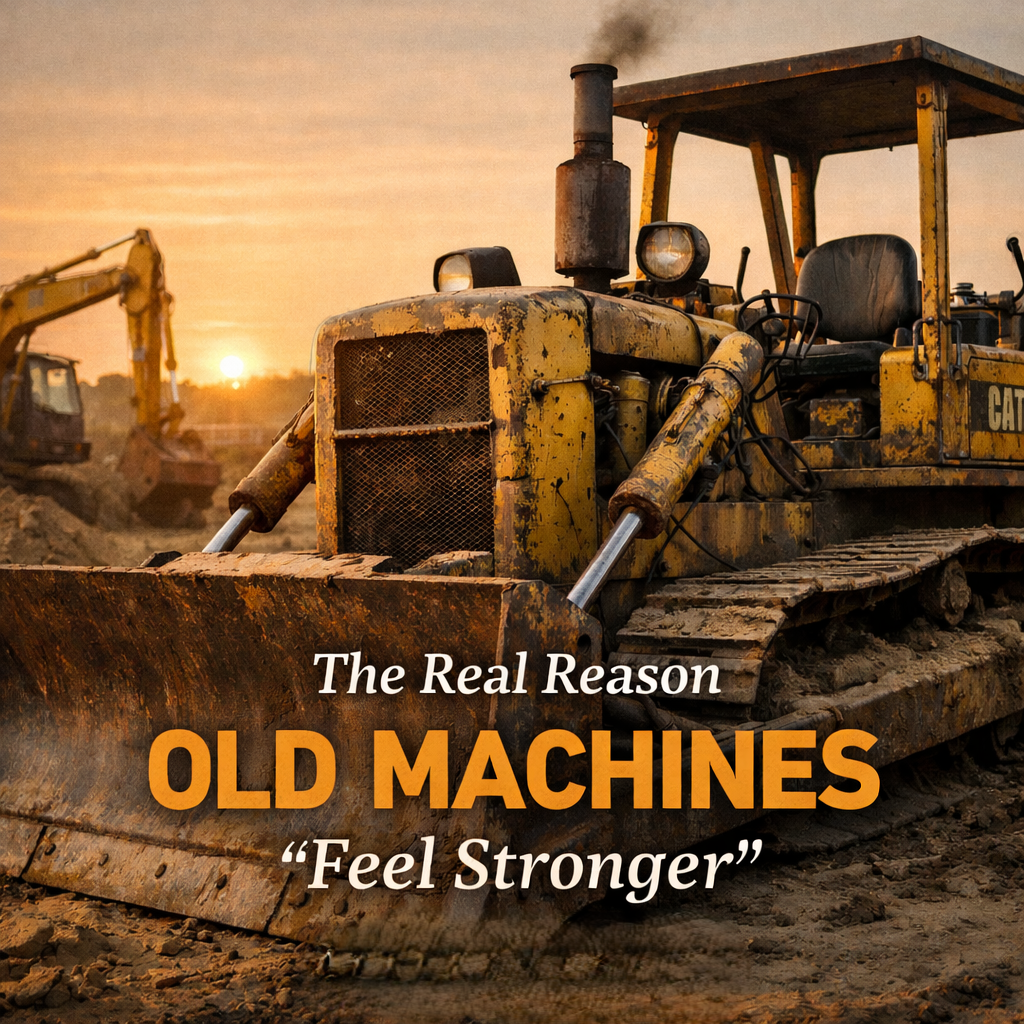
The Real Reason Old Machines “Feel Stronger”
Anyone who’s run equipment long enough knows the feeling.
You climb into an older machine, maybe one that smells faintly of diesel and warm oil, the paint worn smooth where generations of boots climbed in. You ease the throttle up, drop the blade or curl the bucket, and almost immediately you think:
This thing has more guts than anything new.
It’s a common belief, and it’s usually spoken with a little pride and a little sadness. Because whether or not it’s technically true, it feels true. And that feeling comes from somewhere real.
When Power Was Honest
Older machines had very little standing between the operator and the iron.
You moved a lever, and something mechanical happened.
You asked for more, and the engine answered in real time—lugging, growling, or digging in its heels. There was no software smoothing things out, no invisible hand deciding when you’d had enough.
If the machine was working hard, you knew it.
If it was unhappy, it told you.
That honesty builds trust. Over time, you learn exactly how much the machine has left, and you’re rarely surprised by it.
Weight, Steel, and a Sense of Permanence
Many old machines carried more steel than they strictly needed. Frames were thicker. Booms felt solid. Nothing was in a hurry.
They didn’t snap into motion; they leaned into the work.
When you loaded an old machine, the weight settled, the engine tone dropped, and the whole structure seemed to say, Alright then—let’s do this. That sense of mass, of momentum, is something operators still miss.
Modern machines are faster, lighter, and far more efficient—but old iron felt rooted to the ground.
Feedback You Could Feel in Your Bones
Old machines spoke through vibration, sound, and resistance.
You could hear the pump load up.
You could feel the frame twist just enough to warn you.
You learned to read the machine the way a sailor reads wind and water.
Nothing was hidden. Nothing was filtered.
Today’s machines may be doing more work per hour, but they do it quietly, smoothly, and politely. The old ones made you part of the process. They demanded attention—and rewarded skill.
Strength Without Apologies
Older machines didn’t protect themselves from you.
If you pushed too hard, they didn’t step in and save you from your own ambition. Sometimes something bent. Sometimes something broke. But often, the machine surprised you by taking more than you expected.
That freedom—borderline reckless by modern standards—felt like strength.
Not because the machine was invincible, but because it trusted the operator.
The Ones That Earned Their Place
There’s also a reason the old machines we remember are still around.
They survived winters, bad fuel, rushed maintenance, and operators who learned by doing. The fragile ones disappeared quietly. What’s left are the machines that proved themselves again and again.
We remember those machines. The ones that earned names. The ones you still glance back at when you shut them down for the night.
Progress, With a Little Bit of Loss
Modern machines are marvels:
- More productive
- More efficient
- Safer for operators and components alike
They are better tools, by almost every measurable standard.
But in becoming smarter, they’ve also become more reserved. They shield you from the strain, the noise, and the consequences. And in doing so, they’ve taken away some of the raw connection that made old iron feel alive.
Why Old Machines Still Feel Stronger
Old machines feel stronger because:
- They gave you everything they had
- They spoke plainly and loudly
- They carried their weight with confidence
- They trusted the operator to know the line
They weren’t perfect. They weren’t gentle.
But they were loyal, predictable, and deeply human in the way they worked.
And that kind of strength sticks with you long after the engine cools.