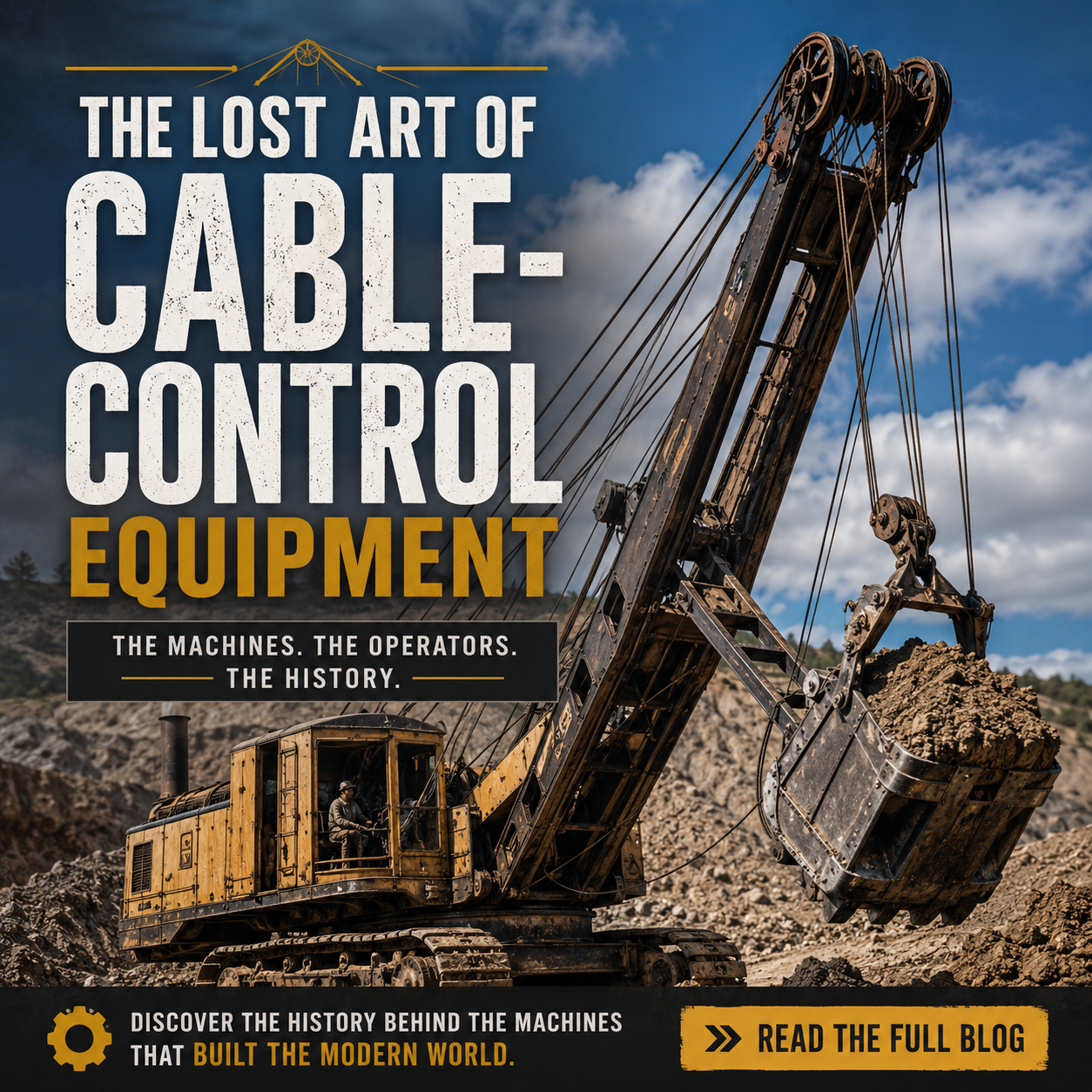
The Lost Art of Cable-Control Equipment
Before hydraulic cylinders became the standard on construction sites around the world, heavy equipment operators relied on a different technology to move earth, lift loads, and build infrastructure. Known as cable-control equipment, these machines dominated the industry for decades and helped shape many of the roads, dams, mines, and cities we still use today.
While most modern operators have never run a cable machine, these mechanical giants represent an important chapter in heavy equipment history—and a level of operating skill that has largely disappeared from today's jobsites.
What Is Cable-Control Equipment?
Cable-control equipment uses steel cables, drums, sheaves, and clutches to operate attachments instead of hydraulic cylinders. The movement of the machine's working components is controlled by winding and unwinding cables powered by the machine's engine.
Common cable-operated machines included:
- Crawler tractors with cable blades
- Draglines
- Cable excavators
- Clamshell cranes
- Lattice boom cranes
- Scrapers
- Logging equipment
These machines were often powered by large gasoline or diesel engines and required extensive mechanical knowledge to operate effectively.
A Different Kind of Operator
Operating cable equipment was often described as both an art and a science.
Unlike modern hydraulic controls that provide smooth and predictable movement, cable systems required operators to coordinate multiple levers, clutches, and brakes simultaneously. Every movement involved anticipation, timing, and feel.
Experienced operators learned to:
- Judge cable tension by sound and vibration
- Coordinate boom and bucket movements precisely
- Manage load swing manually
- Prevent cable overruns and tangles
- Operate efficiently with limited visibility
Many veteran operators could perform remarkably precise work with machines that lacked modern electronics, sensors, cameras, or computerized controls.
The Rise of the Dragline
Few machines symbolize the cable era better than the dragline.
Draglines were once common sights on major excavation projects, strip mines, and canal construction sites. Using a large bucket suspended from cables, these machines could move enormous volumes of material with impressive efficiency.
Some of the world's largest draglines remain among the biggest land vehicles ever built. Their massive booms and intricate cable systems continue to fascinate heavy equipment enthusiasts today.
Although hydraulic excavators have replaced draglines in many applications, some mining operations still use giant draglines where their unique capabilities remain advantageous.
Why Hydraulics Took Over
Beginning in the 1950s and accelerating through the 1960s and 1970s, hydraulic technology transformed the heavy equipment industry.
Hydraulic systems offered several advantages:
- Greater precision
- Faster cycle times
- Easier operation
- Reduced maintenance
- Improved safety
- More compact machine designs
Manufacturers quickly recognized that hydraulic machines could be operated more efficiently and with less specialized training. As hydraulic technology improved, cable-operated equipment gradually disappeared from most construction sites.
By the 1980s, hydraulic excavators and loaders had become the dominant machines for earthmoving and construction work.
The Skills That Are Being Lost
As older operators retire, much of the practical knowledge associated with cable equipment is disappearing.
Skills such as cable splicing, drum rigging, clutch adjustment, and mechanical troubleshooting were once essential parts of an operator's toolkit. Today, many technicians and operators have never encountered these systems outside of museums, historical photographs, or online videos.
For equipment enthusiasts, preserving this knowledge matters because it represents the foundation upon which modern machinery was built.
Understanding cable machines also provides valuable insight into how engineers solved complex problems long before computers and advanced hydraulics existed.
The Collectors Keeping History Alive
Fortunately, a dedicated community of collectors, restorers, and equipment historians continues to preserve cable-control machines.
Across North America, antique equipment shows regularly feature operating examples of:
- Cable bulldozers
- Draglines
- Steam shovels
- Lattice boom cranes
- Early crawler tractors
These events allow younger generations to see firsthand how construction equipment operated before the hydraulic revolution.
Restoring these machines is often a labor of love. Replacement parts can be difficult to find, and maintaining decades-old mechanical systems requires specialized knowledge that is becoming increasingly rare.
Why Enthusiasts Still Love Cable Machines
For many heavy equipment enthusiasts, cable machines represent a time when machinery was visible, understandable, and mechanically elegant.
Operators could see every moving component at work. The cables, drums, clutches, and gears created a direct connection between the machine and the operator that many believe has been lost in today's electronically controlled equipment.
The sights and sounds of a working cable machine—the clatter of the drums, the movement of the cables, and the skill of the operator—remain captivating reminders of an era when operating heavy equipment required a unique blend of strength, timing, and craftsmanship.
As technology continues to advance, preserving the history and knowledge of cable-operated equipment becomes increasingly important. For enthusiasts, operators, and historians alike, the lost art of cable-control equipment serves as a reminder that some of the most impressive engineering achievements were accomplished long before the arrival of modern hydraulics.