The Excavator Attachment That Freezes the Ground
Excavators are usually associated with breaking, digging, ripping and moving earth. But on certain construction projects, an excavator can be part of a process that does almost the opposite: freezing the ground solid before excavation begins.
Ground freezing is a specialized construction technique used when contractors need to temporarily strengthen unstable or water-saturated soil. Instead of trying to pump away groundwater or permanently stabilize difficult soil, engineers can deliberately freeze the water already contained within it.
And in some applications, excavators equipped with specialized attachments can help install the equipment that makes that frozen ground possible.
Why Would Anyone Want to Freeze the Ground?
Imagine trying to excavate through loose, saturated sand below the groundwater table. As material is removed, groundwater can flow toward the excavation, carrying soil with it and potentially destabilizing the surrounding ground.
One solution is artificial ground freezing.
The basic idea is surprisingly straightforward. Pipes or probes are installed into the soil, and a refrigeration system removes heat from the surrounding ground. As the temperature falls below freezing, pore water in the soil freezes.
Eventually, individual frozen zones can grow together into a continuous mass.
The resulting frozen ground can become stronger and substantially less permeable to water. Engineers can use that temporary frozen structure to help create shafts, tunnels, excavations or underground passages.
Once refrigeration stops, the ground eventually thaws.
Where Does the Excavator Come In?
Ground freezing doesn't necessarily require an excavator. Freeze pipes are commonly installed using drilling equipment, particularly when deep, vertical or highly controlled installations are required.
But there are applications where excavators can become part of the installation process.
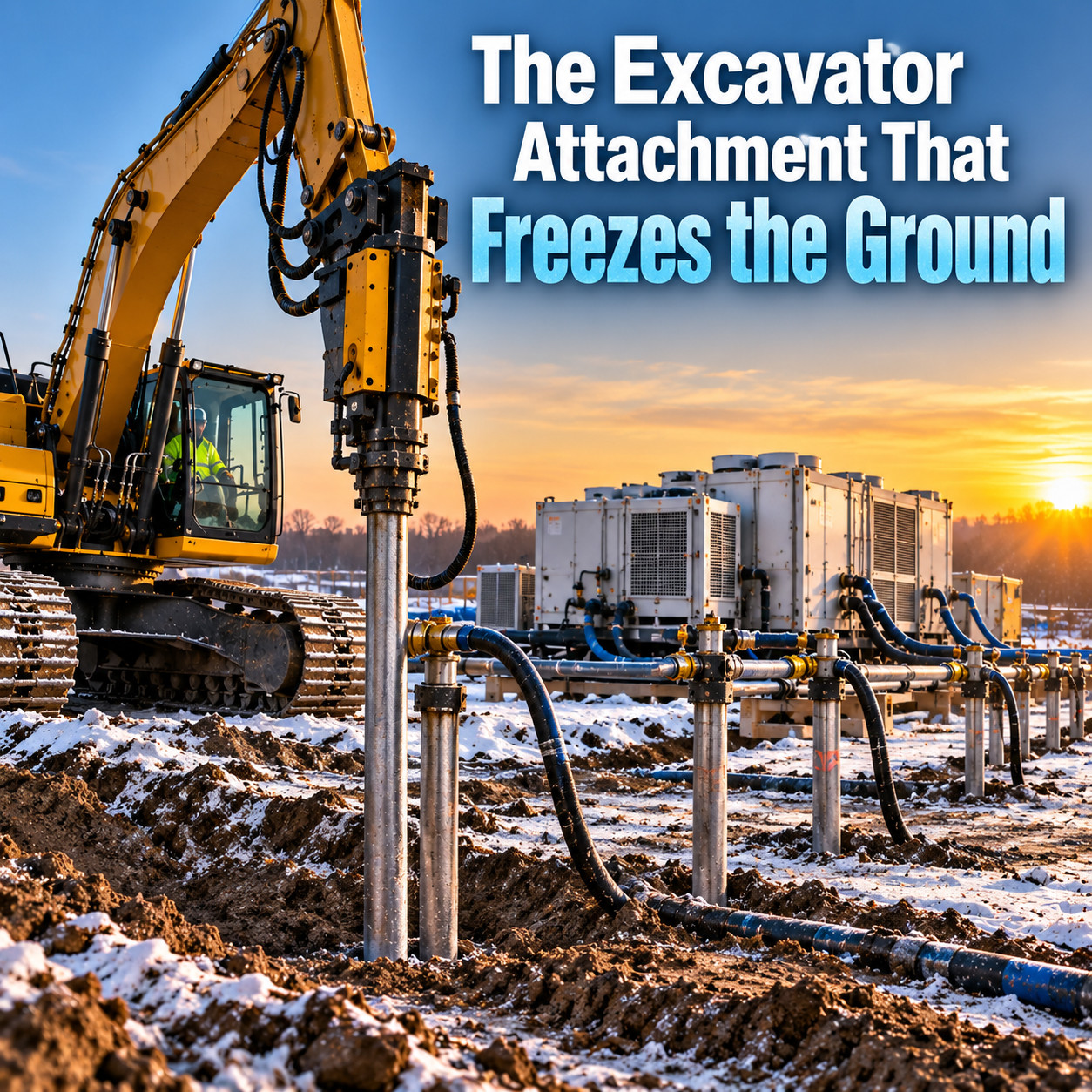
Specialized excavator-mounted equipment can be used to install freezing probes or related ground-treatment equipment into suitable soil conditions. Depending on the system and project, the excavator may position, push, vibrate or otherwise assist with installing probes into the ground.
That makes the excavator an installation platform rather than the actual refrigeration machine.
In other words, the excavator attachment isn't usually producing the cold itself.
It is helping install the components through which the freezing system will operate.
That distinction is important because photographs of these systems can make them look like some kind of giant excavator-powered freezer.
The real process is considerably more complex.
How Is the Ground Actually Frozen?
One common artificial ground-freezing method uses a network of freeze pipes connected to a refrigeration plant.
A chilled fluid—often a brine solution—is circulated through the pipes. Heat transfers from the surrounding soil toward the colder pipe and circulating fluid.
As heat continues to be removed, frozen soil begins forming around each pipe.
Picture a series of cylinders of frozen ground slowly expanding underground.
If the freeze pipes have been positioned correctly, those cylinders eventually intersect, creating a continuous frozen barrier.
Temperature monitoring is extremely important. Engineers need to know whether the frozen zone has actually reached the required dimensions and temperature before excavation proceeds.
This isn't simply a matter of putting pipes into the ground and waiting until the surface looks frozen.
Most of the important work is happening underground.
Liquid Nitrogen Can Freeze Ground Much Faster
Another ground-freezing technique uses liquid nitrogen.
Liquid nitrogen is extremely cold—approximately -196°C (-321°F) at atmospheric pressure. When used in ground-freezing systems, it can remove heat very rapidly.
That can make nitrogen freezing useful when speed is particularly important.
However, rapid freezing comes with different logistical and economic considerations. Liquid nitrogen must be supplied to the project, stored and handled appropriately, and continuously replaced as it is consumed.
Mechanical refrigeration systems using circulating coolant can be more practical for longer-duration projects.
The correct system depends on the soil, groundwater, project geometry, schedule and engineering requirements.
Ground Freezing Can Create an Underground Wall
One of the most interesting things about this technique is that contractors aren't necessarily trying to freeze the entire construction site.
Instead, freeze pipes can be arranged strategically.
For example, engineers might position them in a ring around the location of a future shaft. As the frozen zones surrounding individual pipes expand and connect, they can form a frozen soil wall around the excavation.
Workers can then excavate inside that protected area.
Other configurations can create frozen arches, barriers or blocks of soil depending on what the project requires.
Essentially, engineers can temporarily turn groundwater-bearing soil into part of the construction system.
Where Is Ground Freezing Used?
Artificial ground freezing has been used in some remarkably challenging environments.
It can be considered for projects involving:
• Tunnel construction
• Mine shafts
• Underground stations
• Utility installations
• Deep foundations
• Excavations below the groundwater table
• Cross-passages between tunnels
• Emergency groundwater control
• Temporary excavation support
It can be especially valuable when conventional dewatering would be difficult or could cause problems elsewhere.
Removing groundwater can sometimes change underground water pressures or contribute to settlement in surrounding areas. Ground freezing provides another option because the water can remain in the soil while being temporarily immobilized.
The Soil Matters
Ground freezing doesn't behave identically in every soil.
Water content, groundwater movement, soil type, salinity and temperature can all affect how quickly and effectively a frozen zone develops.
Groundwater movement is particularly important.
If relatively warm groundwater is constantly flowing through the treatment area, the refrigeration system has to remove not only heat stored in the soil but also heat continually arriving with the moving water.
That can make freezing more difficult.
Engineers therefore investigate underground conditions before designing the freeze-pipe arrangement, refrigeration capacity and expected freezing period.
The Equipment Above Ground Can Be Impressive Too
The excavator or drilling rig installing the probes may be the most visually obvious machine on the project, but it represents only one piece of the system.
A ground-freezing operation can also involve refrigeration equipment, pumps, insulated piping, manifolds, temperature sensors, monitoring systems, generators and specialized drilling or installation equipment.
There may be dozens—or considerably more—freeze pipes connected into a carefully engineered network.
The system then operates continuously while the frozen structure develops underground.
Once the required frozen zone has been verified, excavation can begin.
Excavators May Still Have to Dig the Frozen Material
There's another interesting consequence of the process.
After deliberately freezing the ground to make excavation possible, contractors may then have to excavate some of that frozen material.
Frozen soil can behave very differently from ordinary soil.
Depending on its composition and temperature, material that would normally scoop easily with a bucket can become extremely hard. Excavators may require ripping tools, hydraulic breakers or other techniques to remove it efficiently.
So the sequence can become rather unusual:
Install freezing equipment. Freeze the ground. Then bring heavy equipment back to break through the ground you intentionally froze.
It sounds backwards until you consider what the frozen ground is accomplishing around the excavation.
It Is Temporary Ground Engineering
Perhaps the most fascinating part of artificial ground freezing is that the frozen soil itself becomes a temporary construction material.
There is no manufactured retaining wall arriving on a truck.
Instead, engineers change the physical properties of the existing ground.
Water that once contributed to unstable, flowing soil becomes ice binding soil particles together and restricting groundwater movement.
When the underground work is finished, the refrigeration equipment can be shut down.
Heat gradually returns to the frozen zone, the ice melts and the soil moves back toward its unfrozen condition.
That makes ground freezing unusual even among specialized construction techniques: the structure is created from the ground itself and is designed to eventually disappear.
Another Job for the Excavator Nobody Expects
Excavator attachments already allow one machine to hammer rock, compact soil, cut trees, drive piles, crush concrete and handle materials.
Ground-freezing projects add an even stranger role.
An excavator may help install the equipment that transforms saturated soil into a temporary frozen structure strong enough to support excavation.
The machine isn't simply digging the ground.
It's helping engineers change the ground before anyone digs it.
And that may be one of the more unusual jobs you'll ever see an excavator doing.