The Engineering Tradeoffs Behind Short-Radius Excavators
Short-radius excavators are everywhere—urban jobsites, roadwork, utility corridors, and tight industrial plants. They can swing within their tracks, work next to traffic, and operate where conventional machines simply don’t fit.
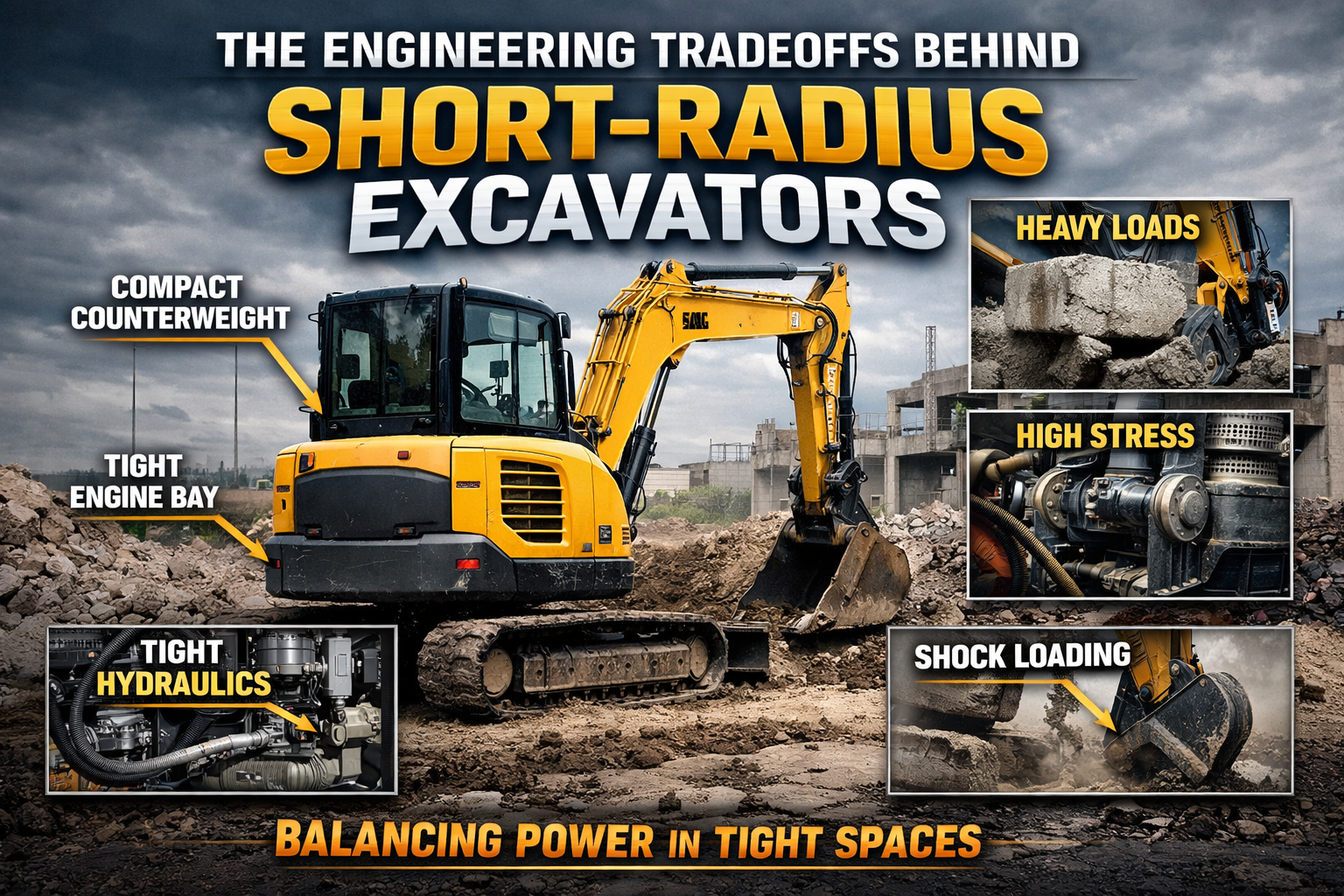
But that compact tail swing comes with real engineering compromises. A short-radius excavator isn’t just a normal machine with less counterweight—it’s a different balance of physics, structure, hydraulics, and durability.
Let’s break down what engineers had to give up to make them work.
Counterweight Mass vs Stability
On a conventional excavator, stability comes from one simple thing: a long lever arm. The counterweight sticks out far behind the swing center, giving it mechanical advantage.
Short-radius machines lose that leverage.
To compensate, manufacturers must:
- Increase counterweight density (heavier material in a smaller volume)
- Widen the undercarriage relative to machine size
- Lower the center of gravity wherever possible
Even with these tricks, short-radius machines generally have:
- Lower rated lift capacities at full reach
- Less margin for error on uneven ground
This is why operators often say they “feel tippier” near the edge of the envelope—because they are.
Higher Structural Loads on the House and Swing System
When the counterweight is closer to the swing center, more of the working load transfers directly into:
- The swing bearing
- The house structure
- The upper frame weldments
Instead of load being balanced by distance, it’s absorbed by strength.
That means:
- Thicker steel sections
- Heavier gusseting
- Reinforced swing ring mounts
Over time, this also means fatigue becomes more critical, especially for machines doing repetitive lifting or hammer work.
Reduced Engine and Cooling Space
Packaging is one of the hardest problems engineers face on short-radius machines.
You still need:
- An engine with enough torque
- Hydraulic pumps
- Cooling packages for engine oil, hydraulics, and charge air
- Aftertreatment systems (DPF, SCR)
All of that has to fit into a much tighter envelope.
Tradeoffs include:
- Smaller cooling surfaces
- Tighter airflow paths
- Less thermal buffer under heavy load
This is why short-radius excavators are often more sensitive to:
- Dirty coolers
- Plugged radiators
- High-ambient or high-load conditions
Cooling isn’t worse—but it’s less forgiving.
Tighter Hydraulic Layouts and Hose Stress
Less space means shorter hose runs, tighter bends, and denser routing.
That leads to:
- Higher hose flex cycles
- Increased abrasion risk
- More heat concentration around valves and pumps
Manufacturers mitigate this with:
- Better hose materials
- Clamps and abrasion guards
- Smarter routing
Still, hose life can be shorter if maintenance and inspections aren’t taken seriously.
Shorter Moment Arms Increase Shock Loading
With less counterweight leverage, the machine relies more on hydraulic force than mass balance.
That changes how shock loads travel:
- Sudden stops transmit more force into the house
- Swing braking loads spike faster
- Attachment impacts travel deeper into the structure
This is especially noticeable when:
- Swinging heavy buckets quickly
- Working on slopes
- Running hammers or compactors
Operators who are smooth on a conventional machine may need to adjust their habits on short-radius iron.
Serviceability Takes a Hit
Compact packaging almost always hurts service access.
Common compromises:
- Side-by-side filters instead of spread-out layouts
- Hinged panels with tighter working clearances
- Components stacked vertically
Nothing is “unserviceable,” but:
- Daily checks matter more
- Deferred maintenance hurts faster
- Small issues escalate quicker
Short-radius machines reward disciplined upkeep.
Why They’re Still Worth It
With all these tradeoffs, why do short-radius excavators dominate urban work?
Because the advantages are real:
- Safer operation near traffic and structures
- Less tail swing damage
- Higher productivity in tight spaces
- Better jobsite logistics
Engineers didn’t remove capability—they rebalanced it.
Short-radius machines trade:
- Passive stability for structural strength
- Space for packaging efficiency
- Forgiveness for precision
A short-radius excavator isn’t a compromised machine—it’s a purpose-built one.
But it demands:
- Better operator awareness
- More attention to maintenance
- Respect for its load charts and limits
Understand the engineering tradeoffs, and short-radius iron becomes one of the most effective tools on a crowded jobsite. Ignore them, and the machine will remind you—often expensively.