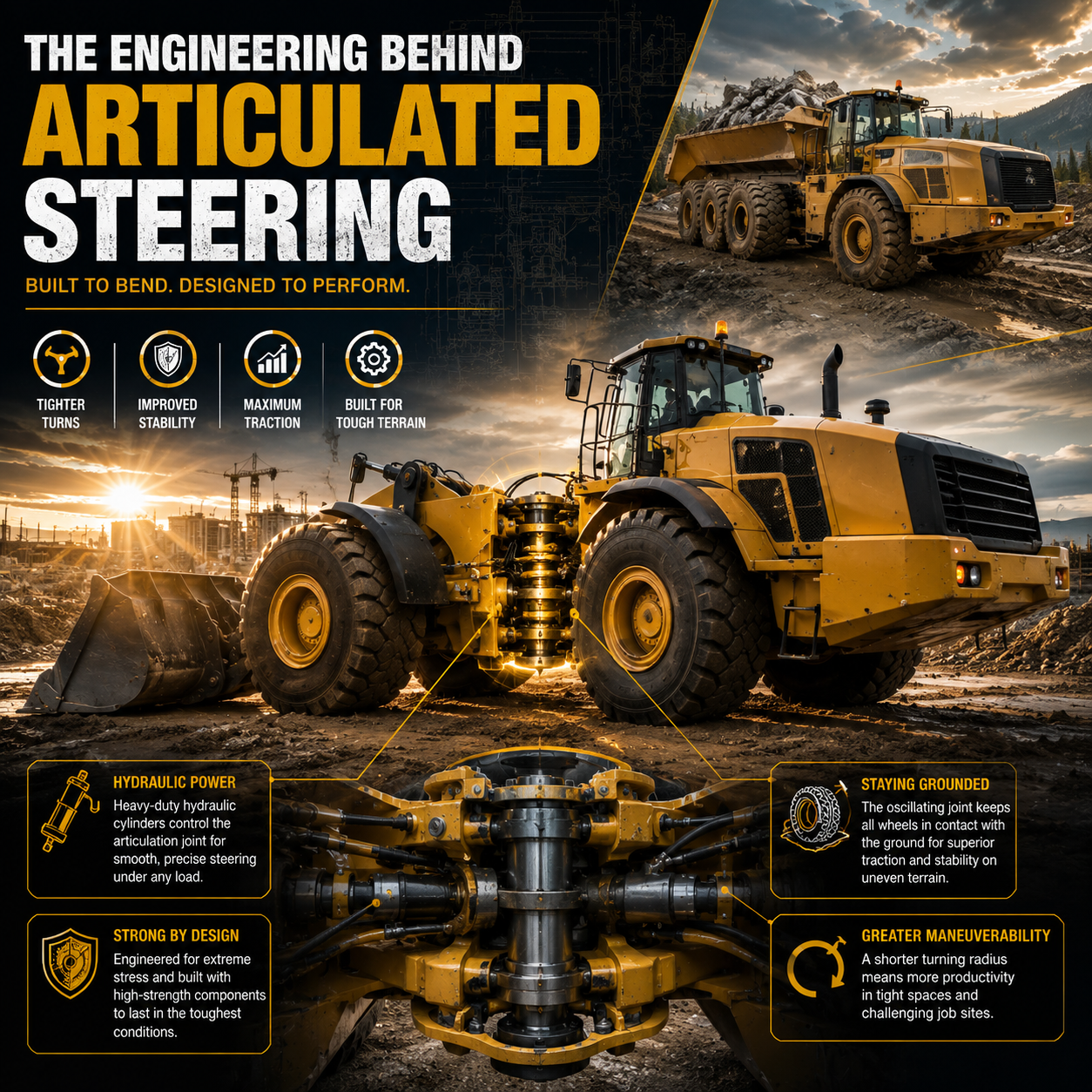
The Engineering Behind Articulated Steering: Why Some Heavy Equipment Bends Instead of Turns
Most people expect a vehicle to steer by turning its front wheels. Cars, pickup trucks, and highway tractors all follow this familiar design. But step onto a construction site or into a quarry, and you'll find machines that seem to bend in the middle instead. This unusual movement isn't a gimmick—it's one of the smartest engineering solutions ever developed for heavy equipment.
Articulated steering allows massive machines to maneuver in places where conventional steering would be impractical or even impossible. From hauling hundreds of tons of material to navigating muddy job sites, articulation has transformed how heavy equipment operates.
Here's a closer look at the engineering principles that make articulated steering so effective.
What Is Articulated Steering?
An articulated machine consists of two separate sections connected by a heavy-duty pivot joint. Instead of turning only the front wheels, hydraulic cylinders rotate the front and rear halves of the machine relative to one another.
Imagine holding two blocks connected by a hinge. Twist one block while holding the other still, and the entire object changes direction. That's essentially how articulated steering works—only on a machine weighing anywhere from 20,000 pounds to well over 100,000 pounds.
The steering angle is created at the center of the machine rather than at the axles.
Why Engineers Chose This Design
The concept solves several engineering challenges at once.
1. A Smaller Turning Radius
Large machines have long wheelbases.
If engineers relied solely on front-wheel steering, these machines would require enormous spaces to turn around.
Articulation dramatically reduces the turning radius by allowing the entire machine to pivot through the center.
This makes operations easier in:
- Construction sites
- Mines
- Forestry operations
- Waste facilities
- Material handling yards
Instead of making wide sweeping turns, articulated machines can snake through confined work areas.
2. Better Weight Distribution
Heavy equipment often carries tremendous loads.
When a wheel loader lifts several cubic yards of gravel or an articulated dump truck carries dozens of tons of rock, maintaining balance becomes critical.
Because articulation keeps both front and rear axles aligned with the machine's direction of travel, weight remains distributed more evenly across all wheels.
This improves:
- Stability
- Traction
- Tire life
- Operator control
3. Superior Off-Road Performance
Construction sites are rarely flat.
Mud, loose gravel, uneven terrain, steep grades, and ruts constantly challenge heavy machinery.
Many articulated machines combine steering articulation with an oscillating center joint.
While articulation allows turning, oscillation allows the front and rear frames to twist independently over uneven ground.
This helps all wheels stay in contact with the surface, maximizing traction and reducing the chance of losing control.
The Hydraulic System That Makes It Work
The heart of articulated steering is hydraulic power.
Large double-acting hydraulic cylinders connect the front and rear frames.
When the operator turns the steering wheel:
- Hydraulic valves direct pressurized fluid.
- One cylinder extends.
- The opposite cylinder retracts.
- The machine pivots smoothly around the articulation joint.
Modern systems are incredibly precise, allowing operators to make fine steering corrections even while carrying heavy loads.
The Engineering Challenge: Stress
Creating a machine that bends introduces enormous engineering challenges.
The articulation joint must withstand:
- Thousands of hours of vibration
- Shock loads
- Twisting forces
- Heavy payloads
- Uneven terrain
- Continuous steering cycles
Engineers use:
- Massive steel pins
- Hardened bushings
- High-strength castings
- Heavy lubrication systems
- Reinforced frame designs
The center joint often becomes one of the strongest parts of the entire machine.
Why Wheel Loaders Love Articulation
Wheel loaders are perhaps the best-known articulated machines.
When approaching a pile, operators often need to:
- Scoop material
- Reverse
- Turn sharply
- Approach a truck
- Dump the load
These movements happen repeatedly throughout the day.
Articulated steering allows quick directional changes without requiring excessive maneuvering space.
It also helps the bucket stay aligned with the pile during loading.
Articulated Dump Trucks
Articulated dump trucks (ADTs) were designed for terrain where rigid-frame haul trucks struggle.
Their articulated design lets them navigate:
- Soft ground
- Tight haul roads
- Forest trails
- Temporary construction roads
- Uneven excavation sites
Because the front tractor and rear dump body can pivot independently, these trucks maintain excellent maneuverability while carrying extremely heavy loads.
Forestry Machines
Logging presents unique steering challenges.
Forestry equipment often operates:
- Between closely spaced trees
- On steep hillsides
- Across roots
- Through mud
- Over rocks
Articulated steering allows operators to weave through obstacles while keeping the machine stable on unpredictable terrain.
Mining Applications
In underground mines, space is limited.
Load-haul-dump (LHD) machines use articulated steering to navigate narrow tunnels where conventional steering simply wouldn't work.
Their compact turning ability increases productivity while reducing the need for oversized haul routes.
Are There Downsides?
Like any engineering solution, articulated steering has trade-offs.
Potential disadvantages include:
- More complex hydraulic systems
- Additional maintenance requirements
- Wear at the articulation joint
- Higher manufacturing costs
- Specialized service procedures
However, for machines operating in demanding off-road environments, the benefits almost always outweigh these drawbacks.
Modern Technology Improves Articulation
Today's articulated machines are smarter than ever.
Many now include:
- Electronic steering sensors
- Steering angle monitors
- Load-sensing hydraulics
- Automatic steering response adjustments
- Stability management systems
- Integrated machine diagnostics
These technologies improve precision while reducing operator fatigue and component wear.
Looking Ahead
As automation becomes more common, articulated steering is evolving alongside it.
Future machines may use:
- Autonomous steering algorithms
- AI-assisted path planning
- Predictive hydraulic control
- Electronic articulation management
- GPS-guided steering corrections
Despite these advances, the basic concept—a machine bending at its center rather than simply turning its wheels—remains one of the most elegant engineering solutions in heavy equipment.
Articulated steering is a perfect example of engineering solving real-world problems. By allowing a machine to pivot at its center, engineers created equipment that is more maneuverable, more stable, and better suited to rough terrain than conventional steering designs.
Whether it's a wheel loader weaving around a busy construction site, an articulated dump truck hauling rock through muddy ground, or an underground mining machine navigating tight tunnels, articulation gives heavy equipment the flexibility to work where traditional vehicles can't.
It's a reminder that in heavy equipment engineering, sometimes the smartest way to move forward is to bend in the middle first.