The Biggest Crane in the World: A Marvel of Engineering Power
When most people think of cranes, they picture something towering over a construction site, lifting steel beams or precast concrete panels. But the biggest cranes in the world are on an entirely different level—machines so massive they can lift entire buildings, bridge sections, or even components of nuclear power plants.
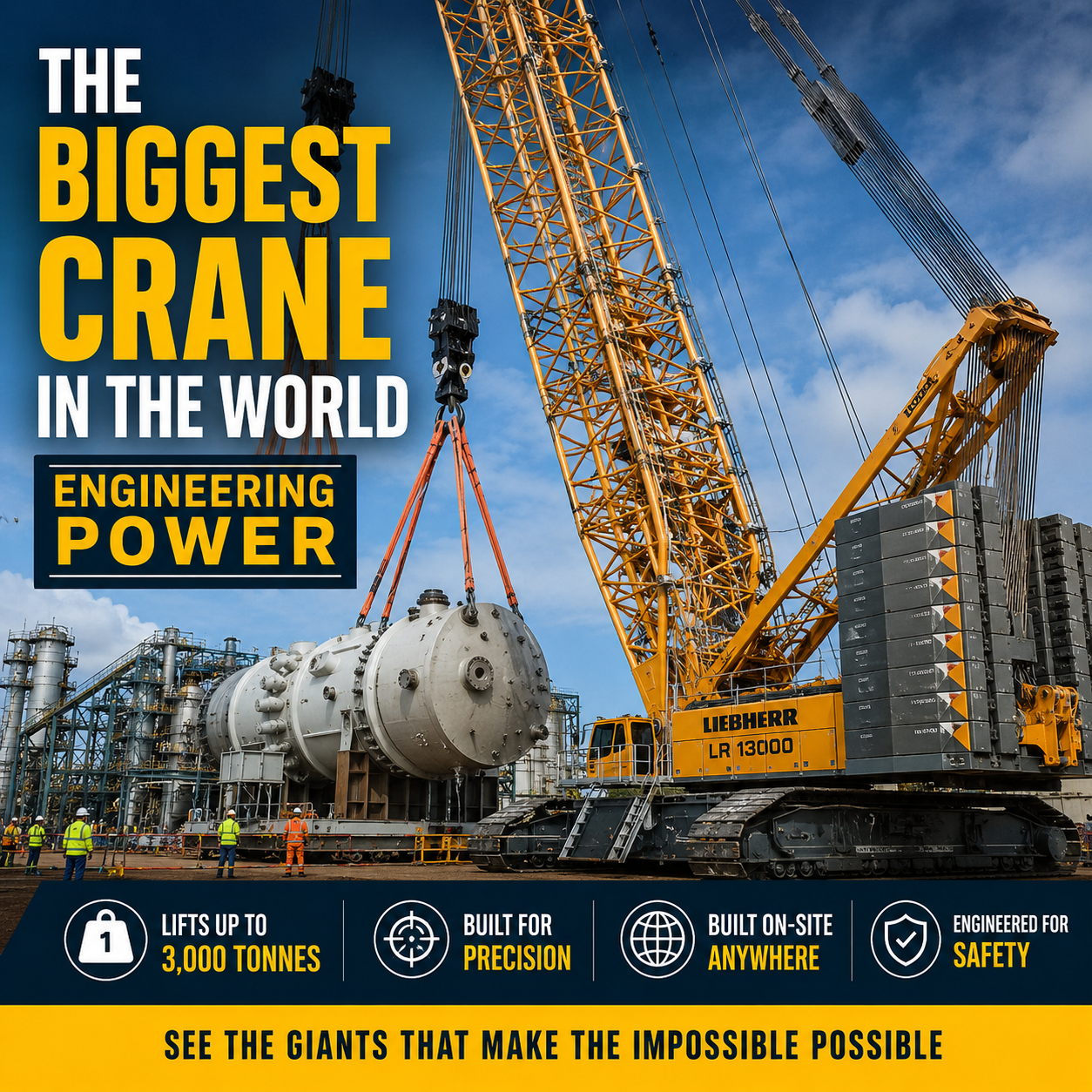
One of the most impressive examples of this engineering category is the Liebherr LR 13000, often regarded as one of the most powerful crawler cranes ever built.
Meet the Giant: Liebherr LR 13000
The Liebherr LR 13000 is a crawler crane designed for extreme heavy lifting. It doesn’t just “lift heavy”—it dominates it.
Here are a few jaw-dropping facts:
- Maximum lifting capacity: around 3,000 tonnes
- Counterweight system: massive modular blocks to stabilize extreme loads
- Use cases: refinery construction, nuclear plants, and large industrial projects
- Mobility: crawls on giant tracked bases instead of wheels
To put that into perspective, this crane could lift roughly the weight of 200–250 adult elephants in a single lift (depending on estimates).
Why It’s Considered One of the “Biggest”
The LR 13000 isn’t just about raw lifting power. Its engineering is about balance, precision, and safety at extreme scale.
Unlike smaller cranes that rely on trucks or basic counterweights, this machine uses:
- Modular assembly (it’s built on-site piece by piece)
- Massive lattice booms extending over 130+ meters
- Advanced load monitoring systems
- Specialized transport logistics just to move its parts
In other words, it’s not just a crane—it’s a temporary industrial structure built for a single purpose: moving the impossible.
Even Bigger: The Floating Giants
While crawler cranes like the LR 13000 dominate land-based lifting, some of the largest cranes in the world float.
One standout is the SGC-250 “Big Carl”, operated by Sarens. It holds records for some of the heaviest single lifts ever performed.
Floating and ring cranes like these are often used for:
- Nuclear power plant construction
- Offshore wind turbine installation
- Oil and gas platform assembly
These machines are so large that they are sometimes transported in sections and assembled like a giant mechanical puzzle.
What Makes These Machines So Cool?
Beyond sheer size, the “cool factor” comes from what they represent:
Human Engineering at Extreme Scale
These cranes are the result of decades of physics, materials science, and mechanical engineering refinement.
Precision With Massive Loads
Despite lifting thousands of tonnes, operators can position loads with millimeter-level accuracy.
Mobile Megastructures
They can be disassembled, transported, and rebuilt across continents.
They Make Impossible Projects Possible
Without these cranes, many modern power plants, bridges, and industrial facilities simply couldn’t be built.
How They Actually Lift So Much
It’s not brute strength alone. The secret is physics:
- Leverage (long booms reduce required force)
- Counterweights (balancing torque)
- Wide tracked bases (spreading ground pressure)
- Load distribution systems (keeping everything stable)
In essence, these cranes don’t “fight” gravity—they outbalance it.
The world’s biggest cranes like the Liebherr LR 13000 and Sarens SGC-250 aren’t just machines—they’re feats of human ambition. They sit at the edge of what’s physically possible, quietly reshaping skylines, energy infrastructure, and industrial capability around the globe.
Next time you see a small crane on a construction site, imagine scaling it up until it can lift an entire building. That’s the world these giants live in—and it’s absolutely fascinating.