Stress Concentrations and Equipment Cracks
Enthusiast Corner
Stress Concentrations in Booms, Sticks, and Loader Arms: Where Cracks Tend to Start
Heavy equipment structures are designed to withstand enormous forces, but even the strongest steel has its limits. When cracks appear in excavator booms, sticks, loader arms, or other major structural components, they rarely occur at random. Most cracks begin in areas known as stress concentrations—locations where loads become focused into a relatively small area of the structure.
Understanding where these stress concentrations occur can help operators, owners, and maintenance personnel spot potential problems early and prevent costly failures.
What Is a Stress Concentration?
A stress concentration is a point in a structure where stress levels become significantly higher than in the surrounding material. Even if the overall load on a boom or loader arm is within design limits, certain features can create localized areas where stress is multiplied.
Common causes include:
- Weld terminations
- Sharp corners
- Changes in material thickness
- Pin bosses and mounting points
- Existing cracks or defects
- Improper repairs
Over thousands of operating hours, these concentrated stresses can initiate fatigue cracks that gradually grow with each loading cycle.
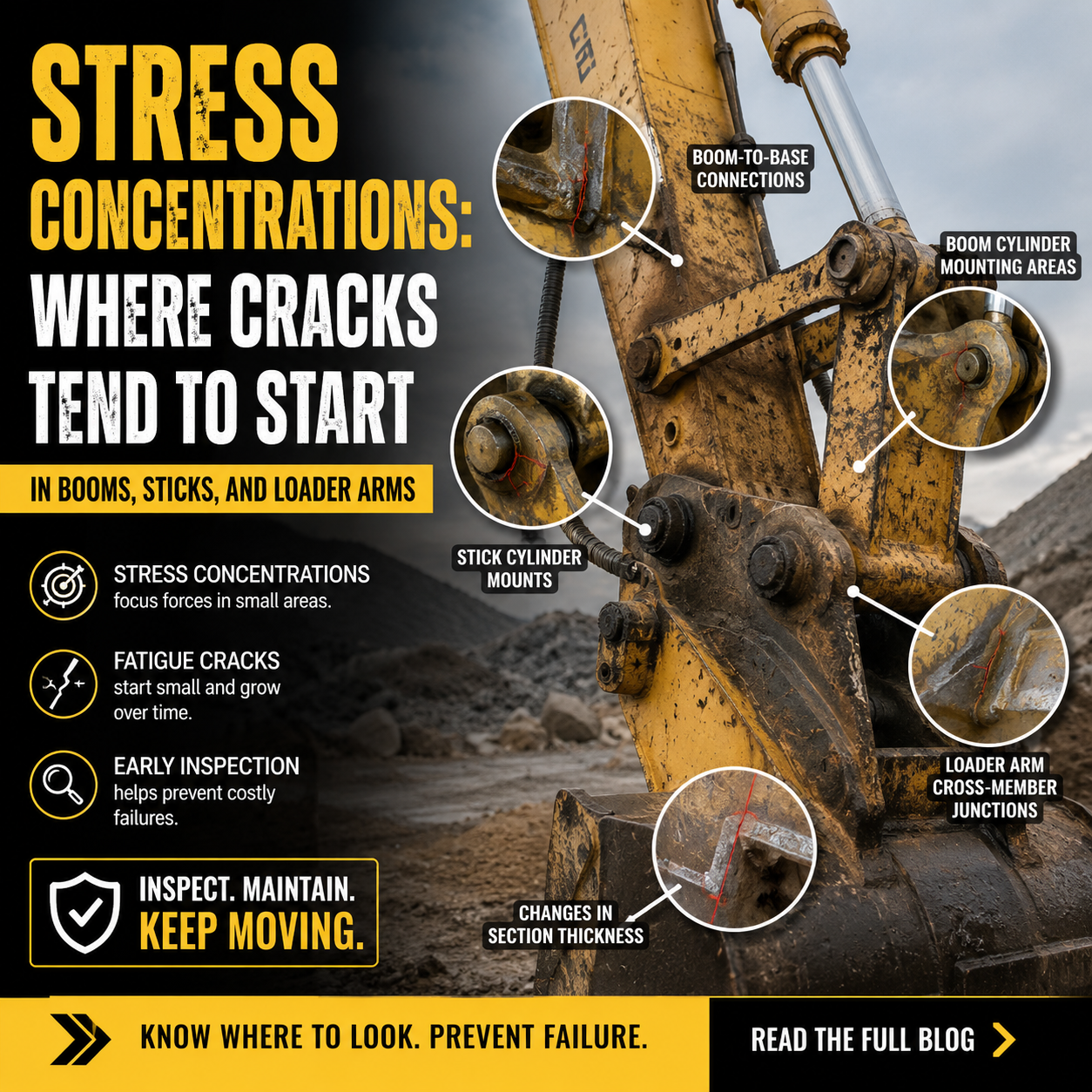
Boom-to-Base Connections
One of the most common crack locations on excavators is near the boom foot where the boom connects to the upper structure.
This area experiences:
- High bending loads
- Shock loads from digging
- Torsional forces during uneven operation
The large pin bosses and surrounding welds create natural stress risers. Cracks often begin at weld toes or in the heat-affected zone adjacent to welds before propagating into the surrounding steel.
Regular inspection around boom foot welds is especially important on machines used in quarrying, demolition, and heavy excavation applications.
Stick Cylinder Mounts
The attachment points for hydraulic cylinders experience tremendous cyclical loading.
Every time the stick cylinder extends or retracts, forces are transferred through the mounting brackets and pin bosses. Over time, the repeated stress reversals can lead to fatigue cracking around:
- Cylinder mounting ears
- Reinforcement plates
- Welded gussets
- Pin bore areas
Wear in pins and bushings can make matters worse by introducing impact loading and uneven force distribution.
Boom Cylinder Mounting Areas
Boom cylinder mounts are another frequent trouble spot.
When operators perform aggressive digging, hammering, or lifting, these mounts can experience sudden load spikes. The combination of thick mounting plates, large welds, and changing cross-sectional geometry creates ideal conditions for stress concentration.
Small cracks often begin where reinforcement plates terminate or where welds intersect.
Loader Arm Cross-Member Junctions
On wheel loaders, cracks frequently appear where cross-members connect to loader arms.
These intersections transfer loads between both sides of the machine and are subjected to:
- Twisting forces
- Bucket breakout loads
- Repeated loading cycles
Because several welded components converge in a relatively small area, stress can become concentrated at weld intersections and corners.
Early cracks may appear as hairline fractures in paint before becoming visible in the underlying steel.
Abrupt Changes in Section Thickness
Engineers generally try to create smooth transitions between thick and thin structural sections.
However, any sudden change in material thickness can increase local stresses. This is particularly true around:
- Reinforcement plates
- Repair patches
- Wear plates
- Structural transitions
A poorly designed repair can sometimes create a new stress concentration that becomes the starting point for future cracking.
Weld Terminations and Weld Toes
Many structural cracks begin not in the steel itself but at the edge of a weld.
The weld toe—the point where weld metal meets the base material—is a natural stress riser. If the weld profile is abrupt or contains undercutting, local stress levels increase significantly.
Likewise, weld terminations can become crack initiation points if they are not properly blended into the surrounding structure.
This is one reason why high-quality welding procedures are critical for structural repairs.
Existing Cracks Create New Stress Concentrations
A small crack is more than just damage—it is also a powerful stress concentrator.
The sharp tip of a crack focuses stress into an extremely small area. As the machine continues operating, the crack tip experiences increasingly high stresses, causing the crack to grow.
This is why small cracks can become major structural failures surprisingly quickly.
How Operators Can Reduce Structural Fatigue
While some fatigue is unavoidable, operators can significantly extend structural life by:
- Avoiding sudden impacts during digging
- Reducing unnecessary travel with loaded buckets
- Avoiding side-loading attachments
- Maintaining pins and bushings
- Respecting lift capacities
- Reporting small cracks immediately
Smooth operation reduces peak loading and minimizes the stress cycles that drive fatigue damage.
The Importance of Early Detection
Most structural failures provide warning signs long before catastrophic failure occurs. Paint cracking, rust streaks emerging from welds, and small visible fractures are often early indicators that a fatigue crack has started.
Routine inspections focused on known stress concentration areas can identify problems while repairs are still relatively simple and inexpensive.
The reality is that booms, sticks, and loader arms are not weakened by a single heavy lift or a single tough day on the job. Most structural failures develop gradually as tiny cracks grow over thousands of load cycles. Understanding where stress concentrations occur helps maintenance teams find these issues early, extending machine life and improving jobsite safety.