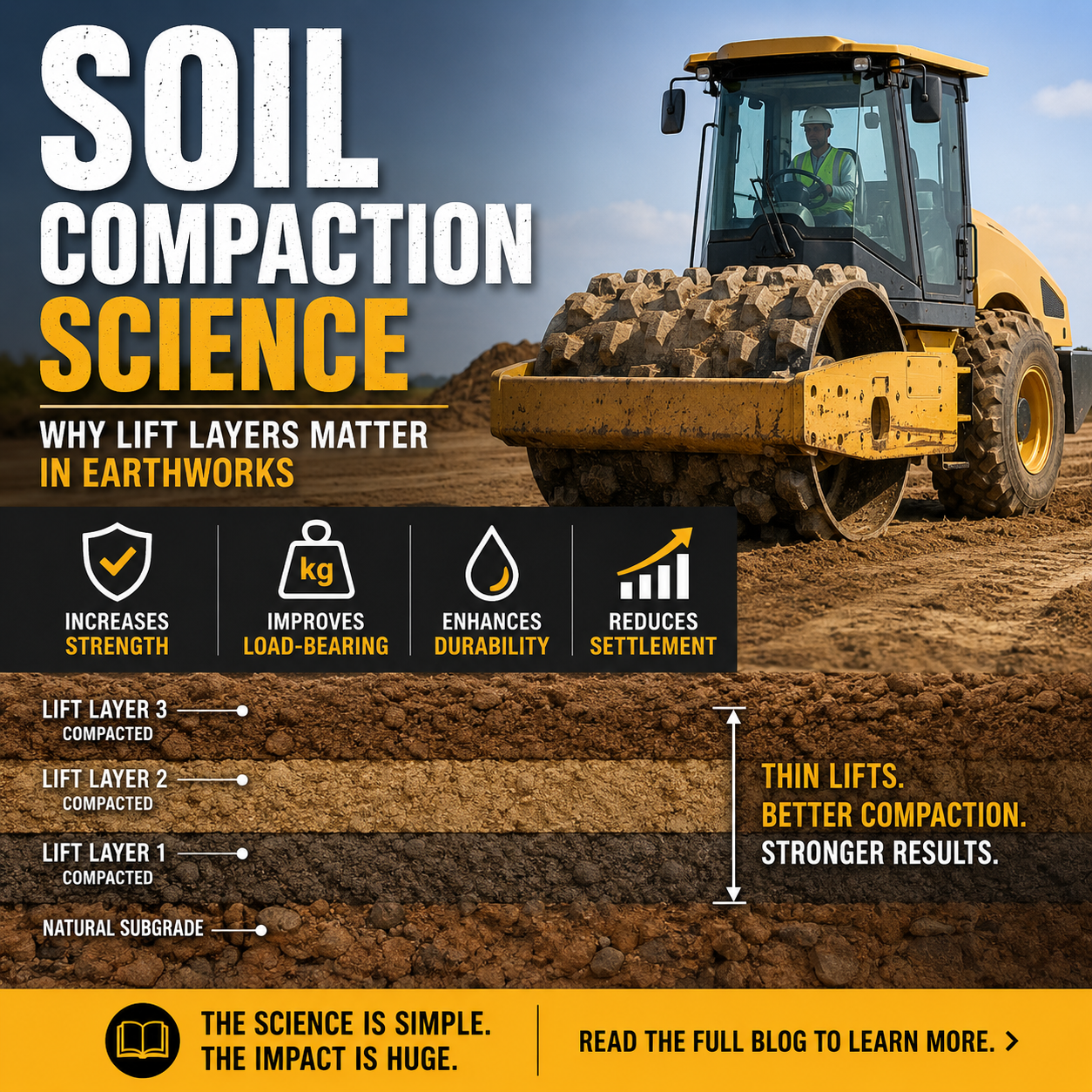
Soil Compaction Science: Why Lift Layers Matter in Earthworks
Earthworks succeed or fail long before asphalt is poured, foundations are set, or drainage systems are installed. The key factor is often invisible once the job is complete: soil compaction. More specifically, the thickness of each placed layer—known as the lift layer—plays a critical role in whether a site performs well or becomes prone to settlement, instability, or premature failure.
Understanding the science behind compaction helps operators, contractors, and site supervisors make better decisions in the field, not just on paper.
What Is Soil Compaction?
Soil compaction is the process of increasing soil density by reducing air voids between particles through mechanical force. The goal is to create a stable, load-bearing base that can support structures, roads, and heavy equipment without excessive shifting.
From a scientific perspective, compaction improves:
- Shear strength (resistance to sliding)
- Load-bearing capacity
- Water resistance and drainage control
- Long-term settlement performance
In earthworks, achieving the correct density isn’t just about running a roller over the surface—it depends heavily on how the soil is placed in layers.
The Role of Lift Layers in Compaction
A lift layer is a single placed thickness of soil or fill material before it is compacted. Instead of dumping fill in large piles and compacting afterward, earthworks are built in controlled, uniform layers.
This is important because compaction energy does not penetrate deeply. Most equipment only effectively compacts a limited depth from the surface.
If lifts are too thick:
- The bottom of the layer remains loose
- Surface may appear compacted but isn’t uniform
- Long-term settlement increases
If lifts are properly controlled:
- Energy is distributed evenly
- Full depth achieves target density
- Stability improves significantly
Why Thickness Matters: The Science Behind It
Compaction efficiency depends on how energy moves through soil particles. As compaction equipment applies force, energy dissipates quickly with depth. This means deeper soil layers receive significantly less compaction force.
Think of it like pressing down on a thick sponge:
- The top compresses first
- The middle compresses less
- The bottom may barely change
Soil behaves similarly, especially cohesive soils like clay or mixed fill.
The optimal lift thickness depends on:
- Soil type (clay, sand, gravel, engineered fill)
- Moisture content
- Equipment used (padfoot roller, smooth drum, plate compactor)
- Required density specification
Common Lift Thickness Ranges in Practice
While specifications vary by project, general field guidelines include:
- Granular soils (sand/gravel): 150–300 mm (6–12 inches)
- Cohesive soils (clay): 100–200 mm (4–8 inches)
- Engineered fills (controlled structural fill): often 150 mm (6 inches) or less
Heavier equipment can allow slightly thicker lifts, but only within tested and verified compaction limits.
Moisture Content: The Hidden Variable
Even with correct lift thickness, compaction can fail if moisture content is off.
- Too dry: particles resist movement and don’t lock together
- Too wet: water fills voids and prevents densification
The “golden zone” is known as optimum moisture content, where soil particles rearrange most efficiently under pressure.
Lift thickness and moisture work together. A properly moist thin lift will outperform a thick dry lift every time.
Field Testing: How We Know It Worked
Compaction isn’t assumed—it’s verified through testing methods such as:
- Nuclear density gauge testing
- Sand cone testing
- Proof rolling (observing deflection under load)
These tests confirm whether each lift meets required density before the next layer is placed.
Skipping this step or building thick uncontrolled lifts is one of the most common causes of:
- Pavement cracking
- Foundation settlement
- Utility line shifting
- Drainage failure
Equipment and Lift Performance
Different machines influence how effectively a lift is compacted:
- Padfoot rollers: best for cohesive soils, penetrate and knead layers
- Smooth drum rollers: ideal for granular materials and finishing layers
- Vibratory rollers: improve particle rearrangement in non-cohesive soils
- Plate compactors/rammers: used for confined areas and trench work
Even with the right equipment, lift thickness still determines whether energy reaches the full depth.
Real-World Consequences of Poor Lift Control
When lift layers are ignored or rushed, problems often appear months or years later:
- Uneven pavement settlement
- Cracked slabs and foundations
- Water pooling due to surface distortion
- Utility breaks caused by shifting soil support
These issues are far more expensive to fix than doing the compaction correctly during construction.
Soil compaction is not just a machinery task—it’s a controlled engineering process. Lift layers are the foundation of that control.
By managing layer thickness, matching it to soil type and equipment, and verifying density at each stage, earthworks become predictable, durable, and structurally sound.
In simple terms: thin, consistent lifts are what turn loose fill into reliable ground.