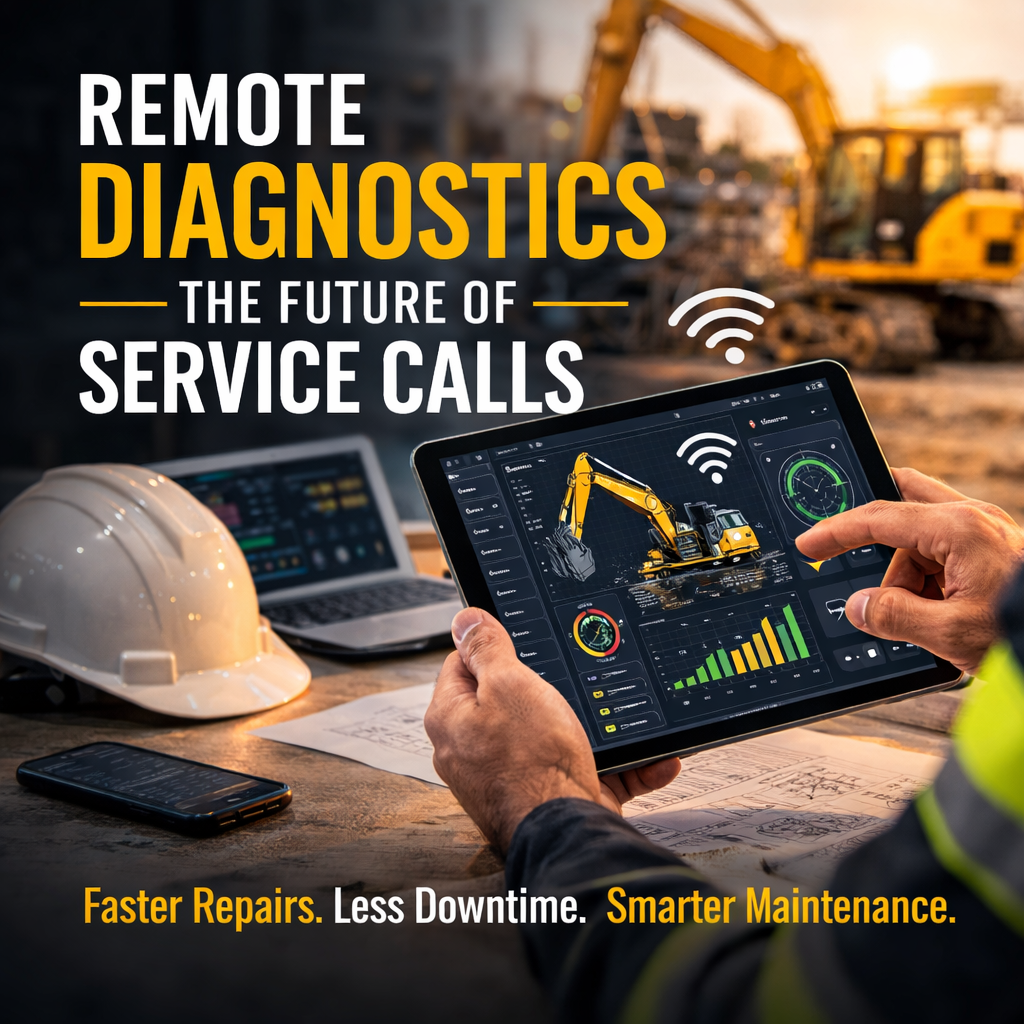
Remote Diagnostics: The Future of Service Calls
For decades, equipment service followed a familiar routine. A machine stopped working, a technician was dispatched to the site, and troubleshooting began once they arrived. While this process has kept fleets running for generations, it often involves delays, travel time, and guesswork.
Today, that model is rapidly changing. Thanks to advancements in telematics, sensors, and connected equipment systems, remote diagnostics are transforming how service and maintenance are handled in the heavy equipment industry.
What Are Remote Diagnostics?
Remote diagnostics allow technicians to access machine data from anywhere. Modern equipment constantly collects information through onboard sensors that monitor everything from engine performance and hydraulic pressure to fuel usage and fault codes.
Instead of waiting for a technician to physically inspect the machine, this data can be transmitted in real time to service teams. Technicians can log into a platform, review machine health, identify error codes, and often determine the cause of a problem before anyone travels to the jobsite.
In many cases, they can even guide operators through quick fixes over the phone or prepare for a repair with the right parts and tools already in hand.
Faster Troubleshooting and Less Downtime
Downtime is one of the most expensive challenges in construction and heavy equipment operations. When a machine stops working, entire workflows can slow or stop completely.
Remote diagnostics significantly shorten the time between failure and solution. Because technicians can analyze issues immediately, they can often diagnose problems in minutes rather than hours. This allows teams to prioritize service calls, dispatch technicians only when necessary, and arrive fully prepared.
The result is fewer repeat trips, faster repairs, and machines getting back to work sooner.
Smarter Preventative Maintenance
Remote diagnostics also play a major role in preventative maintenance. By continuously monitoring machine health, service teams can identify warning signs before they turn into major failures.
For example, if a system detects abnormal temperature readings, declining fluid pressure, or unusual engine behavior, alerts can be triggered automatically. This allows maintenance teams to address issues early, schedule service proactively, and avoid costly breakdowns during critical project timelines.
Instead of reacting to problems, fleets can begin predicting them.
Better Support for Operators
Another advantage of remote diagnostics is improved support for equipment operators. When something doesn’t feel right with a machine, operators no longer have to rely solely on their own troubleshooting.
They can report the issue and have a technician review machine data instantly. In many situations, the technician can confirm whether the machine can continue operating safely or whether service is required.
This collaboration reduces uncertainty for operators and helps maintain safe working conditions on the jobsite.
The Road Ahead
As connectivity improves and telematics systems continue to evolve, remote diagnostics will become even more powerful. Artificial intelligence and predictive analytics are already being integrated into many equipment platforms, allowing systems to detect patterns and anticipate failures with increasing accuracy.
In the future, service teams may be able to schedule repairs automatically, order replacement parts before failures occur, and coordinate service windows that minimize disruption to projects.
While technicians will always play a critical role in maintaining heavy equipment, the way they diagnose and respond to problems is changing. Instead of reacting after a machine fails, the industry is moving toward a smarter, faster, and more proactive approach.
Remote diagnostics aren’t just improving service calls—they’re redefining them.