Rare Prototype Machines That Never Reached Production
The heavy equipment industry is built on innovation. Every excavator, bulldozer, wheel loader, and haul truck on today's job sites exists because engineers were willing to test bold new ideas. While many experimental machines evolved into successful production models, countless prototypes never made it past the testing phase.
Some were simply ahead of their time. Others were too expensive, too complicated, or solved problems that customers weren't asking to fix. Yet these forgotten machines offer a fascinating glimpse into what could have been—and how experimentation has shaped modern construction equipment.
Here are some of the most intriguing prototype heavy machines that never entered full-scale production.
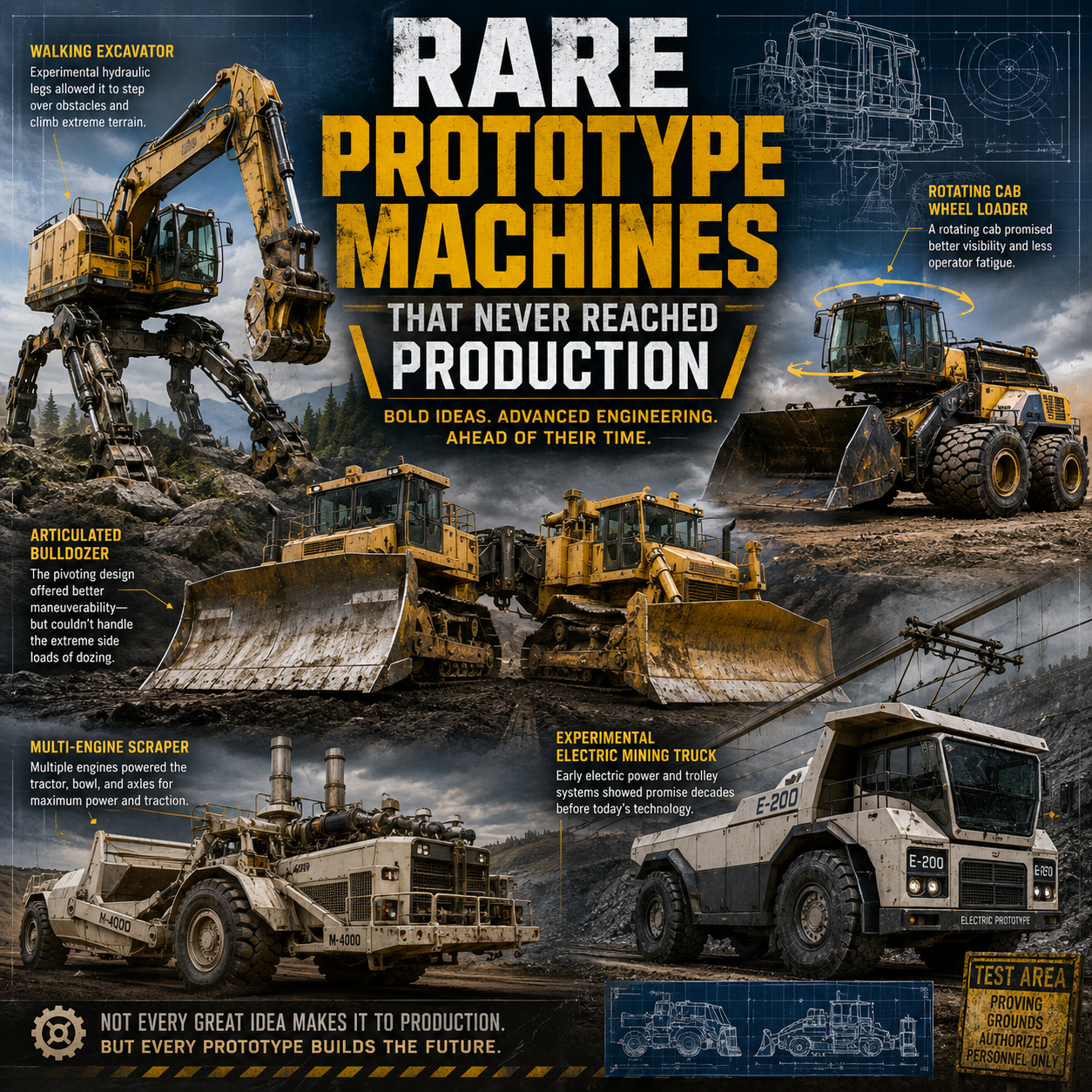
Caterpillar's Walking Excavator Concepts
Before tracked excavators became as capable as they are today, engineers experimented with machines that could literally "walk" across uneven terrain.
Unlike traditional crawler undercarriages, these prototypes used independently moving hydraulic legs designed to step over obstacles, climb rocky slopes, and maintain stability on impossible terrain.
While the concept worked surprisingly well during demonstrations, it proved to be:
- Extremely expensive to manufacture
- Mechanically complex
- Slower than conventional tracked machines
- Difficult to maintain in the field
Instead, improvements in crawler technology ultimately delivered similar terrain capabilities with far greater reliability and lower operating costs.
Giant Articulated Bulldozers
Several manufacturers experimented with articulated bulldozers that used a pivoting center joint similar to articulated wheel loaders.
The idea promised:
- Smaller turning radius
- Improved maneuverability
- Better weight distribution
- Increased traction
However, bulldozers experience enormous side loads while pushing material. Engineers discovered that the articulation joint became one of the machine's weakest points under heavy dozing forces.
Traditional rigid-frame bulldozers continued evolving instead, making articulated dozers an interesting engineering dead end.
Multi-Engine Scrapers
During the rapid expansion of earthmoving in the mid-20th century, prototype scrapers were built with multiple engines positioned throughout the machine.
Some designs powered:
- The tractor
- The scraper bowl
- Individual drive axles
The goal was greater traction and increased productivity on massive earthmoving projects.
Although the additional horsepower was impressive, maintenance became a nightmare. Multiple engines meant:
- More fuel consumption
- More components to service
- Increased downtime
- Higher operating costs
Single-engine machines with improved transmissions eventually proved to be more practical.
Experimental Electric Mining Trucks
Long before today's push toward electrification, mining companies tested electric haul trucks decades ago.
Some prototypes used:
- Battery power
- Overhead electric trolley systems
- Hybrid diesel-electric drivetrains
While diesel-electric drive systems eventually became common on large mining trucks, fully electric prototypes struggled with battery technology that simply wasn't ready.
Limited energy density, long charging times, and enormous battery weight prevented widespread adoption.
Ironically, many of those same concepts are being revisited today as battery technology continues to improve.
Hydraulic Wheel Loaders with Rotating Cabs
Several manufacturers explored wheel loaders whose operator cabs could rotate independently of the machine.
The concept aimed to:
- Improve rear visibility
- Reduce operator fatigue
- Increase loading precision
- Simplify reverse travel
Although operators appreciated the visibility improvements, the additional hydraulic systems, wiring, controls, and structural complexity made the design expensive and difficult to maintain.
Modern camera systems and advanced mirrors ultimately solved many of the same problems much more economically.
Twin-Blade Motor Graders
Motor graders traditionally use a single centrally mounted moldboard, but engineers have experimented with dual-blade configurations.
The second blade was intended to:
- Increase grading efficiency
- Reduce required passes
- Improve material control
- Allow simultaneous cutting and finishing
Field testing revealed that coordinating two blades required significantly more operator skill while adding weight, hydraulic complexity, and maintenance requirements.
Advances in GPS machine control and automated blade systems eventually delivered higher productivity without requiring an entirely new grader design.
Extreme Low-Ground-Pressure Earthmovers
For work in marshes, muskeg, and wetlands, manufacturers developed prototype earthmoving machines with extraordinarily wide tracks and oversized flotation systems.
Some resembled floating platforms more than conventional construction equipment.
Although they could travel across terrain that would swallow normal machines, they introduced several drawbacks:
- Difficult transportation
- Limited travel speed
- Reduced digging performance
- High manufacturing costs
Instead, specialized amphibious excavators and low-ground-pressure crawler systems became the preferred solution.
Self-Leveling Excavator Undercarriages
Long before electronic leveling systems became common, engineers experimented with hydraulic undercarriages capable of automatically keeping the upper structure level on steep slopes.
These prototypes adjusted track height independently while traveling and working.
The concept offered exceptional stability but introduced:
- Numerous hydraulic cylinders
- Complex control systems
- Increased maintenance
- Higher manufacturing costs
Today's machine control technology, improved operator aids, and specialized slope equipment have largely replaced the need for these elaborate mechanical systems.
Why Some Great Ideas Never Succeed
Prototype machines fail for many reasons that have little to do with engineering quality.
Common reasons include:
- Manufacturing costs exceed customer demand.
- Maintenance requirements outweigh productivity gains.
- Existing equipment improves enough to eliminate the need.
- New technology solves the problem more simply.
- Market conditions change before commercialization.
In many cases, prototypes are not failures at all. They simply become stepping stones that inspire future innovations.
Yesterday's Prototypes, Tomorrow's Production Machines
Many ideas once considered impractical are finding new life thanks to advances in electronics, materials, batteries, hydraulics, and artificial intelligence.
Features that were once experimental—GPS machine control, semi-autonomous operation, hybrid drivetrains, advanced suspension systems, and remote operation—have all become reality after years of refinement.
That makes today's experimental machines especially exciting. Some will quietly disappear after testing, while others may become the standard equipment that future generations take for granted.
The next revolutionary machine may already exist inside a manufacturer's proving grounds, hidden beneath camouflage paint and years away from public release.
For heavy equipment enthusiasts, prototype machines serve as a reminder that innovation isn't just about the equipment we see on job sites—it's also about the countless ideas that paved the way, even if they never reached production.