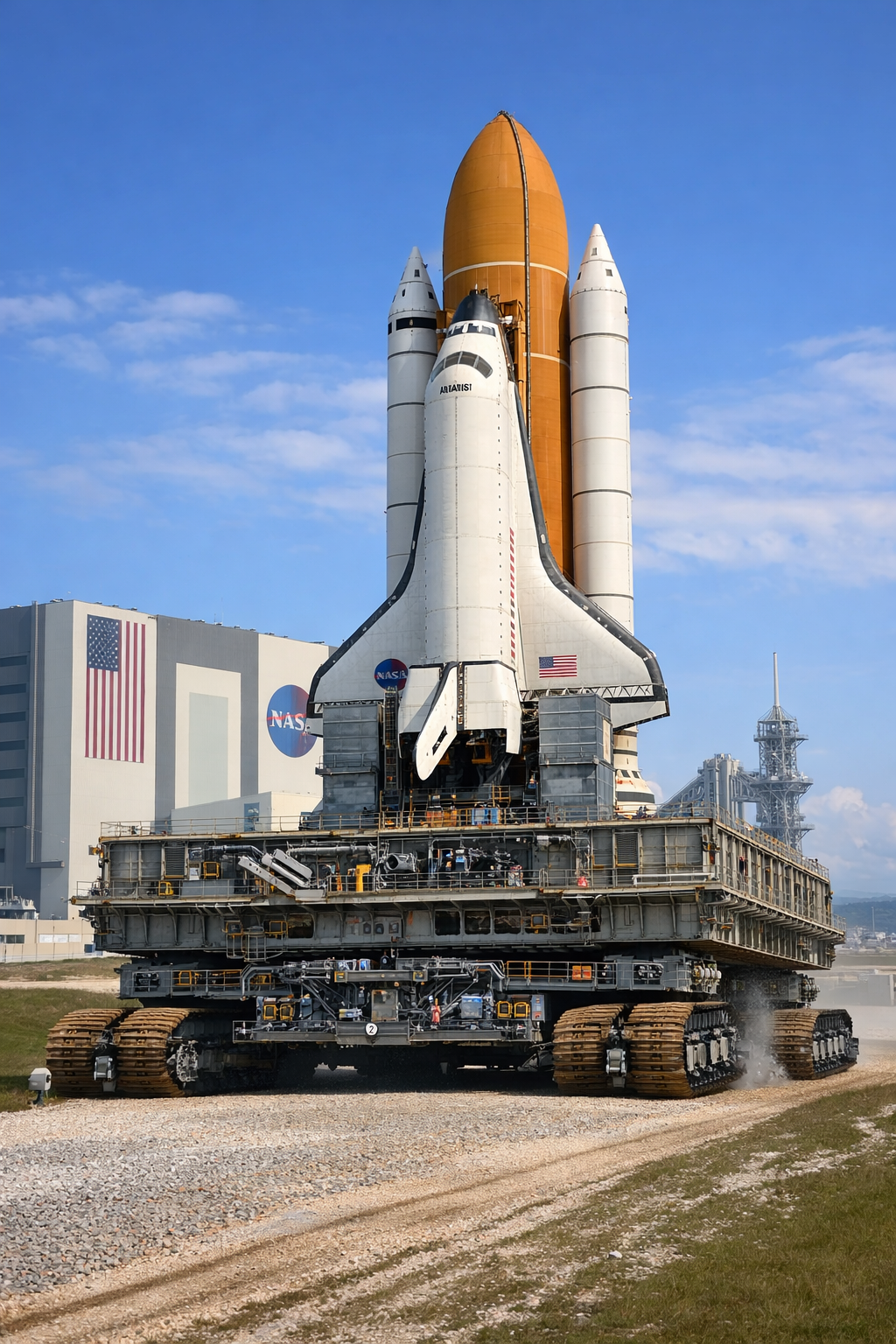
NASA Crawler-Transporter – The Space Shuttle Mover
When it comes to moving massive spacecraft, NASA relies on engineering marvels that often go unnoticed by the public. One of the unsung heroes of the space program is the NASA Crawler-Transporter, a colossal vehicle that transports rockets and shuttles from the Vehicle Assembly Building (VAB) to the launch pads at Kennedy Space Center.
A Monster on Tracks
The crawler-transporter is not just big—it’s enormous. Weighing approximately 2,721 tons empty, it can carry payloads of up to 18 million pounds, including the Saturn V rockets and the iconic Space Shuttles. With a length of 131 feet, width of 114 feet, and a height of 20 feet, this behemoth moves slowly but surely—averaging about 1 mile per hour when loaded.
Incredible Engineering
What makes the crawler-transporter truly remarkable is its precision. Despite its immense size, it can maintain an almost perfectly level platform, keeping spacecraft safe from tilt or stress during transit. Powered by eight 1,000-horsepower engines, it rides on 368 steel-reinforced tires, each 7.5 feet tall, distributed over four tracks.
Historical Significance
The crawler-transporter has played a crucial role in NASA’s history. It carried Saturn V rockets during the Apollo missions and later transported Space Shuttles to the launch pad. More recently, it has been upgraded to support NASA’s Space Launch System (SLS), the next-generation rocket that will carry humans back to the Moon and beyond.
Slow and Steady Wins the Race
Despite its power, the crawler moves deliberately—at speeds of about 1 mile per hour fully loaded. This slow pace ensures the safety of the spacecraft, allowing engineers to monitor every movement. During each trip, the crawler also sprays millions of gallons of water through a sound suppression system to protect the rocket and reduce vibrations.
A Symbol of Human Ingenuity
The NASA Crawler-Transporter is more than just a vehicle; it’s a symbol of human ingenuity and determination. Moving a multi-million-pound rocket across miles of terrain with extreme precision requires meticulous engineering and careful planning. It’s a reminder that behind every rocket launch is a massive team and a massive machine making it possible.