Machine Stability Triangles Explained for Excavators, Loaders, and Telehandlers
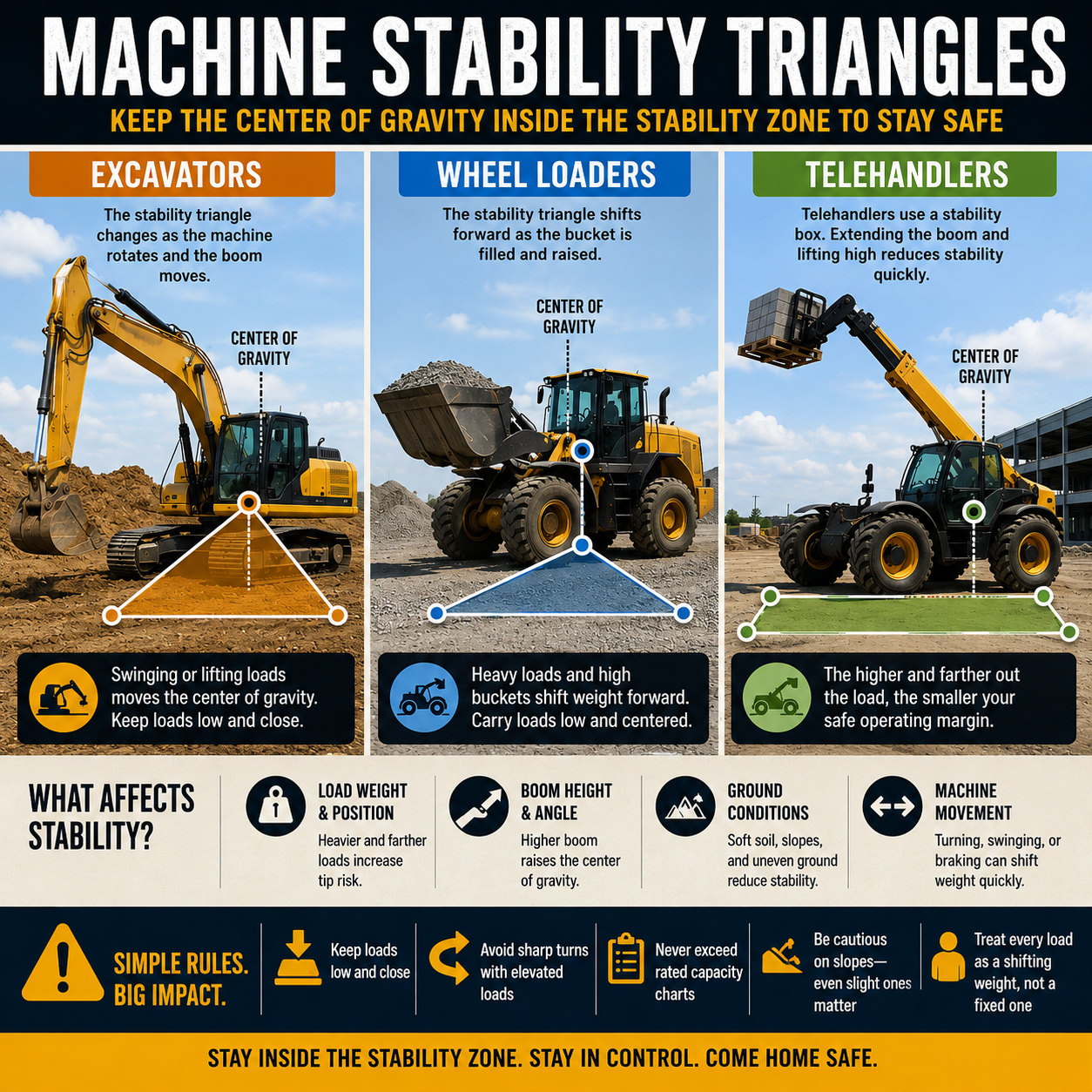
Heavy equipment like excavator, wheel loader, and telehandler all rely on a simple but critical concept to stay upright and safe: the stability triangle (or in some cases, a stability box).
Understanding this concept isn’t just theory—it’s what separates a controlled lift from a tip-over incident.
What Is a Stability Triangle?
A stability triangle is the imaginary area formed by the machine’s points of ground contact. As long as the machine’s center of gravity stays inside this area, it remains stable. If the center of gravity moves outside the triangle, the machine begins to tip.
The size and shape of the triangle change depending on:
-
- Load position
- Boom height or angle
- Terrain slope
- Machine articulation or rotation
Think of it as the machine’s “balance zone.”
Excavators: Stability While Digging and Swinging
On an excavator, stability is constantly changing because the machine rotates and lifts material.
Key stability points:
- The undercarriage track contact area forms the base
- The boom and bucket act as moving weight shifts
- Swinging a loaded bucket to the side moves the center of gravity dramatically
What operators need to watch:
- Digging over the side reduces stability more than digging straight ahead
- Lifting heavy loads at full reach is the most unstable position
- Soft or uneven ground can effectively shrink the stability triangle
A safe practice is to keep loads low and close when swinging.
Wheel Loaders: The Moving Balance Triangle
On a wheel loader, the stability triangle is formed between the front and rear axle contact points.
Stability factors:
- Load in the bucket shifts weight forward
- Raising the boom raises the center of gravity
- Turning sharply with a raised load reduces stability significantly
Common risks:
- Overloaded buckets causing forward tip-over
- Driving with the bucket raised too high
- Turning on slopes or uneven ground
Operators should always carry loads low and centered while traveling.
Telehandlers: The Stability Box Concept
A telehandler is slightly different. Instead of a triangle, it often behaves more like a stability box, because it has four-wheel support and a telescopic boom.
Key stability challenges:
- Extending the boom dramatically shifts the center of gravity forward
- Lifting loads at height reduces stability quickly
- Side slopes are especially dangerous due to high reach
Critical rule:
The higher and farther out the load goes, the smaller the safe operating margin becomes.
Outriggers (if equipped) can expand the stability zone, but only when properly deployed.
What Affects Stability the Most?
Across all machines, stability is influenced by:
Load weight and position
Heavier and farther loads = higher tip risk
Boom height
Higher boom = higher center of gravity
Ground conditions
Soft soil, ice, or slopes reduce stability dramatically
Machine movement
Turning, swinging, or braking shifts weight quickly
Simple Operator Rules to Stay Safe
- Keep loads low and close
- Avoid sharp turns with elevated loads
- Never exceed rated lifting capacity charts
- Be cautious on slopes—even slight ones matter
- Treat every load as a shifting weight, not a fixed one
The stability triangle isn’t just a diagram in a manual—it’s a real-time safety boundary that changes with every movement you make.
Whether operating an excavator, wheel loader, or telehandler, the principle stays the same: if the center of gravity stays inside the support base, the machine stays upright.
Once it moves outside that boundary, physics takes over—and it always wins.