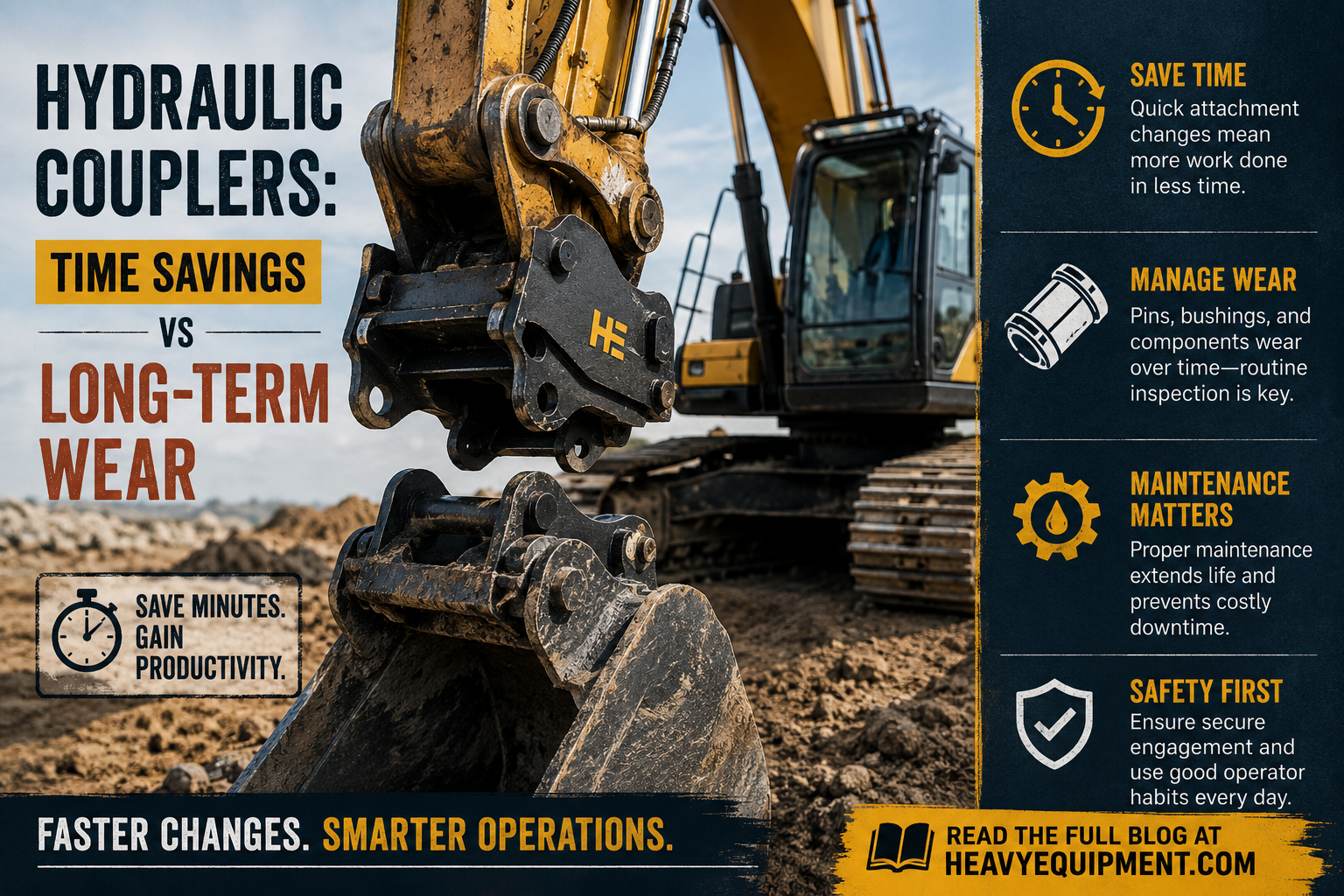
Hydraulic Couplers: Time Savings vs Long-Term Wear
In the world of heavy equipment, every minute counts. Whether you’re running an excavator on a pipeline project, switching attachments at a demolition site, or moving between buckets on a gravel operation, efficiency matters. That’s why hydraulic quick couplers have become a standard feature on many machines. They allow operators to swap attachments in minutes — sometimes without ever leaving the cab.
But while hydraulic couplers can dramatically improve productivity, they also introduce another consideration: long-term wear.
Are the time savings worth the additional maintenance and potential wear points? For many operations, the answer is yes — but only when couplers are used and maintained correctly.
What Are Hydraulic Couplers?
Hydraulic quick couplers are systems mounted to the end of an excavator or other machine that allow operators to rapidly change attachments. Instead of manually removing pins with hammers, pry bars, or lifting equipment, a hydraulic system locks and unlocks the attachment using controls inside the cab.
These systems are commonly used with:
- Buckets
- Hydraulic breakers
- Grapples
- Compactors
- Rippers
- Specialized demolition tools
The biggest advantage is obvious: reduced downtime between tasks.
The Productivity Advantage
On a busy jobsite, attachment changes happen constantly. A crew may switch from trenching to lifting pipe, then move to grading or hammer work — all within the same shift.
Without a quick coupler, each change can take 10 to 30 minutes depending on conditions, equipment size, and crew availability.
With a hydraulic coupler, that same switch may take less than two minutes.
Over days, weeks, and months, those savings add up fast.
Faster Workflows
Quick couplers help operators stay productive by reducing interruptions. Instead of waiting for laborers to assist with pin removal or alignment, operators can continue working independently.
This is especially valuable on:
- Utility projects
- Road construction
- Demolition sites
- Aggregate operations
- Forestry and land clearing work
Reduced Labor Strain
Manual attachment changes are physically demanding and can create safety hazards. Workers handling heavy pins and working near suspended attachments face pinch points and crush risks.
Hydraulic couplers reduce much of that exposure by minimizing manual handling.
Better Machine Utilization
When attachment swaps become easy, operators are more likely to use the correct tool for the task rather than “making do” with whatever is already attached.
That can improve:
- Fuel efficiency
- Cycle times
- Precision
- Overall production quality
The Hidden Cost: Wear and Stress
While hydraulic couplers save time, they also add another component between the machine and the attachment. That extra connection point introduces movement, stress, and wear.
Over time, even small amounts of looseness can become costly.
Common Wear Issues
Pin and Bushing Wear
Couplers create additional pivot points that experience constant pressure and vibration.
Over thousands of cycles:
- Pins can wear unevenly
- Bushings may loosen
- Attachment fitment can develop play
Excessive movement eventually affects digging precision and may place additional stress on the stick and linkage.
Coupler Slack
Operators sometimes describe worn couplers as “sloppy.” Even a small amount of slack becomes noticeable during precise grading or lifting work.
This movement can:
- Reduce accuracy
- Increase shock loads
- Accelerate wear on attachments
- Cause operator frustration
Hydraulic Component Wear
Hydraulic couplers rely on cylinders, hoses, seals, and locking systems. Like any hydraulic component, these parts wear over time.
Potential issues include:
- Hydraulic leaks
- Seal failures
- Locking mechanism wear
- Electrical sensor problems
- Contamination inside hydraulic circuits
Neglected maintenance can turn a productivity tool into a downtime issue.
Operator Habits Matter
A coupler’s lifespan often depends heavily on operator behavior.
Aggressive operation, excessive hammering, or improper attachment alignment can significantly increase wear.
Common bad habits include:
- Slamming attachments into position
- Using buckets as pry bars
- Traveling with poorly secured attachments
- Ignoring unusual movement or noise
- Failing to inspect locking systems daily
Good operators can dramatically extend coupler life simply by operating smoothly and performing routine inspections.
Maintenance Is Critical
Like undercarriage systems or hydraulic cylinders, couplers require regular attention.
Basic maintenance should include:
- Daily visual inspections
- Greasing at recommended intervals
- Checking locking mechanisms
- Inspecting pins and bushings for wear
- Monitoring hydraulic leaks
- Ensuring attachment fitment remains tight
Ignoring maintenance often leads to accelerated wear that affects not just the coupler, but the machine itself.
Safety Considerations
Modern hydraulic couplers are far safer than early designs, but attachment security remains critical.
Improperly engaged attachments can detach unexpectedly, creating extremely dangerous situations.
Many newer systems include:
- Secondary locking systems
- Visual confirmation indicators
- Electronic sensors
- Automatic safety locks
Even with these features, operators should always verify proper engagement before beginning work.
Are Hydraulic Couplers Worth It?
For most operations, hydraulic couplers deliver enough productivity gains to justify the additional maintenance and wear considerations.
The key is understanding that couplers are not “install and forget” components. They are high-use wear items that require inspection and upkeep.
Operations that benefit most include:
- Multi-attachment workflows
- Fast-paced construction sites
- Utility contractors
- Demolition crews
- Rental fleets
- High-production excavation companies
For machines that rarely change attachments, the value may be less significant.
Balancing Efficiency and Longevity
Hydraulic couplers represent a tradeoff that most modern contractors are willing to make. The ability to save time, reduce labor demands, and improve flexibility often outweighs the long-term wear costs.
But maximizing those benefits requires:
- Proper maintenance
- Quality coupler systems
- Skilled operators
- Routine inspections
- Timely repairs
When managed correctly, hydraulic couplers can become one of the most valuable productivity tools on a jobsite — without creating excessive long-term problems.
In heavy equipment, speed matters. But like every component under stress, the real value comes from balancing efficiency with durability.