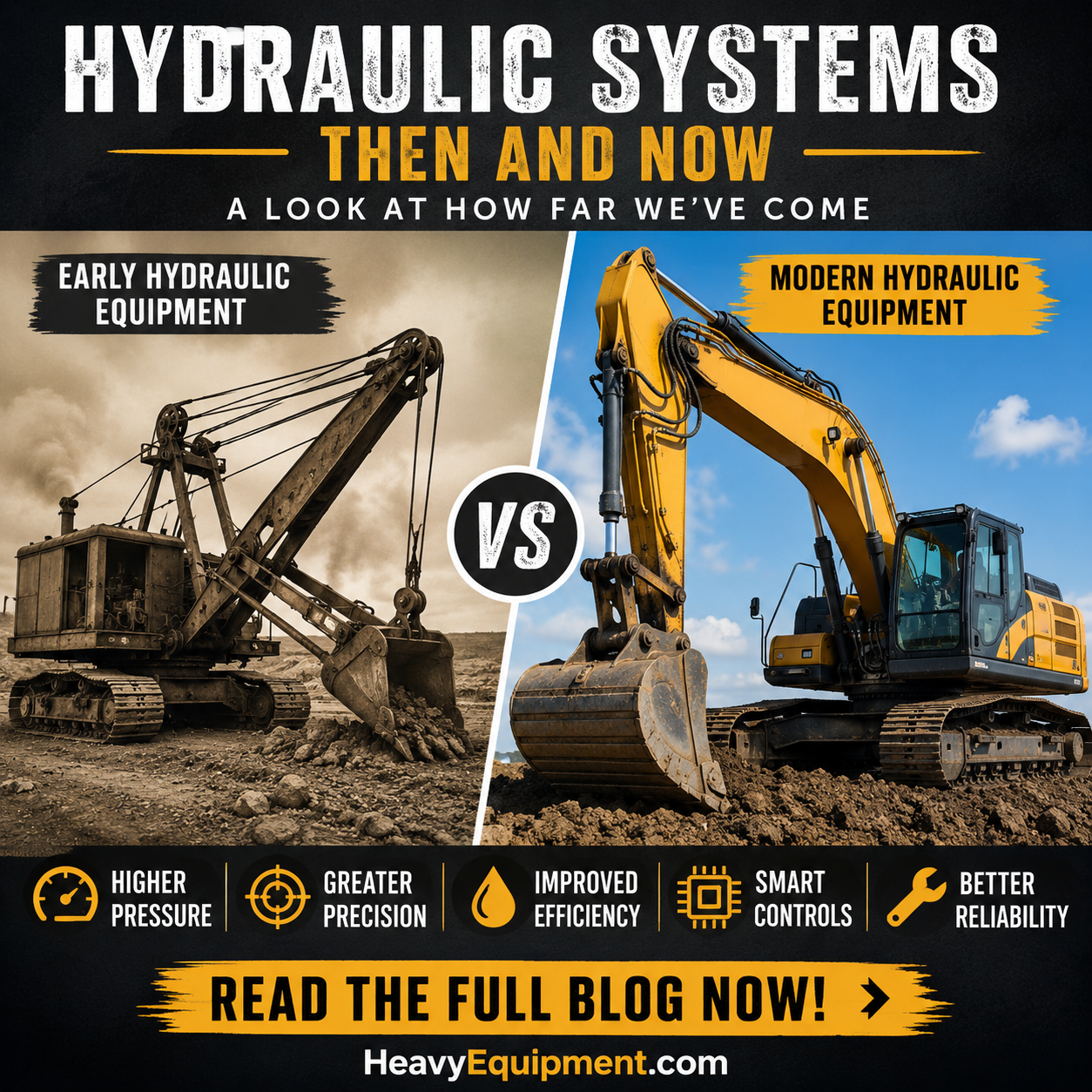
How Modern Hydraulic Systems Compare to Early Hydraulic Equipment
Hydraulic systems are the muscle behind modern heavy equipment. From excavators and wheel loaders to forestry machines and cranes, hydraulics allow operators to lift, dig, push, and move enormous loads with remarkable precision. But hydraulic equipment hasn't always been this capable.
Early hydraulic machines were revolutionary for their time, yet they were slow, inefficient, and difficult to control compared to today's electronically managed systems. The evolution of hydraulic technology has dramatically changed how heavy equipment performs in the field.
The Early Days of Hydraulic Equipment
Hydraulic power began appearing in construction equipment during the first half of the 20th century. Early hydraulic excavators and loaders replaced many cable-operated machines, offering smoother operation and greater lifting power.
However, these early systems had major limitations:
- Low hydraulic pressures
- Limited flow rates
- Basic mechanical controls
- Frequent leaks
- Poor sealing technology
- Minimal filtration
- Slow cycle times
Operators often had to work harder to achieve precise movements, and maintenance was a constant challenge.
How Early Hydraulic Systems Worked
Most early machines used fixed-displacement pumps that delivered the same flow regardless of demand. Control valves were relatively simple, and hydraulic oil cleanliness standards were far less strict than they are today.
Common problems included:
- Overheating
- Pressure losses
- Jerky movements
- Hose failures
- Seal deterioration
- Reduced power in cold weather
Despite these issues, hydraulic equipment was still a huge improvement over many cable-operated machines because it provided more direct and controllable power.
The Rise of Modern Hydraulic Systems
Today's hydraulic systems are vastly more sophisticated. Modern excavators can perform multiple functions simultaneously with smooth, precise control while using less fuel than older machines.
Key advancements include:
- Variable-displacement pumps
- Load-sensing hydraulics
- Electronic control modules (ECMs)
- Electro-hydraulic joysticks
- High-pressure systems
- Advanced filtration
- Improved sealing materials
- Real-time diagnostics
Pressure: Then vs. Now
|
Feature |
Early Equipment |
Modern Equipment |
|
Operating Pressure |
1,000-2,000 psi |
4,000-6,000+ psi |
|
Flow Control |
Basic |
Precision electronic |
|
Efficiency |
Lower |
Much higher |
|
Fuel Consumption |
Higher |
Lower |
|
Diagnostics |
Manual troubleshooting |
On-board monitoring |
|
Operator Control |
Mechanical |
Electro-hydraulic |
|
Reliability |
Moderate |
Significantly improved |
The Biggest Change: Electronic Control
One of the most important developments is the integration of electronics with hydraulics.
Modern machines use sensors and computers to continuously adjust hydraulic flow and pressure. This allows operators to:
- Dig more accurately
- Lift heavier loads safely
- Reduce fuel consumption
- Perform multiple functions simultaneously
- Customize machine response
Many newer excavators even offer selectable work modes such as Power, Economy, and Fine Control.
Efficiency Improvements
Older hydraulic systems wasted a significant amount of energy because pumps often produced more flow than the machine actually needed.
Modern load-sensing systems deliver only the flow required for the task. The result is:
- Lower fuel burn
- Less heat generation
- Longer component life
- Faster cycle times
- Better overall productivity
For contractors, these improvements can translate into substantial savings over the life of a machine.
Maintenance: Easier and Harder
Modern hydraulics are generally more reliable, but they are also more complex.
Easier
- Better diagnostics
- Longer service intervals
- Improved filtration
- Fewer leaks
Harder
- Electronic troubleshooting
- Sensor failures
- Software calibration
- Higher repair costs for advanced components
A mechanic working on a 1960s hydraulic excavator faced very different challenges than a technician working on a modern machine.
Operator Comfort and Precision
Early hydraulic equipment often required considerable physical effort and skill to operate smoothly.
Modern machines offer:
- Fingertip controls
- Pilot-operated hydraulics
- Reduced operator fatigue
- Smoother movements
- Greater precision for grading and trenching
This is one reason why modern excavators can achieve productivity levels that would have seemed remarkable decades ago.
What Hasn't Changed?
Despite all the advances, the basic principle remains the same:
Hydraulic systems use pressurized fluid to transmit force.
Whether it's a vintage excavator from the 1950s or a GPS-equipped machine built today, the core physics of hydraulics are still doing the heavy lifting.
The difference between early hydraulic equipment and modern hydraulic systems is similar to the difference between an early pickup truck and a modern heavy-duty diesel. Both can do the job, but the newer machine delivers more power, better efficiency, greater precision, improved comfort, and far better reliability.
For heavy equipment enthusiasts, looking back at early hydraulic machines provides a fascinating reminder of how much engineering has advanced. Those pioneering systems laid the foundation for the incredibly capable excavators, loaders, dozers, and cranes we rely on today.