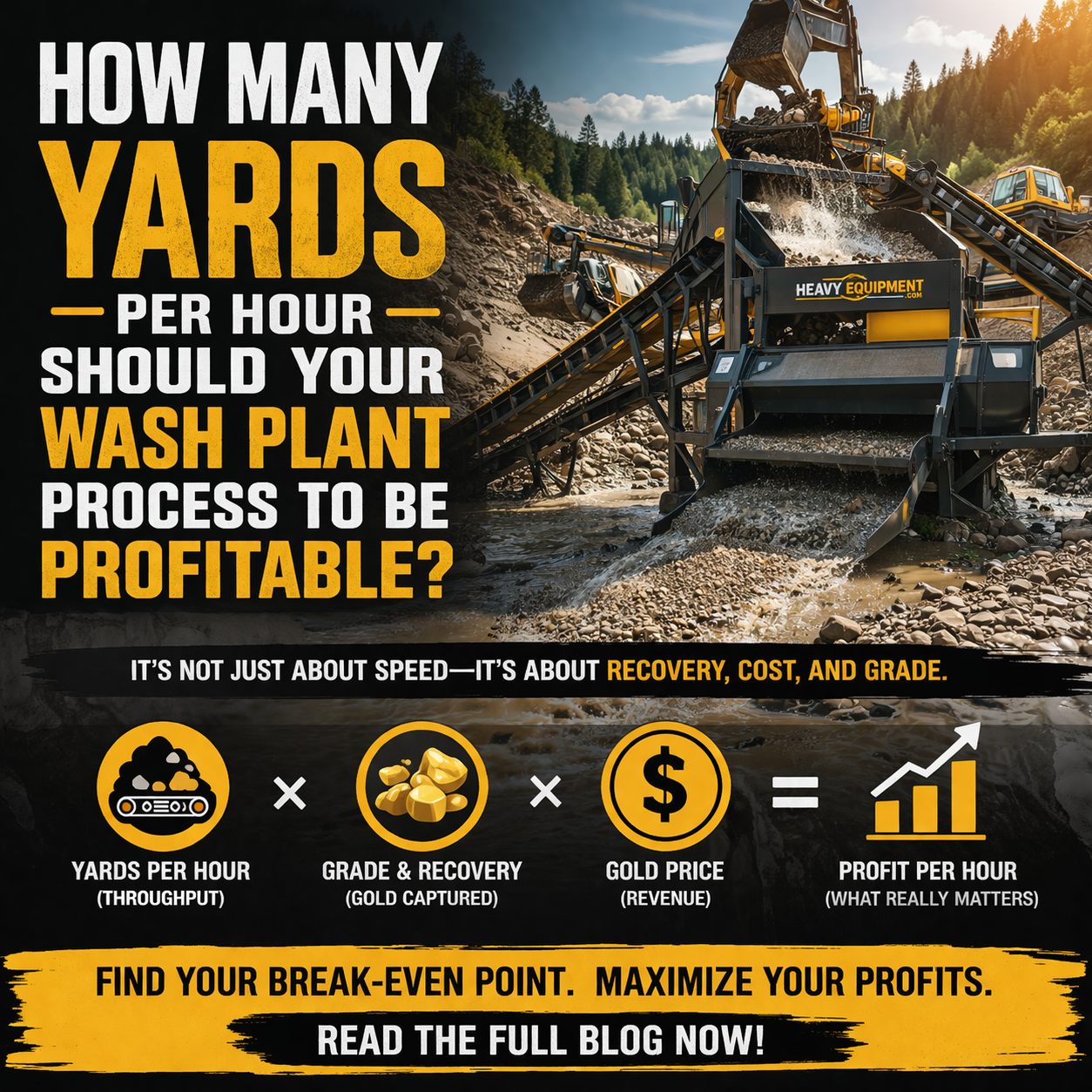
How Many Yards Per Hour Should Your Wash Plant Process to Be Profitable?
If you’re running a placer operation, one question quietly drives every decision you make: how many yards per hour (YPH) do I actually need to run to make money?
The frustrating truth is there’s no universal number—but there is a clear way to figure it out for your operation.
Profitability Isn’t About Speed Alone
A common mistake is chasing higher throughput as the ultimate goal. Bigger numbers feel productive—but yards per hour only matters when it’s tied to recovery and cost.
Profitability comes down to three variables:
- Grade (gold per yard)
- Recovery rate (how much gold you actually capture)
- Cost per yard processed
Your wash plant’s YPH only matters in how it influences those three.
The Simple Profit Equation
At its core, your operation works like this:
Revenue per hour = YPH × grade × recovery × gold price
Profit per hour = Revenue per hour – hourly operating costs
So instead of asking “what YPH should I run?”, the better question is:
“What YPH do I need to cover my hourly costs and generate margin?”
Step 1: Know Your Hourly Costs
Start here. If you don’t know this number, everything else is guesswork.
Include:
- Fuel
- Labor
- Equipment wear & maintenance
- Stripping and hauling costs
- Camp and overhead
Let’s say your total comes to:
$500 per hour to operate
Step 2: Understand Your Ground
Now look at your pay:
- Grade: 0.02 oz per cubic yard
- Gold price: $2,500/oz
- Recovery: 85%
That means each yard contains:
0.02 oz × $2,500 = $50 per yard (in-ground)
Recovered value: $50 × 0.85 = $42.50 per yard
Step 3: Find Your Break-Even YPH
Now divide your hourly cost by value per yard:
$500 ÷ $42.50 ≈ 11.8 yards per hour
That’s your break-even point.
Anything above that is profit. Anything below that is loss.
Step 4: Add a Real Margin
Breaking even isn’t the goal—you need buffer for downtime, variability, and risk.
A healthy operation might target:
- 2× break-even for stability
- 3× break-even for strong profitability
In this example:
- Minimum viable: ~12 YPH
- Stable target: 25 YPH
- Strong profit zone: 35+ YPH
Where Operators Go Wrong
Chasing YPH at the Expense of Recovery
Pushing more material through can overload your plant and lose fine gold.
A plant running 50 YPH at 60% recovery can make less money than one running 30 YPH at 90%.
Ignoring Feed Consistency
Even the best wash plant struggles with:
- Clay-heavy material
- Large rocks
- Poor classification
Inconsistent feed reduces both throughput and recovery.
Oversizing Equipment
A plant rated for 200 YPH doesn’t guarantee profit. If your deposit can’t support it, you’re just burning fuel faster.
What’s a “Good” YPH?
Here’s a rough guideline—but remember, these only matter with decent ground:
- Small operations: 20–50 YPH
- Mid-size operations: 50–150 YPH
- Large operations: 150+ YPH
But a small plant on rich ground can outperform a massive plant on poor ground every time.
The Real Answer
There is no magic number.
The “right” YPH is:
The rate where your plant maximizes recovered gold per hour—not just material moved.
That sweet spot balances:
- Efficient throughput
- High recovery
- Controlled operating costs
Final Thought
If you want to improve profitability, don’t start by asking how to push more yards.
Start by asking:
- Are we losing gold?
- Are we feeding the plant properly?
- Do we actually know our cost per yard?
Because in placer mining, the operators who win aren’t the ones who move the most dirt—
They’re the ones who recover the most gold from every yard they run.