How Is Wire Rope Made?
Wire rope is one of the hardest-working components found in construction, mining, lifting and material handling. From cranes and draglines to winches and hoists, it provides the strength and flexibility needed to safely lift and move heavy loads. Although wire rope may look simple, producing it requires precision, careful control and attention to detail throughout the manufacturing process.
Here's a closer look at how wire rope is typically made.
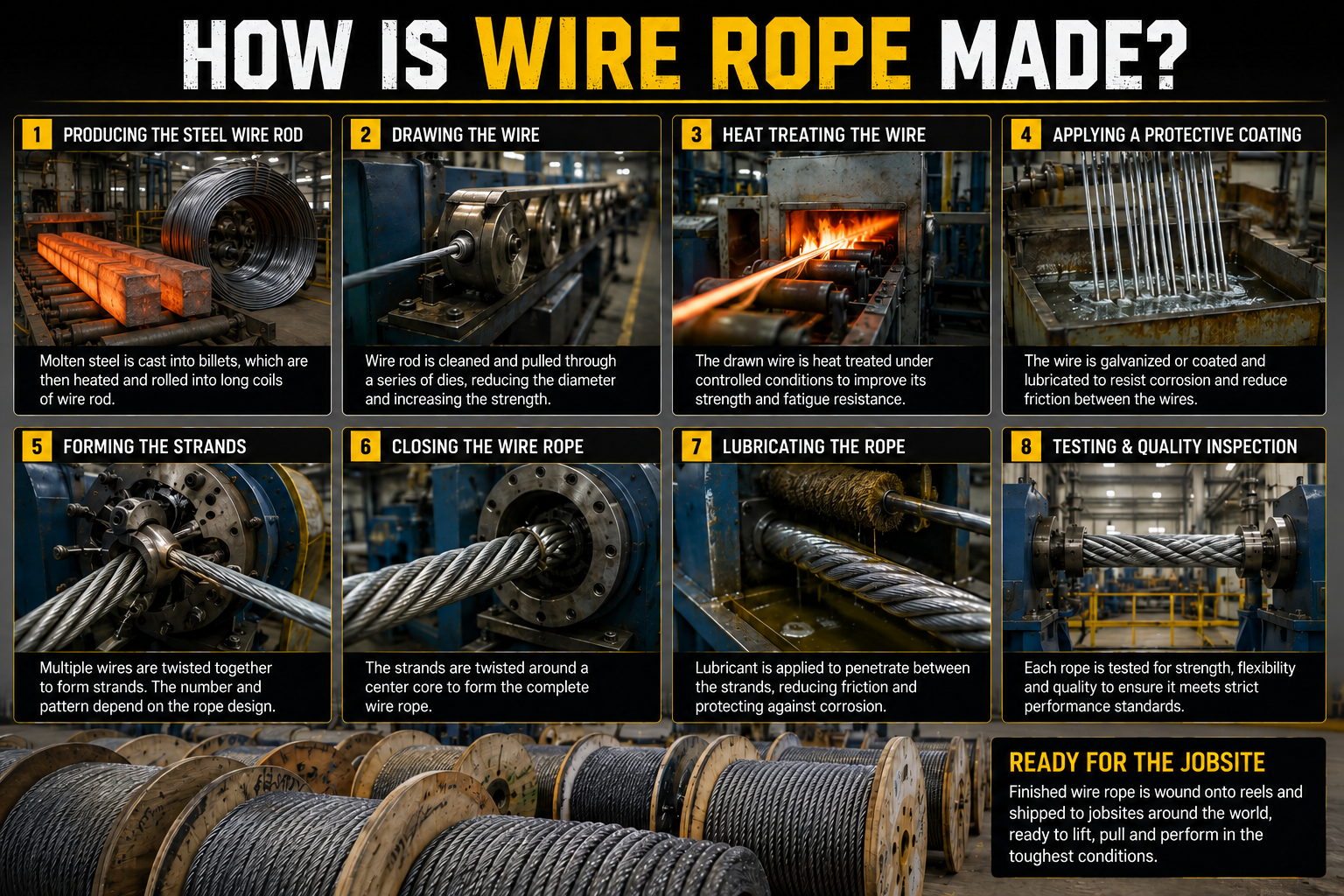
Step 1: Producing the Steel Wire Rod
The manufacturing process begins with high-quality steel. Molten steel is cast into billets, which are then heated and rolled into long coils known as wire rods.
These wire rods serve as the raw material for the individual wires that will eventually make up the finished wire rope.
Step 2: Drawing the Wire
The wire rods are cleaned to remove scale before being pulled through a series of progressively smaller dies in a process known as wire drawing.
Each pass through a die reduces the wire's diameter while increasing its strength. Depending on the final rope design, the wire may pass through several dies until it reaches the required size.
Step 3: Heat Treating the Wire
Many manufacturers heat treat the drawn wire to improve its strength, toughness and fatigue resistance.
The wire is carefully heated and cooled under controlled conditions to achieve the mechanical properties needed for demanding lifting applications.
Step 4: Applying a Protective Coating
To help resist corrosion, the wire may receive a protective coating before assembly.
Some wire is galvanized by applying a layer of zinc, while other wire may receive specialized coatings or lubricants depending on its intended application. Lubrication also helps reduce friction between the wires during operation.
Step 5: Forming the Strands
Next, multiple individual wires are twisted together to create strands.
Depending on the type of wire rope being produced, each strand may contain several wires arranged in specific patterns to balance strength, flexibility and resistance to wear. Specialized stranding machines carefully control the tension and twist throughout the process.
Step 6: Closing the Wire Rope
Once the strands are complete, they are twisted around a central core to form the finished wire rope.
The core may be made from steel wire, independent wire rope or synthetic fiber, depending on the rope's intended use. Precision closing machines ensure each strand is evenly positioned and properly tensioned.
Step 7: Lubricating the Rope
Many wire ropes receive additional lubrication as part of the manufacturing process.
The lubricant penetrates between the wires and strands, helping reduce internal friction while protecting against corrosion and extending the rope's service life.
Step 8: Testing and Quality Inspection
Before leaving the factory, every wire rope undergoes thorough quality inspections.
Manufacturers verify the rope's diameter, construction and appearance while performing tensile strength, flexibility and fatigue testing. Some ropes are also subjected to proof loading to confirm they meet their specified performance requirements.
Ready for the Jobsite
After passing inspection, the finished wire rope is wound onto large reels or spools for shipment.
Although it appears to be a simple cable, wire rope is the result of a highly engineered manufacturing process. From raw steel to finished rope, every stage of manufacturing plays a role in creating a product built for strength, flexibility and reliability. The finished rope is capable of handling some of the toughest lifting and pulling applications in the world.