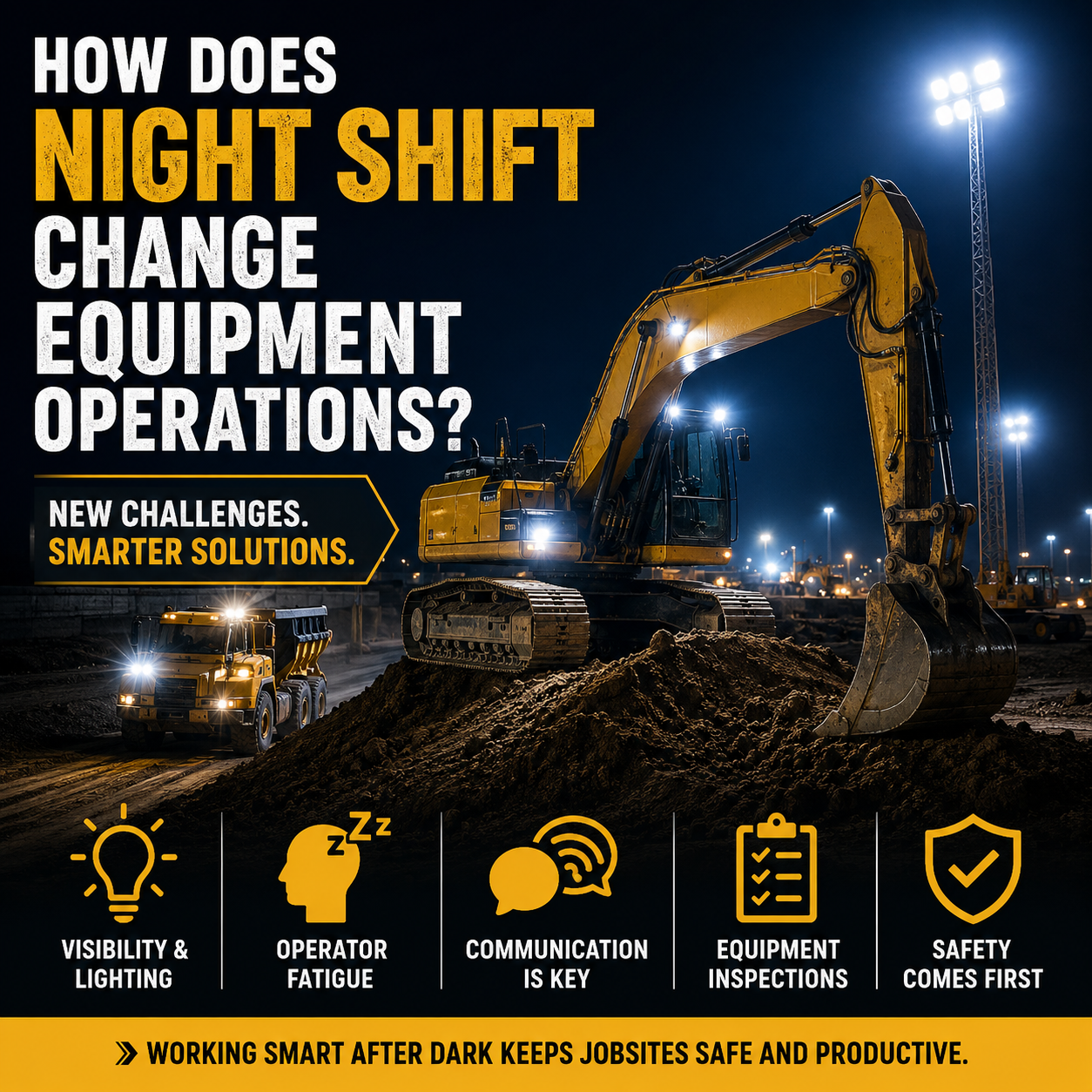
How Does Night Shift Change Equipment Operations?
For many construction projects, mining operations, road-building jobs, and industrial sites, the workday doesn't end when the sun goes down. Night shifts are often necessary to meet deadlines, reduce traffic disruptions, take advantage of cooler temperatures, or keep production moving around the clock. But operating heavy equipment after dark is far different from working during daylight hours.
From visibility challenges to operator fatigue, night shift operations require unique planning, specialized equipment, and heightened safety awareness. Understanding these differences helps crews maximize productivity while minimizing risk.
Why Companies Operate Equipment at Night
There are several reasons contractors and equipment owners schedule night operations:
- Highway construction and maintenance to avoid daytime traffic
- Mining operations that run 24 hours a day
- Emergency repairs after storms or natural disasters
- Pipeline and utility projects with tight schedules
- Large earthmoving projects requiring continuous production
- Hot-weather regions where daytime temperatures are unsafe
In many cases, the cost of operating at night is justified by increased productivity or reduced public disruption.
Visibility Changes Everything
The most obvious challenge of night operations is limited visibility.
During daylight hours, operators can easily judge distances, identify obstacles, and observe ground conditions. At night, even powerful work lights cannot completely replicate natural sunlight.
Operators may struggle to:
- Spot uneven terrain
- See personnel on foot
- Identify overhead hazards
- Judge depth and distance accurately
- Detect changes in soil conditions
This is particularly important for equipment such as excavators, dozers, graders, and wheel loaders that often work near other machines and ground crews.
Modern LED lighting systems have dramatically improved nighttime visibility, but operators still need to remain more cautious than during daytime operations.
Lighting Becomes Critical Equipment
On a night shift, lighting is just as important as the machine itself.
Today's heavy equipment often features:
- High-output LED work lights
- Wide-angle flood lighting
- Rear-view lighting systems
- Lighted access points and stairs
- Auxiliary lighting packages
Many jobsites also install portable light towers to illuminate work zones.
Proper lighting placement is essential. Excessive glare can create blind spots and reduce visibility rather than improve it. Lighting plans must ensure operators can see without being blinded by neighboring equipment.
Operator Fatigue Becomes a Major Concern
One of the biggest risks during night operations is fatigue.
Human bodies are naturally programmed to sleep at night. Even experienced operators may experience:
- Reduced alertness
- Slower reaction times
- Difficulty concentrating
- Increased errors
- Reduced situational awareness
Studies across multiple industries have consistently shown that fatigue contributes to workplace accidents.
Successful night-shift operations often implement:
- Scheduled breaks
- Rotation schedules
- Fatigue management programs
- Proper rest requirements
- Additional supervision
Experienced operators learn to recognize the warning signs of fatigue before performance begins to suffer.
Communication Must Improve
Nighttime operations place greater demands on communication.
Since visual contact is often limited, crews rely heavily on:
- Two-way radios
- Spotters
- Lighted signaling systems
- GPS machine monitoring
- Clear work-zone boundaries
Miscommunication that might be corrected quickly during daylight can become dangerous after dark.
Many contractors establish stricter communication protocols for night shifts to ensure everyone understands machine movements and work plans.
Equipment Inspections Become More Important
Night shifts place additional stress on equipment systems.
Before starting work, operators should carefully inspect:
- Headlights and work lights
- Backup alarms
- Cameras and monitoring systems
- Reflective markings
- Windshield cleanliness
- Mirrors
- Electrical systems
A failed work light during daylight may be a minor inconvenience. At night, it can become a serious safety hazard.
Preventive maintenance is often scheduled more aggressively for equipment that regularly operates overnight.
Weather Has a Greater Impact
Darkness can make weather-related hazards harder to detect.
Operators may have difficulty spotting:
- Fog
- Ice formation
- Wet surfaces
- Dust accumulation
- Snow-covered obstacles
In some cases, weather conditions that would be obvious during daylight become nearly invisible at night.
This is one reason many night operations conduct frequent site inspections throughout the shift.
Technology Helps Bridge the Gap
Modern technology has transformed night-shift productivity.
Many newer machines now include:
- 360-degree camera systems
- Radar-based object detection
- Proximity warning systems
- GPS machine guidance
- Grade-control technology
- Thermal imaging systems
These tools help operators maintain awareness when natural visibility is limited.
Machine control systems can be particularly valuable during nighttime grading, excavation, and earthmoving operations where precision is critical.
Productivity Can Be Surprisingly High
While many assume night shifts are slower, that is not always the case.
Some operations experience increased productivity because:
- Temperatures are cooler
- Traffic interference is reduced
- Equipment experiences less overheating
- Continuous production eliminates downtime
- Work zones are less congested
However, productivity gains depend heavily on proper planning, adequate lighting, and well-rested operators.
Without these factors, efficiency can decline quickly.
Safety Culture Matters Most
Successful night operations depend on more than lights and technology.
The most effective crews emphasize:
- Thorough pre-shift meetings
- Strong communication
- Fatigue awareness
- Consistent equipment inspections
- Proper lighting management
- Clear safety procedures
Night shifts introduce challenges that simply don't exist during daylight hours. Companies that recognize these differences and prepare accordingly can maintain both productivity and safety long after the sun goes down.
Operating heavy equipment at night requires a different mindset than daytime work. Reduced visibility, increased fatigue risks, and greater reliance on communication create unique challenges for operators and site managers alike.
With proper planning, modern lighting systems, advanced technology, and strong safety practices, night-shift crews can perform efficiently and safely. As construction, mining, and infrastructure projects continue to demand around-the-clock productivity, understanding how darkness changes equipment operations becomes increasingly important for everyone on the jobsite.