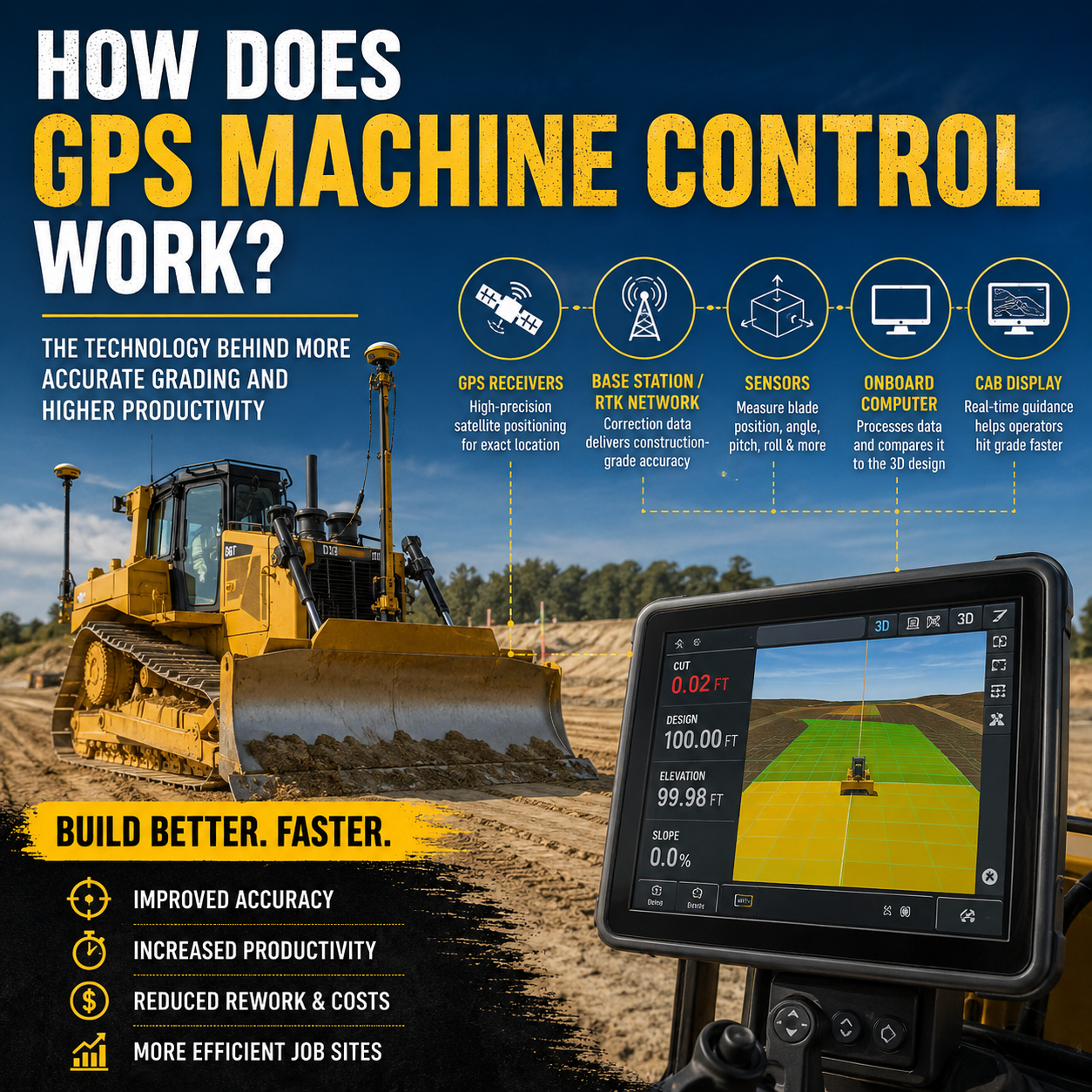
How Does GPS Machine Control Work?
Modern construction sites are changing rapidly, and one of the biggest technological advancements in recent decades is GPS machine control. What was once considered cutting-edge technology is now becoming standard equipment on many grading, excavation, and earthmoving projects. But how does GPS machine control actually work, and why has it become so valuable to contractors?
What Is GPS Machine Control?
GPS machine control is a system that uses satellite positioning, onboard computers, sensors, and digital site plans to guide heavy equipment operators. The technology helps machines perform grading, excavation, and earthmoving tasks with a high degree of accuracy.
Instead of relying solely on stakes, string lines, and manual grade checking, operators can view real-time positioning information directly from displays mounted inside the cab.
The result is faster production, improved accuracy, and less rework.
The Basic Components
Several technologies work together to make GPS machine control possible:
GPS Receivers
High-precision GPS receivers mounted on the machine communicate with satellites orbiting the Earth. These receivers constantly calculate the machine's exact location on the jobsite.
Unlike the GPS found in a smartphone, machine control systems use highly accurate positioning signals capable of measuring location within fractions of an inch.
Base Stations or RTK Networks
To achieve construction-grade accuracy, GPS machine control systems use correction data from either:
- A local base station set up on the project site
- An RTK (Real-Time Kinematic) correction network
These corrections eliminate much of the error found in standard GPS signals and allow operators to work with extreme precision.
Inertial Sensors
GPS alone isn't enough. Sensors mounted throughout the machine measure:
- Blade position
- Boom angle
- Bucket position
- Machine pitch and roll
- Machine heading
These sensors continuously update the onboard computer with the exact orientation of the machine.
Onboard Computer
The onboard computer processes information from the GPS receivers and sensors. It compares the machine's current position against the project's digital design model.
The system then calculates exactly how much material must be moved to reach the target grade.
Cab Display
A touchscreen monitor inside the cab provides real-time guidance. Operators can see:
- Current elevation
- Target elevation
- Cut and fill amounts
- Machine position
- Project design surfaces
This allows operators to make adjustments without constantly stopping for grade checks.
How the System Works in the Field
Imagine a bulldozer grading a building pad.
The project engineer uploads a digital 3D site model into the machine control system. As the dozer moves across the site, GPS receivers determine its position while sensors track blade location.
The onboard computer continuously compares the blade's position to the desired grade shown in the digital model.
The operator can instantly see whether the blade needs to cut more material or raise up to avoid overcutting.
Many modern systems can even control the blade automatically, making small adjustments hundreds of times per minute to maintain the correct grade.
Machine Control vs. Traditional Grading
Before machine control became common, grading crews depended heavily on:
- Survey stakes
- String lines
- Laser levels
- Frequent grade checks
- Survey crews
Operators often had to stop repeatedly while grade was verified manually.
GPS machine control reduces many of these interruptions. Operators can work more independently while maintaining accurate grades across large areas.
The technology doesn't eliminate surveyors, but it significantly reduces the amount of staking required.
Which Machines Use GPS Machine Control?
The technology is commonly found on:
Dozers
Dozers are among the most popular machine control applications. GPS-guided blades allow operators to achieve finished grade with fewer passes.
Motor Graders
Machine control helps graders produce smooth, accurate surfaces for roads, parking lots, and site development projects.
Excavators
GPS-equipped excavators can dig trenches, foundations, and utility installations to exact depths without repeated grade checks.
Scrapers
Scraper operators use machine control to optimize cut and fill operations while maintaining proper elevations.
Compact Track Loaders
Smaller grading projects increasingly utilize machine control systems on compact equipment.
Benefits of GPS Machine Control
Improved Accuracy
Machines can achieve highly precise grades, reducing costly mistakes and rework.
Increased Productivity
Operators spend less time waiting for grade checks and more time moving material.
Reduced Survey Costs
Fewer stakes and manual measurements are required throughout the project.
Less Material Waste
Accurate grading helps prevent over-excavation and unnecessary material movement.
Faster Project Completion
Many contractors report significant reductions in project timelines after implementing machine control systems.
Are Operators Being Replaced?
A common misconception is that machine control replaces operators. In reality, skilled operators remain essential.
The technology acts more like a highly advanced tool. Experienced operators still make critical decisions regarding machine movement, site safety, production strategy, and material handling.
GPS machine control simply provides operators with better information and greater precision.
The Future of Machine Control
Machine control technology continues to evolve. New systems integrate drones, digital twins, cloud-based site models, and advanced automation features.
As construction projects become more complex and labor shortages continue, GPS machine control will likely play an even larger role in helping contractors complete projects safely, accurately, and efficiently.
For today's heavy equipment operators and contractors, understanding machine control technology is becoming just as important as understanding the machines themselves.
GPS Technoloy
GPS machine control has transformed the way earthmoving and grading projects are completed. By combining satellite positioning, sensors, digital models, and onboard computing, modern machines can achieve levels of accuracy that were once impossible.
While the technology requires investment and training, the benefits in productivity, accuracy, and efficiency have made GPS machine control one of the most influential innovations in the history of heavy equipment.