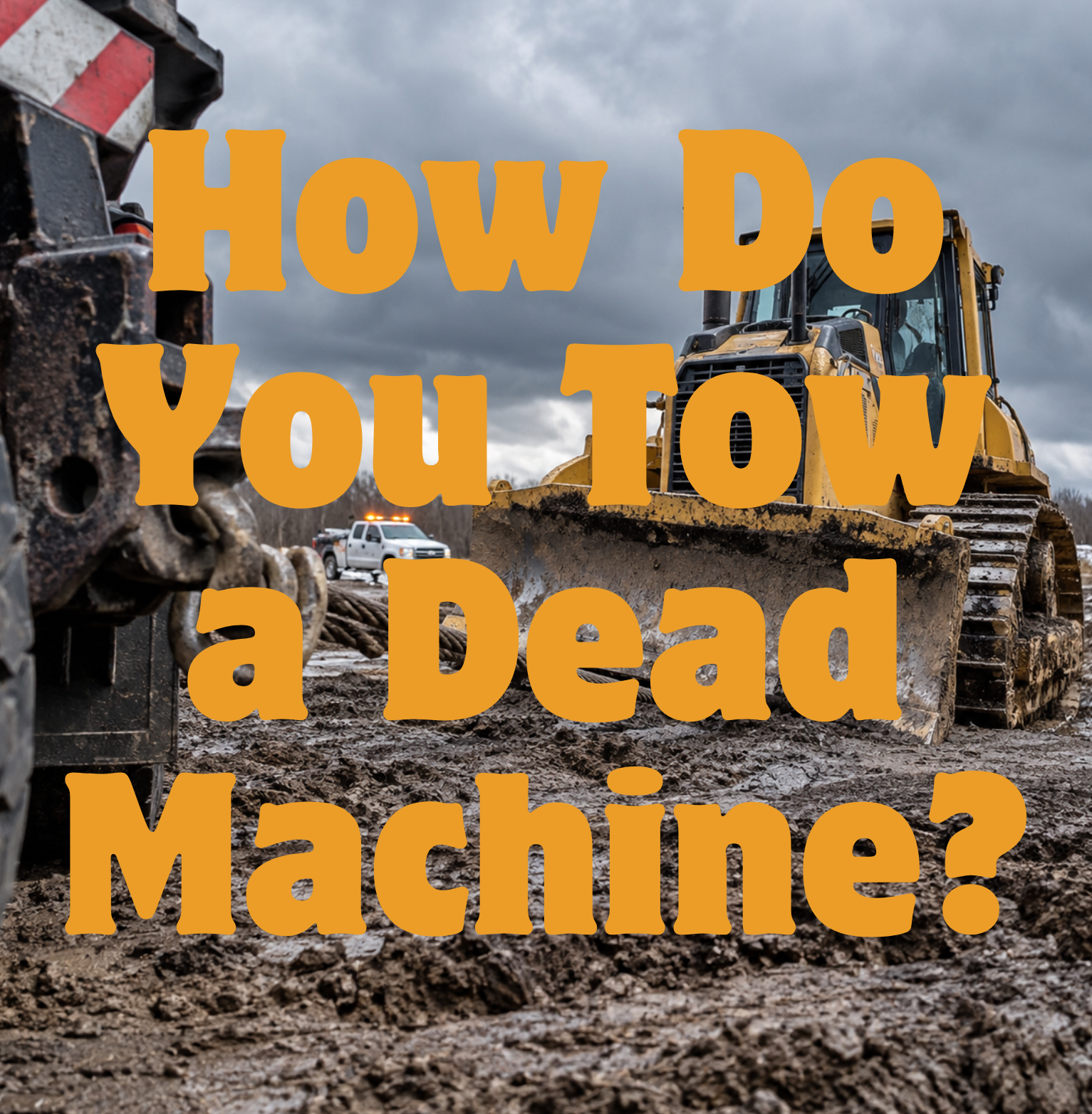
How Do You Tow a Dead Machine That Was Never Designed to Roll Freely?
When a pickup truck dies, putting it in neutral may be enough to get it onto a tow truck. When a 40-ton dozer, wheel loader, excavator or other piece of heavy equipment dies, things can get considerably more complicated.
Many machines are deliberately designed not to roll freely when they lose power. Spring-applied brakes may engage automatically. Hydrostatic drives can resist movement. Hydraulic circuits may remain pressurized. Final drives, transmissions and other components may be damaged if they're forced to rotate without normal lubrication.
So when a dead machine has to be moved, attaching a tow cable and pulling harder isn't the solution.
The machine first has to be made capable of moving without turning a breakdown into a much more expensive repair.
Why Doesn't a Dead Machine Just Roll?
On many pieces of heavy equipment, stopping the engine changes several systems at once.
Oil pumps stop circulating lubricant. Hydraulic pumps stop producing pressure. Electrically or hydraulically controlled valves return to their default positions. Steering assistance may disappear. And, importantly, parking or emergency brakes may automatically apply.
That's intentional.
A 60,000-pound machine shouldn't start rolling down a grade simply because its engine stalled.
The problem comes when that same safety feature prevents recovery crews from moving it.
Exactly how a disabled machine is prepared for towing depends heavily on its design, which is why the manufacturer's towing and recovery procedure matters. But several systems commonly need attention.
The Brakes May Have to Be Manually Released
Heavy equipment frequently uses spring-applied, hydraulically released brakes.
During normal operation, hydraulic pressure holds the brakes released. If the machine loses hydraulic pressure, powerful springs apply them automatically.
That's an excellent fail-safe system.
It's also why a dead machine may refuse to move even when the transmission selector is sitting in neutral.
Depending on the machine, the manufacturer may provide a mechanical brake-release mechanism, a hydraulic hand pump, an external pressure connection or another prescribed method of releasing the brakes.
But releasing them creates another problem.
You've just removed one of the systems preventing several tons of equipment from moving.
The machine therefore has to be properly restrained before brake-release procedures begin, particularly on a slope. Wheel chocks, blocking, recovery equipment and appropriately rated machines may all be part of the recovery plan.
A brake release isn't simply a way of making the machine roll. It transfers responsibility for controlling the machine from its braking system to the recovery setup.
Neutral Doesn't Always Mean Disconnected
Moving the transmission control into neutral doesn't necessarily mean every drivetrain component is safe to rotate.
When a machine is being towed, wheels, axles, final drives, driveshafts, transmissions, pumps or motors may be forced to turn even though the engine isn't operating.
That can create lubrication problems.
Some transmissions rely on an engine-driven pump to circulate oil. If the machine is towed with the engine stopped, internal components may rotate without receiving the lubrication or cooling they normally depend on.
That's why manufacturers may specify very restrictive towing speeds and distances—or require part of the driveline to be disconnected entirely.
Depending on the machine, recovery procedures can involve disconnecting a driveshaft, disengaging an axle, removing axle shafts or using another manufacturer-specified method of isolating the drivetrain.
The important question isn't simply:
"Is it in neutral?"
It's:
"What components will rotate when we pull it, and are they designed to rotate with the engine off?"
Those are very different questions.
Hydrostatic Drives Add Another Complication
Hydrostatic machines can be particularly resistant to conventional towing.
Instead of a straightforward mechanical connection between an engine, transmission and wheels or tracks, a hydrostatic drivetrain uses hydraulic pumps and motors to transmit power.
Trying to force the machine to move can therefore force hydraulic motors and pumps to rotate.
Depending on the design, manufacturers may provide bypass valves or other procedures that allow oil to circulate during limited towing. Other machines may require mechanical disconnection.
Improvising here can be expensive.
Dragging a hydrostatic machine without following the correct procedure can generate extreme pressures, cavitation or inadequate lubrication and potentially damage pumps and motors.
The fact that the tracks or wheels can be forced to move doesn't mean they should be.
Hydraulic Pressure Doesn't Necessarily Disappear When the Engine Stops
A dead engine doesn't automatically mean a dead hydraulic system.
Accumulators can retain substantial stored pressure after shutdown. Cylinders can also be supporting heavy attachments, and trapped oil can remain pressurized between valves and actuators.
That becomes especially important when recovering excavators, loaders, cranes and other machines with large implements.
A boom hanging in the air isn't merely an inconvenient position. It's stored gravitational energy.
Recovery crews may need to lower, block, secure or otherwise stabilize attachments before moving the machine. The appropriate procedure depends on the equipment and the nature of the failure.
Never assume a hydraulic system is depressurized simply because the engine isn't running.
Steering May Be Limited—or Completely Unavailable
Getting the machine rolling is only part of the problem.
It still has to go where you want it to go.
Some equipment loses normal steering when engine-driven hydraulic pressure disappears. Articulated machines present an additional hazard because the articulation joint can move unexpectedly and creates a major crush zone.
Manufacturers may provide emergency steering capability or special procedures for disabled towing, but these systems often have significant limitations.
That means a recovery plan has to consider both pulling and directional control.
On some recoveries, one machine provides the pulling force while another helps control the disabled machine. On others, winches, rigging or specialized recovery equipment provide more controlled movement.
Tracks Create Their Own Problems
Tracked equipment isn't necessarily easier to recover simply because it doesn't have conventional wheels.
A dead dozer or excavator may have spring-applied brakes, hydrostatic or hydraulic drive motors and high drivetrain resistance. Tracks also create substantial rolling resistance, especially on soft ground.
Dragging locked tracks isn't the same thing as towing a rolling machine.
It can damage the undercarriage, disturb the ground and create enormous loads on recovery equipment.
Sometimes the objective isn't to make the machine freely towable at all. The safer strategy may be to move it only far enough to get it out of danger or into a position where it can be repaired, loaded or recovered by another method.
The Ground Matters as Much as the Machine
A disabled machine sitting on level compacted gravel is one problem.
The same machine buried to its belly in mud on a side slope is an entirely different recovery.
Recovery forces can become much greater than the machine's weight alone might suggest. Mud can create suction and resistance. Slopes introduce gravitational forces. Obstacles can cause sudden changes in loading.
That's why simply looking at the machine's operating weight isn't enough to select a tow line, shackle, winch or recovery vehicle.
Recovery planning has to account for the expected forces, equipment ratings, attachment points, terrain and the possibility of shock loading.
And those attachment points matter.
A convenient-looking hole, drawbar, bucket component or structural member isn't automatically a rated recovery point.
Avoid Shock Loading
One of the worst approaches to recovering heavy equipment is the classic:
"Back up and give it a good yank."
Suddenly accelerating a towing machine can create forces far greater than those produced by a steady pull.
That shock load travels through the recovery line, shackles, attachment points and machine structures. If something fails, the stored energy in the system can make the consequences catastrophic.
Controlled force is generally preferable to impact.
Winches, properly selected recovery equipment and carefully coordinated pulling machines can allow forces to be applied progressively rather than suddenly.
Personnel should also remain outside the potential line of fire created by tensioned recovery equipment.
Sometimes You Shouldn't Tow It at All
One of the most important recovery decisions is knowing when towing isn't the appropriate solution.
If the machine has suffered drivetrain damage, brake failure, structural damage or a hydraulic failure that makes movement unsafe, further towing could dramatically increase the damage.
Similarly, terrain or machine position may make conventional towing too hazardous.
In those situations, the answer may be lifting, winching, using specialized recovery equipment, partially disassembling the drivetrain, repairing the machine where it sits or bringing in a heavy recovery contractor.
The goal isn't necessarily to get the machine moving as quickly as possible.
It's to move it without creating a second problem.
Recovery Is an Engineering Problem
A disabled piece of heavy equipment can look deceptively simple from the outside.
The engine isn't running. Attach a line. Pull it away.
But inside the machine, brakes may be locked, pumps aren't turning, lubrication systems aren't circulating and hydraulic pressure may still be trapped. The drivetrain may be mechanically incapable of safely freewheeling.
That's why proper heavy-equipment recovery starts before anything moves.
You need to know what is holding the machine stationary, what will rotate once it begins moving, how those components are normally lubricated, whether the brakes and steering will function, where pulling forces can safely be applied and how the machine will be controlled once those forces are released.
Sometimes the hardest part of towing a dead machine isn't finding something powerful enough to pull it.
It's figuring out what has to be disconnected, released or controlled before you ever start pulling.
Recovery and towing procedures vary significantly by machine. Always follow the manufacturer's service and recovery instructions, use appropriately rated recovery equipment and qualified personnel, and establish exclusion zones around tensioned rigging and uncontrolled machine movement.