How Do They Move a Machine That's Too Heavy for the Road?
Moving a 20-ton excavator is fairly routine. Put it on the right trailer, secure it properly, obtain whatever permits are required and send it down the road.
But what happens when the machine weighs 100, 300 or even 1,000 tons?
At that point, transportation stops being primarily a trucking problem and becomes an engineering problem. The question isn't simply whether a tractor and trailer can pull the load. Engineers have to determine whether every section of road, bridge and structure along the route can physically support it.
For the biggest machines, planning the move can be almost as interesting as the machine itself.
The Problem Isn't Just Total Weight
Roads and bridges don't experience a vehicle's weight as one giant number. What matters enormously is how that weight is distributed.
Imagine placing 200 tons on four wheels versus spreading the same 200 tons across 40 wheels. The total weight hasn't changed, but the load being applied at each wheel position is dramatically different.
This is why axle loading becomes so important.
Heavy-haul trailers use numerous closely spaced axles to distribute the load over a larger area. Depending on the equipment and jurisdiction, engineers may analyze individual axle loads, axle-group weights, tire loading, axle spacing and the total gross combination weight.
Adding axles doesn't make the machine lighter. It makes its weight easier for the infrastructure beneath it to handle.
Eventually, a Conventional Trailer Isn't Enough
There is a practical limit to what an ordinary lowboy or multi-axle heavy-haul trailer can accomplish.
For truly enormous loads, transporters can become machines in their own right.
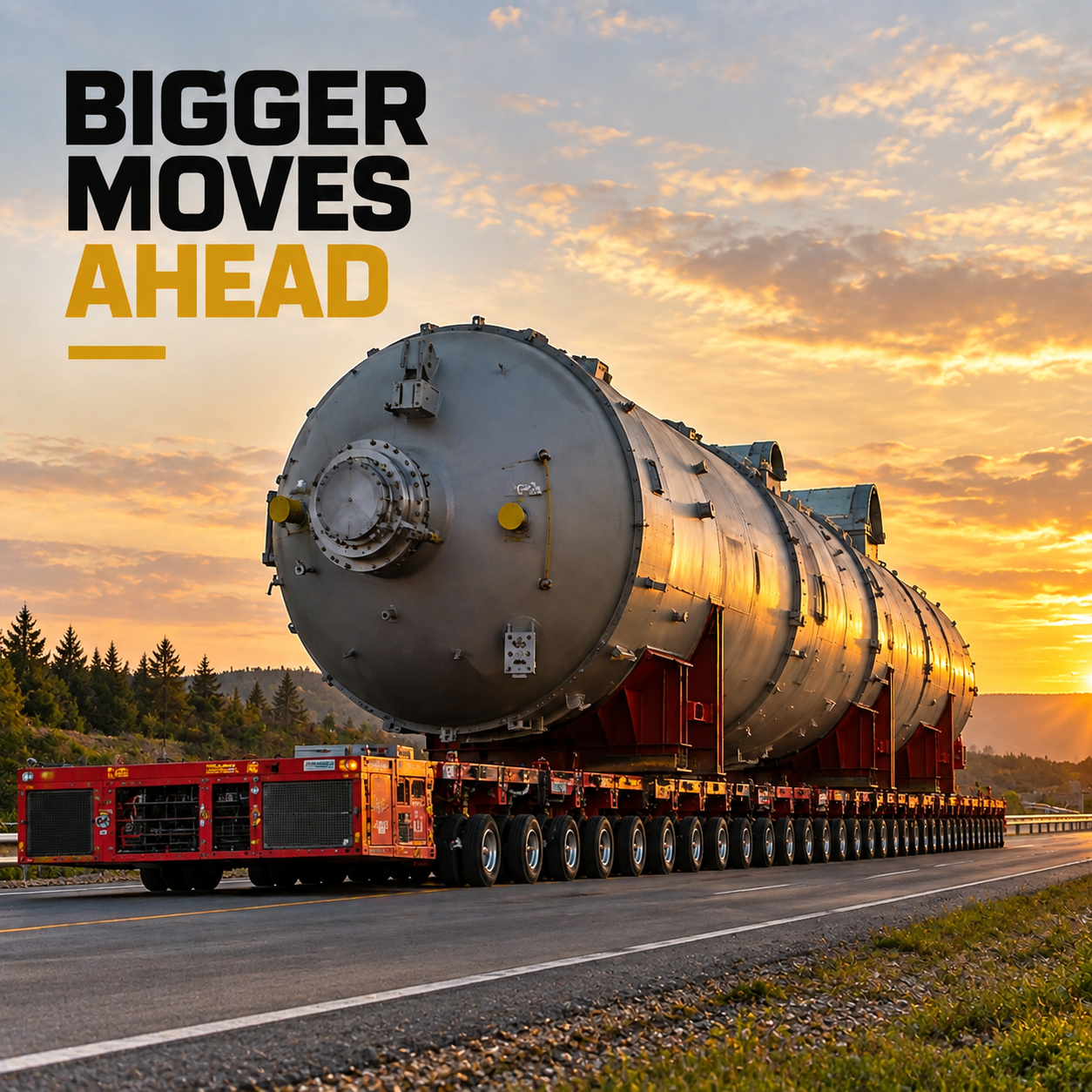
One of the most impressive examples is the self-propelled modular transporter, commonly called an SPMT.
Instead of looking like a traditional highway trailer, an SPMT consists of modular platform sections containing numerous independently controlled wheel units.
Modules can be connected side-by-side or end-to-end to create a transporter specifically sized for the load.
The result can be a platform with dozens—or even hundreds—of wheels beneath it.
SPMTs are commonly associated with exceptionally large industrial loads such as refinery components, power-generation equipment, ship sections and other structures that would be extremely difficult to move conventionally.
Hydraulic suspension can also help distribute loading while allowing the transporter to negotiate uneven surfaces.
And unlike an ordinary trailer, an SPMT doesn't necessarily need a highway tractor pulling it. It can propel and steer itself.
Watching hundreds of tons apparently glide sideways around a corner can look almost impossible.
It isn't. It's carefully controlled engineering.
The Bridge May Decide the Entire Route
For extreme loads, the shortest route is rarely automatically the best route.
A bridge that handles thousands of ordinary vehicles every day may still be unsuitable for one exceptionally concentrated load.
Engineers therefore conduct route studies before the move.
They may examine a bridge's design, span lengths, structural condition, axle placement and how the transporter's weight will travel across the structure.
Sometimes the solution is surprisingly specific.
The transporter may have to cross at a prescribed speed. It might have to remain precisely positioned within a particular portion of the roadway. Other traffic may be temporarily prohibited from occupying the bridge at the same time.
In some cases, engineers can adjust the transport configuration so that different axle groups interact with the bridge more favourably.
If calculations show that the bridge still can't safely accommodate the load, there may be only one answer:
Find another route.
That alternative could add many miles to a move that looks straightforward on a map.
The Road Itself Has Limits Too
Bridges aren't the only concern.
Extremely heavy loads can expose weaknesses that ordinary highway traffic rarely reveals.
Engineers may have to consider pavement strength, culverts, buried utilities, soft shoulders, railroad crossings and underground structures.
Even something as ordinary as a drainage culvert can become a critical obstacle when hundreds of tons are about to pass over it.
Temporary reinforcement may sometimes be required. In specialized moves, steel plates, mats or other load-distribution systems can be installed at vulnerable locations.
The route isn't simply inspected for clearance.
It's evaluated as part of the transport system.
Then There Are the Obstacles Above the Road
Weight is only half the challenge.
A massive mining machine, transformer or industrial component may also be extraordinarily wide, tall or long.
Suddenly the route study includes overhead power lines, traffic signals, signs, trees, railway infrastructure and utility lines.
Crews may temporarily remove signs or raise certain overhead lines where permitted and coordinated with the appropriate utility or authority.
Intersections can present another problem.
A transporter hundreds of feet long can't necessarily turn where an ordinary tractor-trailer can. Engineers may model the vehicle's swept path through corners before the move ever begins.
Sometimes the route has to be altered simply because the transporter cannot physically make a particular turn.
Hills Create Another Engineering Problem
Getting a gigantic load moving is one challenge.
Stopping it is another.
Grades therefore become an important part of route planning.
On steep sections, additional prime movers may be used to push or pull a conventional heavy-haul combination. Engineers must consider available traction, braking capacity, road surface conditions and the forces acting through the transport equipment.
The objective isn't simply to have enough horsepower.
The entire combination has to remain controlled.
With extremely valuable cargo, nobody wants to discover halfway down a grade that the calculations were optimistic.
Sometimes the Machine Gets Taken Apart
There is another solution that is considerably less dramatic:
Don't move the whole machine.
Large equipment is often designed with transportation in mind. Buckets, booms, counterweights, attachments, tracks or other components may be removed so that the remaining machine meets practical weight and dimensional limits.
A giant machine may therefore arrive at a jobsite on several trucks and be assembled there.
For some of the world's largest mining equipment, disassembly—or even substantial onsite assembly—is effectively unavoidable.
At a certain scale, trying to transport the complete machine would create more problems than taking it apart.
Some Moves Barely Use Public Roads at All
When extremely large equipment needs to travel within a mine, port, refinery or industrial complex, planners may avoid public highways whenever possible.
Temporary haul roads can sometimes be constructed specifically for the move.
SPMTs can also transfer equipment between fabrication areas, barges, ships and final installation locations without requiring conventional highway transportation for the entire journey.
For major industrial projects, transportation logistics can influence where something is manufactured in the first place.
If a component is too large to move conveniently over land, building it near navigable water can suddenly become very attractive.
The Transporter Can Be Almost as Interesting as the Load
Extreme heavy hauling flips the normal transportation equation.
With ordinary equipment, the trailer exists simply to carry the machine.
With a truly massive load, the transportation system becomes an engineered machine of its own—complete with hydraulic suspension, steering systems, multiple axle lines, power units and carefully calculated load distribution.
Before anything moves, engineers may have studied bridges, measured intersections, checked overhead clearances, calculated axle loads and identified weak points along every mile of the route.
The machine may take only a few hours or days to reach its destination.
Planning that journey can take considerably longer.
That's the fascinating part of extreme heavy hauling: when a machine becomes too heavy for the road, the solution isn't necessarily to find a stronger truck. It's to engineer the entire journey around the weight.