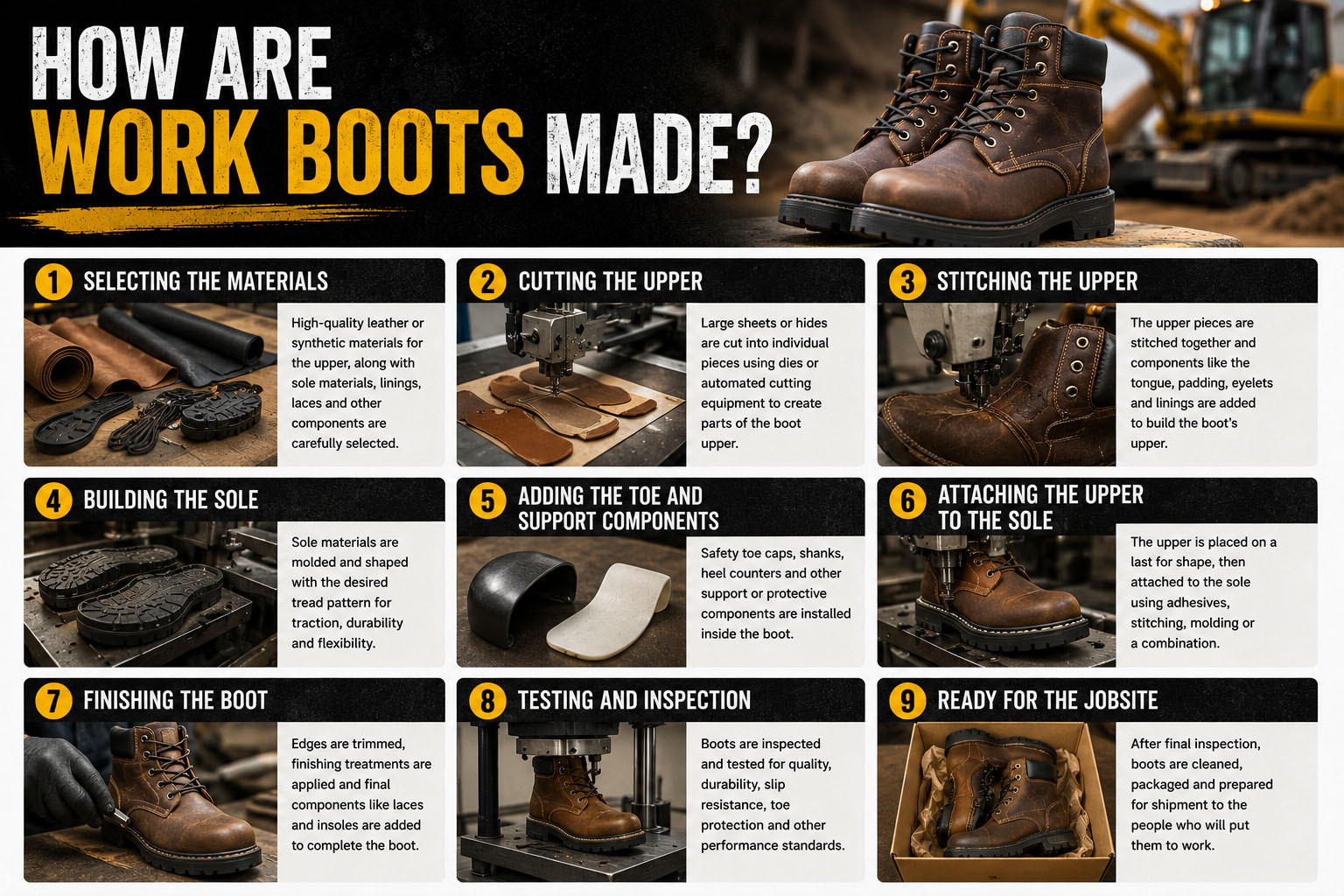
How Are Work Boots Made?
Work boots are built to do more than protect your feet. They need to withstand long hours on the job, rough terrain, moisture, dirt and repeated wear while providing support and traction.
Depending on the type of boot, manufacturers may use leather or synthetic materials for the upper, rubber or other compounds for the sole, and additional components for protection and support.
But how do all those pieces become a finished work boot?
1. Selecting the Materials
The process starts with choosing the high-quality materials that will make up the boot.
Leather is a common choice for work boot uppers because of its durability and ability to conform to the wearer's foot over time. Synthetic materials can also be used to provide specific combinations of durability, flexibility, weight and water resistance.
Other materials are selected for the sole, lining, insulation, laces and reinforcement components. For safety boots, manufacturers also select materials for components such as the protective toe.
The materials are chosen based on the boot's intended use and the performance characteristics it needs to provide.
2. Cutting the Upper
Once the materials are selected, large sheets or hides are cut into individual pieces that make up the upper.
Leather hides and synthetic materials are laid out and cut using dies, automated cutting equipment or other specialized machinery. The pieces can include the toe, quarters, tongue, heel and other sections of the boot.
Precision is important because these individual pieces need to fit together correctly during assembly.
Manufacturers also work to arrange the pieces efficiently to minimize material waste.
3. Stitching the Upper
The individual pieces are then assembled to create the boot's upper.
Workers or automated sewing equipment stitch the pieces together, forming the basic shape of the boot.
During this stage, manufacturers may also add components such as the tongue, lining, padding, eyelets and lace hooks.
Additional stitching can be used in areas that experience higher loads or greater wear.
By the end of this stage, the separate pieces of leather or synthetic material have become a recognizable boot upper.
4. Building the Sole
While the upper is being assembled, the sole components are prepared.
Work boot soles can be made from materials such as rubber or polyurethane, depending on the design and intended application. The material needs to provide the combination of traction, durability and flexibility required for the boot.
To form the sole, the material is placed into a mold that contains the shape of the sole and its tread pattern. Depending on the material, heat and pressure can be used to shape it, while some polyurethane soles are formed through a chemical reaction that causes the material to expand and cure inside the mold. This process creates the sole's overall shape, tread and other design features.
The tread pattern is also an important part of the design. Deep or aggressive tread can help provide traction on loose or uneven surfaces, while other patterns may be designed for smoother indoor or hard-surface environments.
5. Adding the Toe and Support Components
Many work boots include additional components designed to provide protection or structural support.
Safety-toe boots may incorporate a protective toe made from steel, aluminum, composite material or another approved material. The toe is positioned inside the front portion of the boot.
Other components can include a shank for support beneath the foot, a heel counter to help stabilize the heel and additional reinforcement in high-wear areas.
The exact components depend on the design and intended use of the boot.
6. Attaching the Upper to the Sole
With the upper and sole prepared, the two major sections come together.
The upper is placed over a form called a last. The last gives the boot its shape and helps establish the final dimensions and fit.
The upper is then secured to the sole. Depending on the construction method, this can involve adhesives, stitching, direct molding or a combination of techniques.
The attachment needs to be strong enough to withstand repeated flexing, impacts and exposure to the conditions encountered during work.
7. Finishing the Boot
After the upper and sole are joined, the boot goes through finishing operations.
Excess material may be trimmed, edges are cleaned up and the boot's surface may receive treatments or conditioning. Insoles, laces and other final components are installed.
Manufacturers may also check the shape of the boot and make adjustments to ensure it meets the required specifications.
8. Testing and Inspection
Before work boots leave the factory, they undergo inspection and, depending on the boot and applicable requirements, a variety of performance or safety tests.
Manufacturers may check the boot's construction, stitching, sole attachment and overall appearance. Safety footwear can also undergo testing for characteristics such as toe protection, impact and compression resistance, slip resistance or electrical properties when those features are part of the design.
Other tests may evaluate durability, flexibility, water resistance or the performance of specific materials.
The goal is to make sure the finished boot meets the specifications it was designed to achieve.
9. Ready for the Jobsite
After passing inspection and testing, the boots are cleaned, packaged and prepared for shipment.
What began as leather or synthetic material, rubber or other compounds, thread and individual components is now a finished work boot designed to protect and support the wearer.
From the cut of the upper to the pattern of the tread, every part of a work boot serves a purpose. And for the people who spend their days around heavy equipment, that combination of durability, protection, traction and support can make a big difference when the workday begins.