How Are Pallet Forks Made?
The Dirt Desk - Q&A
How Are Pallet Forks Made?
Pallet forks may look simple compared with other heavy equipment attachments, but they have to handle substantial loads without bending, cracking or coming loose. Their manufacturing process combines heavy-duty steel, forming, machining, heat treatment and careful inspection.
While designs vary by manufacturer, pallet forks generally go through several key steps before they're ready to move material on a jobsite.
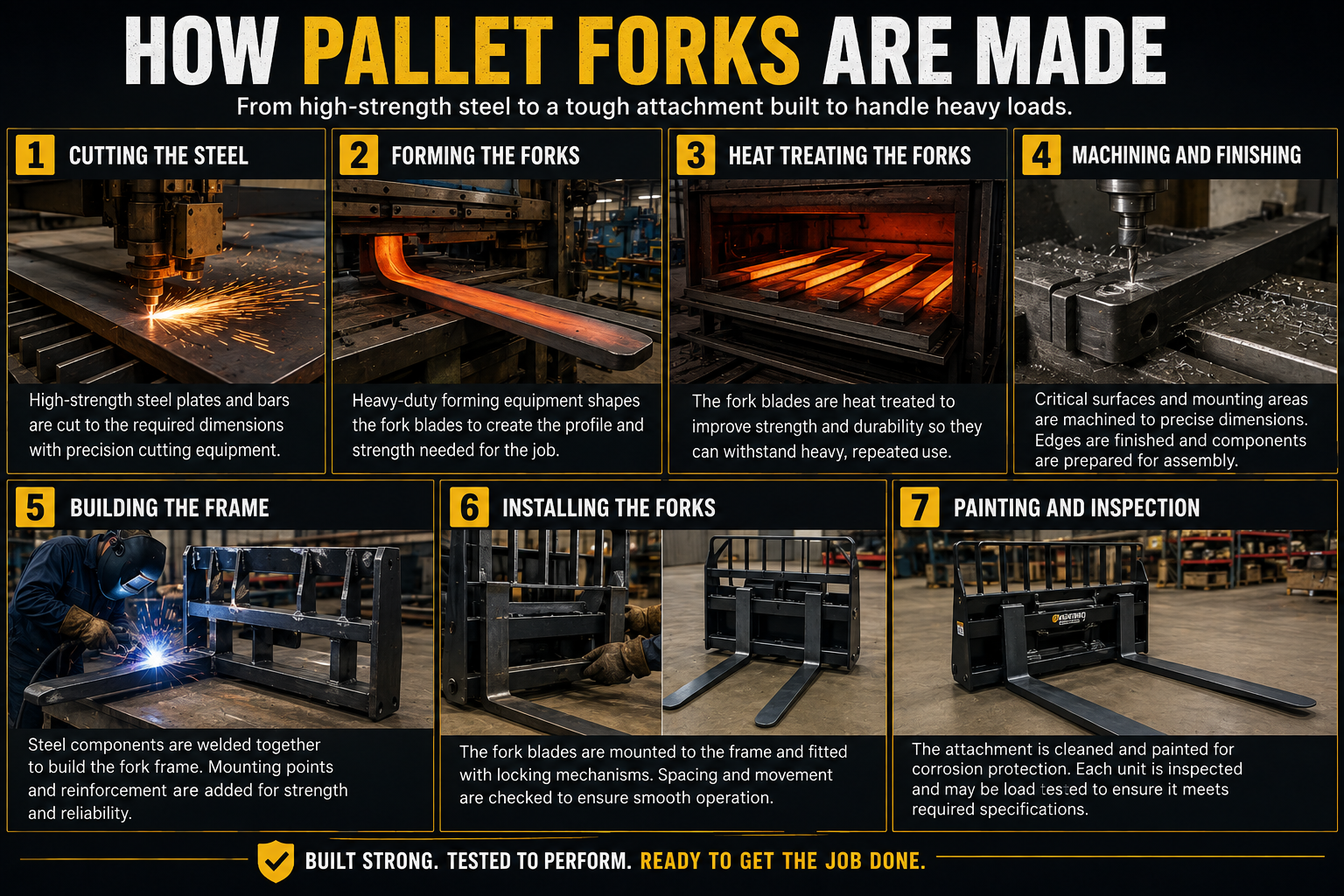
1. Cutting the Steel
The process starts with high-strength steel used for the fork blades, frame and mounting components.
Large steel plates and bars are cut to the required dimensions using precision cutting equipment. The cuts must be precise so the components will fit together correctly during assembly.
2. Forming the Forks
The long fork blades are formed into their required shape using heavy-duty forming equipment.
This step creates the profile and thickness needed for the forks to slide beneath pallets while providing the strength required to carry heavy loads.
3. Heat Treating the Forks
The fork blades undergo a controlled heat-treatment process to give the steel the required strength and durability.
Heat treatment changes the properties of the steel, helping the forks withstand repeated loading and unloading without excessive wear or deformation.
4. Machining and Finishing
Critical surfaces and mounting areas are machined to precise dimensions.
The fork tips and other areas are finished to remove sharp edges and create the correct shape. Components such as hooks, locking mechanisms and mounting points are prepared during this stage.
5. Building the Frame
The fork frame is assembled separately from the blades.
Steel components are positioned and welded together to build the fork frame that connects the forks to a skid steer, compact track loader, wheel loader or other carrier. Mounting points and reinforcement are added for strength and reliability.
6. Installing the Forks
Once the frame and fork blades are ready, they're brought together.
The forks are mounted to the frame and fitted with locking mechanisms that allow them to slide or lock into position. The spacing and movement of the forks are checked to make sure they operate correctly.
7. Painting and Inspection
The completed attachment is cleaned and receives a protective coating to help guard against corrosion.
Before leaving the factory, the pallet forks are inspected for weld quality, dimensions, locking mechanisms and overall assembly. Load testing may also be performed to verify that the attachment meets its required specifications.
From a few pieces of heavy-duty steel to a finished attachment, the manufacturing process is all about producing forks strong enough to safely handle the loads they're designed to carry.