How Are Hydraulic Hoses Made?
Hydraulic hoses may not get the same attention as engines or hydraulic cylinders, but they're among the most important components on any piece of heavy equipment. Every time an excavator raises its boom, a wheel loader tilts its bucket, or a skid steer powers an attachment, hydraulic hoses are hard at work carrying pressurized fluid throughout the machine.
Built to withstand thousands of pounds per square inch (psi), these flexible lines must endure constant movement, extreme temperatures, abrasion and exposure to dirt, oil and the elements. So how are hydraulic hoses made tough enough for the demanding conditions found on construction sites, farms, mines and forests?
Let's take a closer look at how hydraulic hoses are manufactured.
Step 1: Selecting the Right Materials
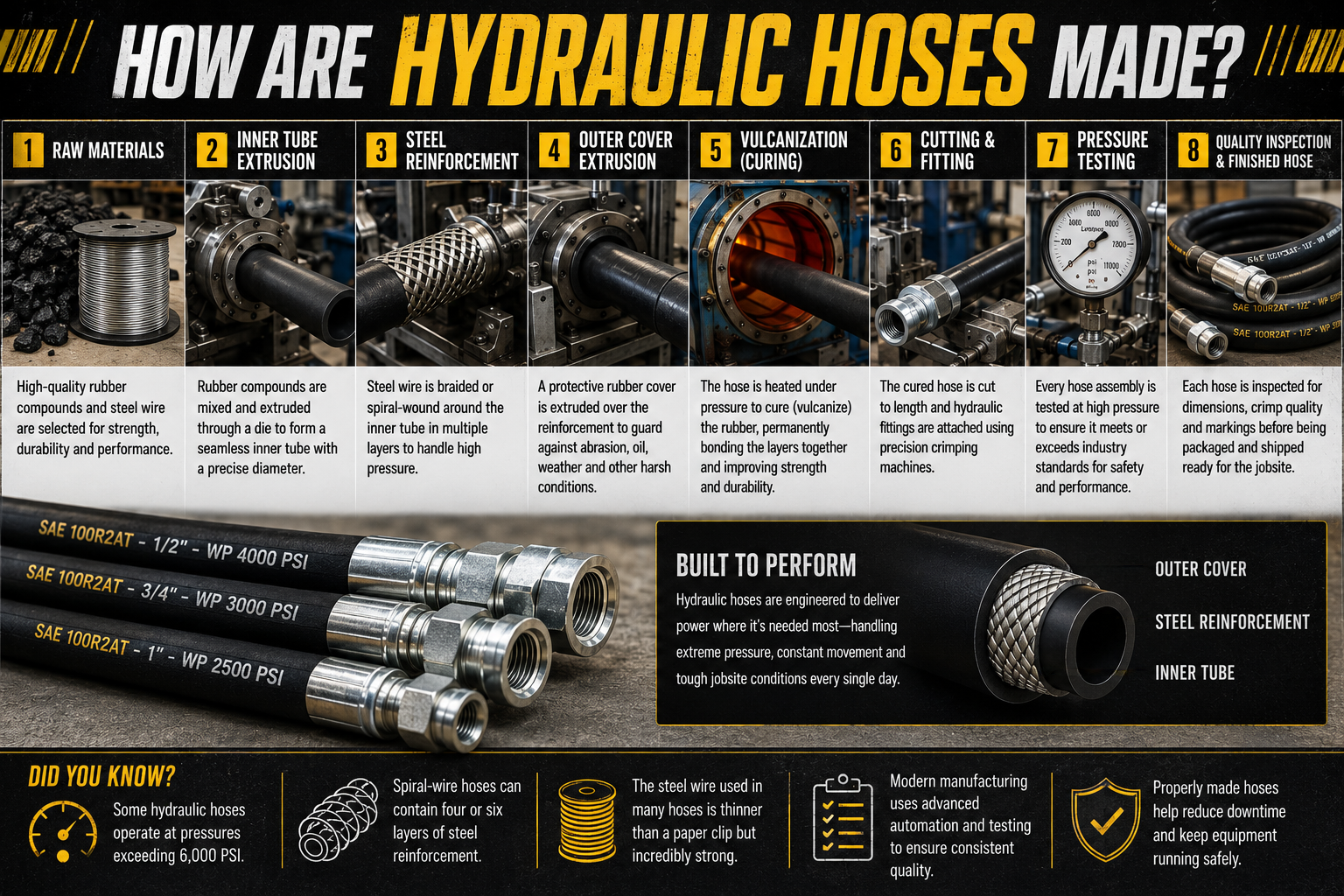
A hydraulic hose is made up of three primary layers, each serving a specific purpose.
The inner tube carries hydraulic fluid through the hose. It's typically made from synthetic rubber or thermoplastic materials that resist oil, heat and chemical degradation.
Next comes the reinforcement layer, which provides the hose with its strength. Depending on the hose's intended application, manufacturers may use braided steel wire, spiral-wound steel wire or textile reinforcement. Higher-pressure hoses generally require multiple layers of steel wire to withstand the intense forces generated by modern hydraulic systems.
The final layer is the outer cover, which protects the hose from abrasion, weather, UV exposure, chemicals and everyday jobsite wear.
Together, these layers create a hose that's both flexible and incredibly durable.
Step 2: Forming the Inner Tube
The manufacturing process begins by producing the hose's inner tube.
Raw rubber compounds are mixed with additives that improve flexibility, heat resistance and durability. The mixture is then fed into an extruder, where it's forced through a specially shaped die to produce a continuous tube with a precise inside diameter.
Maintaining tight dimensional tolerances at this stage is critical, as the inner tube determines how hydraulic fluid flows through the finished hose.
Step 3: Adding Steel Reinforcement
Once the inner tube has been formed, it's reinforced to handle high operating pressures.
For many hydraulic hoses, automated braiding machines weave fine, high-strength steel wire around the tube in an interlocking pattern. This braided construction provides excellent flexibility while allowing the hose to withstand substantial internal pressure.
Applications that demand even greater pressure capability often use spiral reinforcement instead. In this process, multiple layers of steel wire are wrapped around the tube in alternating directions, creating a structure capable of handling extremely demanding hydraulic systems.
Lower-pressure hoses may use textile fibers rather than steel wire, depending on the intended application.
Step 4: Applying the Protective Outer Cover
With the reinforcement in place, manufacturers apply the hose's protective outer cover.
Like the inner tube, the outer cover is typically extruded over the hose before being shaped to its final dimensions. The rubber compound is specifically formulated to resist abrasion, cuts, weather, ozone, oils and other harsh environmental conditions that heavy equipment regularly encounters.
Some hoses are also manufactured with specialty covers designed for high temperatures, exceptional abrasion resistance or applications where a smaller bend radius is required.
Step 5: Vulcanizing the Hose
At this point, the hose has all of its layers but still needs to be cured.
The hose passes through a vulcanization process, where heat and pressure permanently bond the rubber components together. During curing, the rubber's molecular structure changes, improving its strength, elasticity and resistance to wear.
This step transforms the uncured materials into a finished product capable of surviving years of demanding service.
Step 6: Cutting and Installing the Fittings
After curing, the hose is cut into specific lengths based on customer or equipment manufacturer requirements.
Hydraulic fittings are then attached using precision crimping machines that compress the metal fitting onto the hose with carefully controlled force. The crimp diameter must be exact—too loose and the fitting could leak or separate, too tight and the hose itself could be damaged.
Accurate crimping is essential for ensuring reliable performance under pressure.
Step 7: Pressure Testing
Before hydraulic hoses leave the factory, they undergo extensive testing to verify their performance.
Depending on the hose type, manufacturers may perform:
- Hydrostatic pressure testing
- Burst pressure testing
- Impulse cycle testing
- Flex testing
- Leak inspections
Many hoses are tested at pressures well above their normal working ratings to confirm they meet industry standards and manufacturer specifications.
Pressure testing helps verify that the finished hose can withstand the demands it is designed to handle before it is put into service.
Step 8: Quality Inspection and Finished Hose
After testing, each hose assembly undergoes a final quality inspection before being approved for shipment.
Inspectors may verify:
- Hose dimensions
- Reinforcement placement
- Fitting installation and crimp quality
- Identification markings
- Overall assembly condition
These checks help ensure the finished hose meets the required specifications and is ready for use on the jobsite.
Built for Tough Jobs
Hydraulic hoses are designed to operate in some of the harshest environments imaginable. They're constantly exposed to vibration, pressure fluctuations, dirt, moisture and extreme temperatures while flexing thousands of times throughout their service life.
Whether they're installed on an excavator, dozer, wheel loader, skid steer or forestry machine, every hydraulic hose plays a vital role in delivering the power that allows heavy equipment to lift, dig, push and move materials efficiently.
The next time you see a machine in action, remember that behind every smooth hydraulic movement is a carefully engineered hose built through a precise manufacturing process designed to handle some of the toughest working conditions on earth.